Designers


Fashion and the Humanities: Exploring New Angles

by Rizvana Bradley

I am currently completing my sixth year of Ph.D. work in the Literature Program at Duke University, and am working to develop a variety of critical approaches to theorizing fashion and the body. I have taught courses at Duke that are intended to enable students to recognize how various literary, filmic and artistic texts continue to richly shape fashion culture, and highlight the complex theoretical and social issues contemporary fashion thematizes.

Having greatly admired the academic work coming out of Central Saint Martins College of Art and Design, I was excited to introduce students at Duke to the field now referred to as critical fashion studies. Initially I was at a loss as to how to design such a course, as some four years ago there was nothing like the CSM model being taught in US universities. Typically courses would mention fashion incidentally, or as an object of inquiry. With respect to the latter approach, fashion is constructed either purely as an anthropological object, proposing an analysis of historical dress, or as a sociological phenomenon, providing a detailed account of subcultural styles, for example. I knew that content-wise, the course I wanted to develop would incorporate the best of these strategies, but be less a fashion history course. I was most interested in concentrating on aesthetics, and spotlighting the visionary photography and runway productions happening in fashion since the late 1980s.

From the start it was evident that students had little exposure to an international fashion culture, the richness and eclecticism of various fashion figures, image-makers, entrepreneurs and designers. The courses challenged them to think about designers’ creative efforts in refreshing new ways. The first course, “Contemporary Fashion: Image, Object, Idea,” I taught once. I then taught a course entitled, “Fashion, Literature and the Avant-Garde,” twice. The final course, “Art, Media and the Body,” placed fashion in dialogue with the contemporary arts more broadly. All of these courses include fashion in the context of discussions about contemporary artistic practices that are currently provoking key concerns in the humanities, specifically questions of discourse, identity, representation and subjectivity, as well as certain questions about aesthetics, materiality and difference. Students learn that some of the most innovative fashion designers explore these themes in complex, beautiful and challenging ways. For this reason, the readings for the courses draw from different disciplines, among them, philosophy, critical theory, science studies, and feminist theory.

Read the rest of this entry »

Posted in Designers, Fashion & Technology, Fashion Shows, Research/University Programmes


Elisava: Fashion, Film and Performance


Papabygote, Elisava, 2010

Another end of the year show which I visited in July was organized in conjunction with the graduation of the masters students in fashion design at Elisava, a school of design in Barcelona. It was great to witness the experimental and imaginative projects completed by the graduating class. In a testament to the multi-media nature of fashion today, the students were recquired to complete a collection, stage a performance to present their collection and produce a short video showcasing their work and the concepts behind it. Also in the spirit of collaborations, the majority of the students worked in pairs or more for the completion of the work—a system that brilliantly debunks the outdated notion of the “genius” artist (and by extension designer) for the more realistic idea of collaborative work.

The program is directed by Beatriu Malaret and Toni Miró; the year-end presentation was attended by Diana Pernet, the Parisian fashion critic and video journalist. Through Pernet, I learned that a number of different tutors from various disciplines work at Elisava (for instance, Alex Murray-Leslie of Chicks on Speed). This is probably one of the reasons for the experimental and innovative nature of the work.

One of my favourite pieces was the film and collection by Papabygote. Their short is witty and subtle and reminded me of the work of David Bestué and Marc Vives, the brilliant video artist duo, also from Barcelona.

Francesca

Read the rest of this entry »

Posted in Designers, Fashion Shows, Performance, Research/University Programmes


Royal College of Art: Department 21


Department 21, Royal College of Art.

Among the year end shows that I visited in a rather happenstance manner this summer, the one I found most stimulating was that of the Royal College of Art in London. Off to the side of the exhibition space was what looked like an outdoor seminar room which was, in fact, a self-built outside deck and the “exhibition space” of Department 21, where a series of free lectures and workshops took place concomitantly with the show. An entirely student-run initiative, Department 21 was started to promote new models of art and design education and interdisciplinarity. Its name plays on the fact that are 20 existing departments at the Royal College.

Throughout the year, the founders took over a temporarily vacant space at the college where students were assigned studio space regardless of their departmental affiliations and where a series of lectures, seminars, critiques and presentations were developed. They also published a small book to recount the project.

In their own words: “Department 21 appropriated institutional territory to explore alternative models of education and to create a new kind of conceptual and social space. […] Department 21 adopted a radical strategy towards a broader definition of education, of practice and of disciplinarity. As an autonomous space, it encouraged a greater critical awareness of the students’ role within the institution.” (Polly Hunter, Bianca Elzenbaumer and Fabio Franz edited, Department 21, London, June 2010)

Francesca

PS Also, on the topic of design education, you might be interested in reading my short interview on Ecouterre on teaching sustainable fashion.

Posted in Designers, Exhibitions, Publications, Research/University Programmes, Sustainable Fashion


Teaching Sustainable Fashion: A Theoretical Perspective

Martin Margiela, Spring/Summer 1990


This past spring I taught a Senior Seminar at Parsons on the topic of sustainable fashion. The seminar was based largely on the exhibition that Sarah Scaturro and I co-curated at the Pratt Institute, as well as on my work on experimental fashion and the intersection between fashion, memory and materiality, which was explored in both Fashion Projects and in my doctoral studies. The class was meant to give a theoretical as well as a cross-cultural and historical perspective on the relation between fashion and sustainability.

It was interesting to notice the challenges and the rewards of the process. One of the main challenges consisted in the fact that incorporating sustainability in fashion demands a radical re-thinking of systems of consumption, distribution and production, so much so that the very topic of sustainable fashion can be in and of itself rather controversial and, in some sense oppositional to traditional fashion education.

What was perhaps most rewarding was to notice students’ imaginative incorporation of sustainable practices in their own work. (This was a theoretical/historical class, so the work was produced within the context of their studio classes.) For instance, the work of Seung Yeon Jee, which was based on her research in Kurt Schwitters’s collage techniques incorporated notions of modularity within her work, and as she herself noted promoted a level of participation from the consumer in the design process. Through complex pattern-making techniques Jee created garments which could be worn in a number of different ways—all of which were at the same time experimental, functional and visually engaging.

Below you can find a description of the class. I would love to hear any feedback by fashion educators and anyone interested in the topic of incorporating sustainability in fashion and design education

Read the rest of this entry »

Posted in Designers, Research/University Programmes, Sustainable Fashion


Gone Green Long Ago

Left to right: Martin Margiela, jacket repurposed from vintage scarves, Spring 1992; Martin Margiela, socks, partially constructed sweater, and completed sweater, early 1990s; XULY.Bët, recycled ensemble, Fall 1994

All photos courtesy of the Museum at the Fashion Institute of Technology.

Fashion Projects is very pleased to present an interview with the curators of Eco-Fashion: Going Green, currently on view in the Fashion and Textile History Gallery of the Museum at the Fashion Institute of Technology. Jennifer Farley and Colleen Hill have thoughtfully, and at times provocatively, organized an enlightening and entertaining exhibition about eco-fashion, tracing the movement back over 200 years. The show is based around six themes: fiber origins, labor practices, the re-purposing and recycling of materials, quality of craftsmanship, textile dyeing and production, and the treatment of animals.

This exhibition importantly fulfills a gap in scholarship available about the eco-fashion movement. Recent exhibitions like the one that Francesca Granata and I co-curated at Pratt Manhattan Gallery, Ethics + Aesthetics = Sustainable Fashion, surveyed and tried to make sense of the movement as it exists today, seeking to suggest ways to balance aesthetic needs with environmental stability. However, Farley and Hill have taken a different course. They have used a tough mandate – to chronologically tell the history of fashion over the past two centuries using only the MFIT collection – and ingeniously exposed the ways in which sustainability and fashion have always been intertwined. There are some very special things in the exhibition – besides an arsenic-dyed dress, there is a rare cape made from exotic bird feathers, a man’s dressing coat made from a patch-work quilt, and an electric blue fringed cellophane cape from Parisian couturier Lucien Lelong. I wish there would have been some examples of 19th century aesthetic dress, like a robe Jane Morris might have worn, but given the tight constraints of the gallery and the six themes, such a garment doesn’t really fit in. For any fashion student or scholar who is interested in sustainability (which is hopefully all of you) this exhibition should be a requirement.

Farley and Hill graciously took a moment out of their day to answer the following questions for Fashion Projects:

Fashion Projects: As you mention in your essay for the exhibition, recently there seems to be a critical mass of exhibitions and writings on the current status of sustainable fashion, but relatively little on its history. What made you both decide to tackle this incredibly important gap in scholarship? Was there anything surprising that you learned?

Jennifer Farley and Colleen Hill: Our general interest in the topic started with the small selection of eco-fashion included in The Museum at FIT exhibition Fashion & Politics (July – November 2009). We discovered that the approaches to eco-design are very diverse, and we began thinking that those varied points of view would be interesting to explore in a historical context. When we intensively researched contemporary eco-fashion, we were surprised to discover very little discussion of fashion’s impact on the environment prior to the 1960s and 1970s. We thought the Museum at FIT’s Fashion & Textile History Gallery, which traces the history of fashion from the 18th century to the present, would lend itself perfectly to an evaluation of the topic.

In researching this topic, we delved into topics ranging from the science of synthetics to mechanization of production to labor regulations. Researching these often very technical subjects helped us to look at fashion from another perspective. We learned that synthetics can have merit in terms of production (i.e. using less water) and recyclability.

We knew the dangers of chemicals, such as chromium used in leather production, but were surprised to discover that the use of large amounts of salt, a seemingly innocuous substance, can also be an environmental concern.

1920s actress Minnie Maddern Fiske’s anti-fur stance was also a bit of a revelation. Celebrity activism has become common, but it was amazing to find that such a well-known actress (in her day) had taken a public position more than 90 years ago.
Read the rest of this entry »

Posted in Designers, Exhibitions, Interviews, Museums, Sustainable Fashion


reFASHIONer: A Curated Clothing Swap

There seems to be a critical mass forming around the topic of sustainability in fashion here in New York, but one aspect that perhaps goes under reported in favour of coverage of design strategies is that of alternative business models that promote sustainability in fashion.

One of our favourite examples is the newly launched reFASHIONer. Started by journalist, and high-fashion aficionado Kate Sekules, it is a curated swap site for designers’ fashion, ranging from Comme des Garçons to Dries Van Noten. Allowing people to swap what tend to be long-lasting pieces in the first place, reFASHIONer allows them to extend their clothes’ lifecycle and renew their wardrobe in a sustainable way.

Despite its high fashion bent, the site is quite unpretentious and user-friendly and also taps into our interest in fashion and memory as it allows people to tell the story of their clothes right before they part with them.

Below is a brief interview with reFASHIONer founder Kate Sekules.

I was wondering how and why you started reFASHIONer?
I was editor-in-chief of Culture+Travel magazine when they folded it… Saw the writing on the wall–death of the magazine business. And I thought, I do like turnover in my closet, and I love the designers I love. And I’m lacking a paycheck for said designers, not to mention an office to dress for every day. So I thought: swap meet. And when it was impossible to get my fancy-wardrobe friends in a room at the same time, I got to thinking… And realized there’s no such thing as curated swapping online. How did I start? By making it up as I go! Starting a year ago, with a great deal of figuring out the system.

Read the rest of this entry »

Posted in Designers, Sustainable Fashion


Sustainable Exchange

.
Crochet Workshop

This past weekend the exhibition cum workshop “Sustainable Exchange: Methods and Practices for Collaborative Partnerships took place at TODA, a design studio in Tribeca. Curated by Megan Howard in collaboration with Rachel Littenberg-Weisberg (both study Integrated Design at Parson), the exhibition included the experimental eco designer Susan Cianciolo, the collective Eko-Lab, and the jewelry company Black Sheep and Prodigal Sons, which creates beautifully unsettling pieces using repurposed materials. The exhibition design was completed by the talented design team from the interior design graduate program at the Pratt Institute under the supervision of design director Jon Otis. The exhibition structure was, in fact, made of repurposed material from the exhibition “Ethics + Aesthetics,” that Sarah and I curated this past Fall at Pratt.

Particularly interesting was the focus on process, participation and collaboration underscored by the exhibition design, which allowed people to interact with the clothes and furniture and leaf through sketchbook. The interactive nature of the exhibition was also underscored by the rather impromptu performances, which took place during the exhibition opening, as well as several workshops, which covered experimental crochet techniques, natural dying processes, organic cooking and collage-making, which took place throughout the weekend.

Read the rest of this entry »

Posted in Designers, Performance, Sustainable Fashion


Eco Chic: Towards Sustainable Swedish Fashion


Julian Red. Photo: Mikael Schultz @ Swedish Institute

by Francesca Granata

The Eco-Chic: Towards Sustainable Swedish Fashion Exhibition at the Scandinavia House opened with an interesting panel discussion including Marcus Bergman (managing director of Ecocotton, a pioneer in organic cotton production), Sass Brown (a professor at the Fashion Institute of Technology whose research focuses on women’s cooperatives in Latin America) and Karin Stenmar (a founder of the Swedish eco-fashion company Dem Collective). It was moderated by Hazel Clark, Dean of the School of Art and Design History and Theory at Parsons, who has a longstanding interest in slow fashion and the secondhand clothing trade.

Organized as a roundtable discussion, it covered the difficulty in sourcing sustainable material, partially attributed to the lack of innovation in the textiles industry, the need for living wages and the development of women’s cooperatives. Bodkin tied her interest in eco-fashion to her interest in Swedish Modernism and a drive towards functionality in clothing. However, it was interesting to hear how, according to Bergman, the ethos of Swedish design “of functionality and honesty in design” did not sufficiently enter the realm of fashion, due to the fact that fashion/textiles studies developed separately from other branches of design, at least in Sweden. The need for a new fashion design education was thus addressed to allow for the development of more aware designers. Also mentioned was the need for mass-market companies to join the conversation. According to Brown, this is actually occurring: As an example she mentioned Wal-Mart’s commitment to transitional cotton—a company which seemed odd to bring up due to their long-standing history of labour exploitation.

Clark asked about the creation of memories and narratives through clothes, something that Stenmar’s company, Dem Collective, addressed by having buyers record the life of their clothes in a project called One in a Thousand Jeans. This reminded me of an evocative and inspiring project I had been meaning to write about by a Dutch designer Ruby Hoette—Worn Relics—which involves the recording of the life story of one’s favourite piece of clothes.

The exhibition, shows the diversity of design comprising Swedish eco fashion, and proves a real commitment on the part of Sweden and the Swedish design community to the search for sustainable solutions for the fashion industry. It remains open through August 21.

Read the rest of this entry »

Posted in Designers, Exhibitions, Lectures, Sustainable Fashion, Textiles


Conference Review: Finding Our fashion Footing

by Marco Pecorari

What is the Future of Fashion studies? If one year ago affirmed fashion scholars met in Warwick to find an answer (McNeil 2010), “Finding Our Fashion Footing” was the occasion for Phd students to discuss their research future as a possible answer to such challenging question.

Organized the last 19th March by the research students at London College of Fashion and the Center for Fashion Studies – Stockholm University, this first International Fashion Phd workshop was hosted by LCF. The presentation of each project was the occasion to discuss, problematize and individualize personal experiences, methodological issues and future research connections. As the title of the meeting suggests, it was also an opportunity for placing each individual work in a global geography of Fashion research.

The one-day meeting started with a session on Style and Youth Culture that saw the presentation of “The Indie Project: style and youth culture in London” by Rachel Lifter. Her research cuts across three diverse trajectories: the London fashion environment, theoretical style’s approaches and contemporary youth culture. Despite the diverse disciplinarian affiliation, Lifter’s use of Foucault’s discourse is shared by Pecorari’s Phd that aims to argument an archeology of the fashion discursive formation on contemporary ephemera through three different but generative dimensions of such discourse: academia, museum and designers.

Read the rest of this entry »

Posted in Designers, General, Lectures, Research/University Programmes


Fashion Projects Launch/Screening Event!


Boudicca, Film Still, Essay, 2009

The M.A. Fashion Studies At Parsons The New School for Design presents:

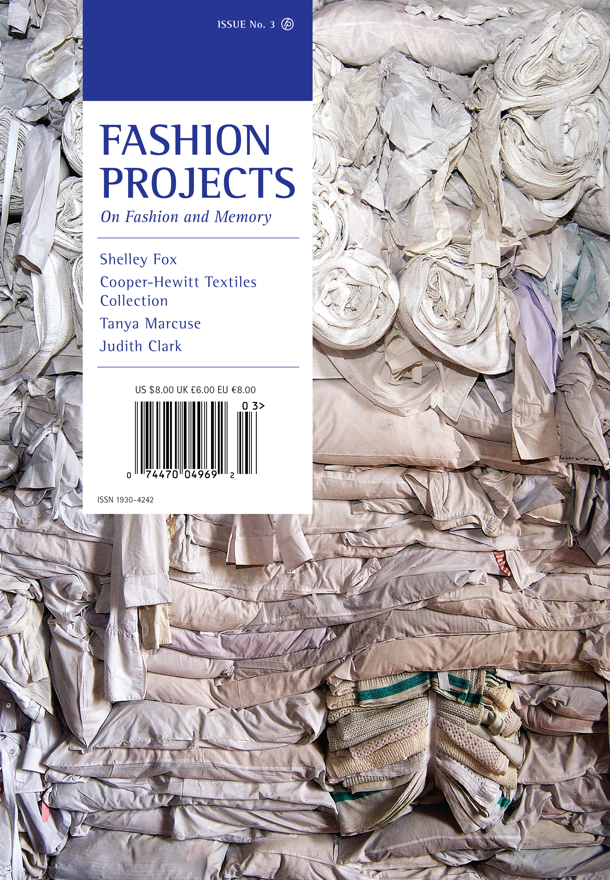
A screening to celebrate the new issue of Fashion Projects. The screening features a range of short experimental films on the topic of fashion and memory–the topic of the new issue. They include films by the British-based fashion design duo Boudicca, Dutch photographer Erwin Olaf, designer Shelley Fox, and fashion photographer Laura Sciacovelli. The screening is curated by Tamsen Schwartzman and Francesca Granata.

The screening will take place Friday the 23rd of April at 6 pm in the Wollman Hall, 65 West 12th Street. (PS: It will start promptly!). A reception will follow the screening.

The event is free and open to the public. Below is the official flyer: Feel free to circulate it.

SP10 PDF Fashion Projects

Read the rest of this entry »

Posted in Designers, Film, Issue #3, Performance, Publications


« Previous Entries         


About Fashion Projects

Fashion Projects began in New York in 2004, with the aim to create a platform to highlight the importance of fashion — especially “experimental” fashion — within current critical discourses. Through interviews with a range of artists, designers, writers and curators, as well as through other planned projects and exhibits, we hope to foster a dialogue between theory and practice across disciplines.

We are primarily a print journal, however we also publish web-based updates and interviews (a “digest” version of which you can receive by signing up to our mailing list or via our RSS feed) and are currently working on exhibits based on past and future issues. To order any of our issues visit our ordering page.

We are a nonprofit organization, which has previously received grants from the Lower Manhattan Cultural Council and the New York City Department of Cultural Affairs.

We are currently a sponsored project by the New York Foundation of the Arts, a 501(c)(3), tax-exempt organization. Contributions on behalf of Fashion Projects can be made payable to the “New York Foundation of the Arts,” and are tax-deductible to the extent allowed by the law. For more information please don’t hesitate to contact us.


Mailing List


Contact

For editorial inquiries please email francesca

For advertising and all other matters please email erin

Distribution

Fashion Projects is distributed in the U.S. and Canada through Ubiquity Distributors (tel. 718-875-5491, info [at] ubiquitymags.com) and in Japan through Presspop Inc. (info [at] presspop.com). It can be found in independent bookstores, Universal News, and other magazines stands across North American and in select stores in Japan and Europe. You can also order it on our site via paypal.

Contributors

Editor:
Francesca Granata
recently completed her PhD at Central Saint Martins, University of Arts London, with a focus on experimental fashion, performance and gender studies. She has previously worked as a lecturer in the visual arts department at Goldsmiths, University of London and as a fellow at the Metropolitan Museum of Art, Costume Institute. She currently lectures at New York University and Parsons, as well as working as an independent curator.

Art Directors:
Shannon Curren (Issue #3) is a freelance graphic designer based in New York.

Jennifer Noguchi (Issues #1 and 2) is a freelance graphic designer based in New York. She has worked for several publications including Print.

Web Design/Development:
John Golding is a software developer living in San Diego.

Writers and Photographers:

Shannon Bell Price
is Senior Research Associate in the Costume Institute at the Metropolitan Museum of Art where she has worked since 2000. Price is also pursuing her doctorate at the Bard Graduate Center.

Rizvana Bradley is completing her Ph.D. in the Literature Program at Duke University. She focuses on the ways technology is integrated into video art, dance, architecture, and concept clothing. Her writing has appeared in Hint Magazine.

Kim Burgas is a freelance web designer and artist based in New York (kimburgas.com). As a former model, she is interested in the role sustainability will play in fashion modeling in the future.

Patty Chang holds a PhD in political science from the University of Oxford. She has worked for UNDP and the UN Department for Political Affairs and is a lecturer at New York University.

Piper Carter is a New York–based photographer who for years worked as an assistant to Steven Klein. Her photographs have appeared in various publications, including British Elle and Spin.

Jessica Glasscock is a writer, college instructor and independent curator. Her first exhibition, a retrospective on Stephen Sprouse, is being presented through Deitch Projects. Her writings include the book Striptease: From Gaslight to Spotlight.

Amanda Haskins is a senior research assistant at the Costume Institute at the Metropolitan Museum of Art and is completing her master's at the Bard Graduate Center.

Cynthia Leung is a fashion writer based in New York and Berlin.

Erin Lindstrom is a graduate of the Fashion and Textile Studies program at FIT. She is currently working with the archives at Ralph Lauren.

Marco Pecorari is completing his Phd in Contemporary Fashion Theory at the Centre for Fashion Studies - Stockholm University, with a thesis entitled “The Show is not Enough: new trajectories for reading contemporary fashion”. He writes for several fashion, arts and cultural magazines.

Nicola Pietroluongo is a programmer and web developer based in Italy.

Keith Price is a photographer and graphic designer living in New York (www.pricephotostudio.com)

Lidia Ravviso is a journalist and filmmaker based in Rome.

Jay Ruttenberg is a staff writer for Time Out New York and editor of the Lowbrow Reader (www.lowbrowreader.com)

Sarah Scaturro is the textile conservator for the Cooper-Hewitt National Design Museum. She is researching fashionable camouflage, as well as the intersection of fashion technology and sustainability.

Tamsen Schwartzman is Associate Research Curator at The Museum at FIT, where she has curated and co-curated a number of exhibits.

Sonya Topolnisky has written about fashion and history for Montreal-based Worn fashion journal, and is currently completing her master's at the Bard Graduate Center.

Tae Yano is a software engineer. She is completing her PhD in computer Science at Carnegie Mellon.


Magazine


Ordering

Click here to order

Search


Interviews


Categories

  • Designers (69)
  • Exhibitions (90)
  • Fashion & Technology (13)
  • Fashion Shows (24)
  • Film (7)
  • From the Magazine (5)
  • General (21)
  • Interviews (15)
  • Issue #1 (4)
  • Issue #2 (5)
  • Issue #3 (6)
  • Lectures (41)
  • Museums (26)
  • Performance (26)
  • Photography (13)
  • Publications (32)
  • Research/University Programmes (6)
  • Sustainable Fashion (34)
  • Textiles (9)
  • Uncategorized (3)


  •  Subscribe in a reader


    Enter your email address:

    Delivered by FeedBurner


    Recommended Sites


    find_us_on_facebook_badge-1.gif