Tiger Collection, Autumn/Winter 2005/2006
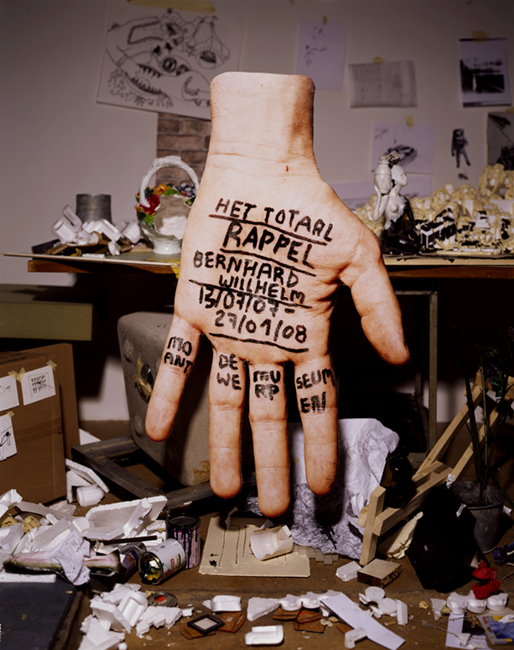
KD: And here you see a cardboard mountain that Taiyo and Nico made for one of his [Willhelm’s] collections.
FP: So they did work with Willhelm before. It’s great how he often collaborates with artists in his work.
KD Yes, I also think he collaborates with them in interesting ways. They try to find similarities between his work and their work and then they make something new.
KD: This is Bernhard himself. Pointing to a print from his Tiger Collection (Fall Winter 2005) depicting a photograph of a 19th century wall clock with the designer himself as a small decorative figure in black makeup and with a skirt of golden banana leaves.
FP: He is in black face…The prints seem a revisitation of colonial motives.
KD: Yes, but Bernhard also often disguises himself. Here he is supposed to be a black chief. In another collection he dressed as a 1970s porn-star. There is one picture where he is dressed like a Tyrolean guy…
KD: This print is also nice. It is a picture of all the people who worked with Bernhard at the time, all of his all staff, and they made a print of it, using the African tradition of the wet print…
Often what he does is not really explicitly political. For instance, in this next collection [Spring/Summer 2006, titled “I Am the One and Only Dominator”] there is a stars and stripes motif. Yet Bernhard would never in an interview say anything anti-American. When I asked him about it, he said: “Well everybody looks good in stars and stripes.” I like the way he is never explicit in his statement…
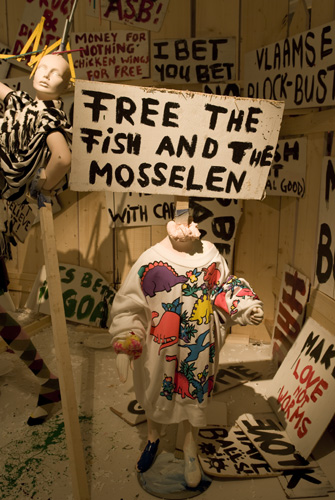
This [referring to the display of the Spring/Summer 2006 collection] was one of his first ideas. “I want these seventies mannequin guys with their pants down,” he asked.
FP: He was on the first cover of Butt, wasn’t he?
KD: And the model in the photos at the end of the exhibition is a very famous French porn star François Sagat.




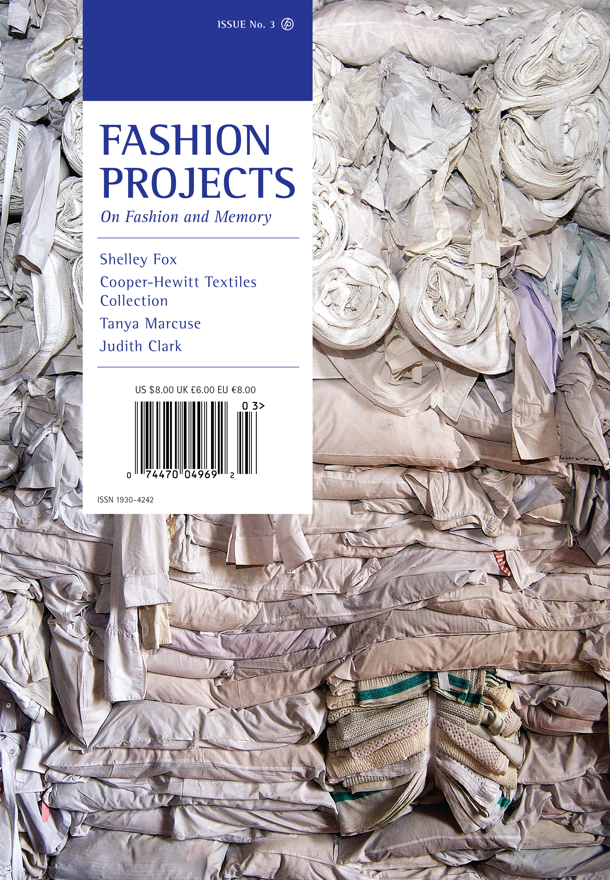


Fashion Projects #5 is devoted to fashion curation, examining the meteoritic rise in relevance of fashion exhibitions.
It features interviews with an eclectic assortment of leading practitioners from different corners of the world. The issue includes long Q&As with Harold Koda, the longtime, recently retired curator of the Met’s Costume Institute, as well as the Museum at FIT’s veteran leader Valerie Steele. It also features interviews with curators in Antwerp (the ModeMuseum’s Kaat Debo), Toronto (Royal Ontario Museum’s Alexandra Palmer) and Venice (Maria Luisa Frisa); academics studying the field (Hazel Clark, Annamari Vänskä, and Alistair O’Neill); and, giving an on-the-ground perspective, the Met’s head conservator, Sarah Scaturro. The issue’s cover stars Greer Lankton’s sculptural representation of legendary Vogue editor and Costume Institute doyenne Diana Vreeland, who continues to loom over the field years after her death.
Table of Contents
Introduction
Showmanship and History: An Interview with Harold Koda by Francesca Granata
Woman of Steele: An Interview with Valerie Steele by Lisa Santandrea
Exploring Fashion’s Openness: An Interview with Kaat Debo by Alex Esculapio
London, After a Fashion Curator: An Interview with Alistair O’Neill by Alexis Romano
Curation and Conservation: An Interview with Sarah Scaturro by Mae Colburn
Reflections on Fashion Curating
An Interview with Hazel Clark and Annamari Vänskä
Fashion in the Vast Museum: An Interview with Alexandra Palmer by Ingrid Mida
Restless Curating: An Interview with Maria Luisa Frisa by Marco Pecorari