
X-Initiative II
/
Anicka Yi and Maggie Peng, "Acceptable Substitute, I Mean One Acceptable Substitute To Me," 2009. Photo: Margaret Lee
Among the unusually sparse number of exhibitions currently up in Chelsea is a small and unassuming show on the roof of the former DIA Center, now home to the X-Initiative. The show, titled “Today and Everyday,” brings together a number of works that seem to share an interest with notions of artificiality.
One of the pieces included was a glass case containing empty perfume bottles alongside a video and sawdust (I later learned the case also contained moths).Titled “Acceptable Substitute, I Mean One Acceptable Substitute To Me,” the piece was the continuation of an earlier project that the New York–based artist Anicka Yi and the architect Maggie Peng had completed the same year. They had developed a conceptual perfume called “Shigenobu Twilight” after Fusako Shigenobu, former leader of the violent dissent group the Japanese Red Army. Shigenobu eventually went into exile in Lebanon. Yi and Ping used the cedar wood, as the dominant notes of the perfume as well as its encasement to represent Shigenobu’s relation with Lebanon.
For the X-initiative project, they commissioned a Chinatown perfume forger to create a replica of their perfume, which they exhibited alongside a video. Both the video and the forged perfume bottles were meant to explore what brought Shigenobu to move to Lebanon and join the Palestinian cause, and thus questions notions of authenticity and nationality.
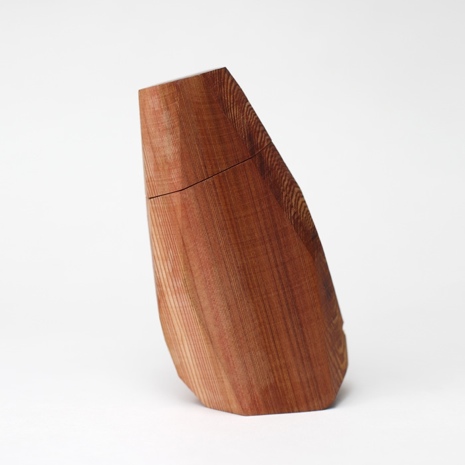
Anicka Yi and Maggie Peng, Shigenobu Twilight Perfume
Ultimately, however, the original perfume seems to play into the aesthatization of 1970s terrorist groups, perhaps best exemplified in the fascination with RAF member Ulrike Meinhof. This analogy is made particularly relevant by the fact that Shigenobu was an object of fascination due to her gender and looks—something the perfume hints at, but never fully develops. The installation at X-Initiative, instead, creates a more complex dynamic in its exploration of forged and borrowed identities and national struggles.
Francesca Granata
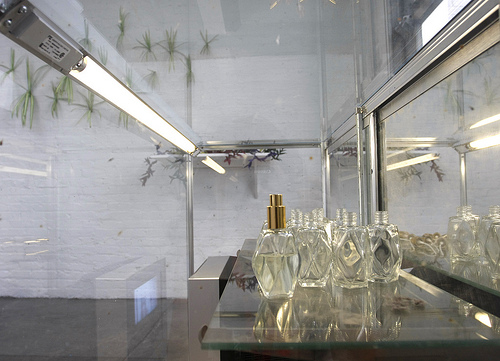
Anicka Yi and Maggie Peng, "Acceptable Substitute, I Mean One Acceptable Substitute To Me," 2009. Photo: Margaret Lee





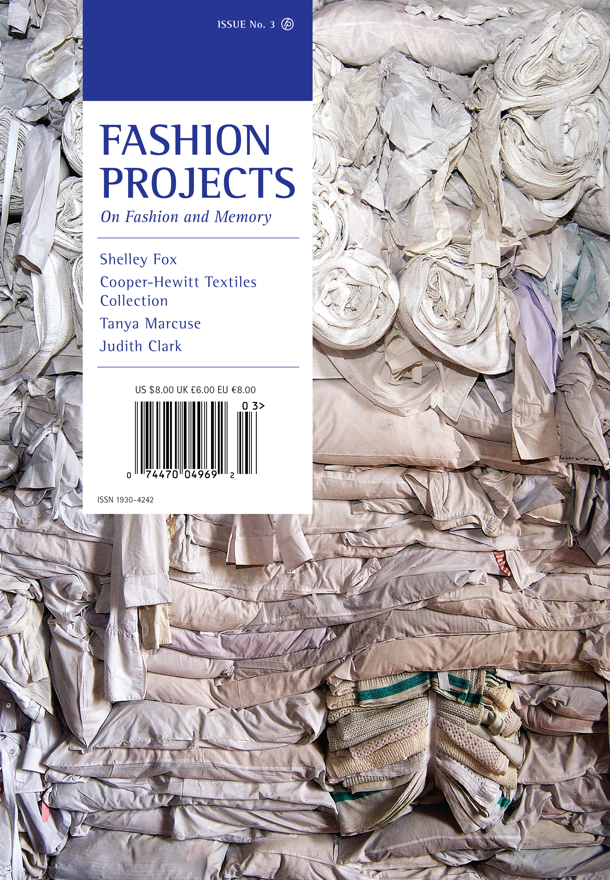


Fashion Projects #5 is devoted to fashion curation, examining the meteoritic rise in relevance of fashion exhibitions.
It features interviews with an eclectic assortment of leading practitioners from different corners of the world. The issue includes long Q&As with Harold Koda, the longtime, recently retired curator of the Met’s Costume Institute, as well as the Museum at FIT’s veteran leader Valerie Steele. It also features interviews with curators in Antwerp (the ModeMuseum’s Kaat Debo), Toronto (Royal Ontario Museum’s Alexandra Palmer) and Venice (Maria Luisa Frisa); academics studying the field (Hazel Clark, Annamari Vänskä, and Alistair O’Neill); and, giving an on-the-ground perspective, the Met’s head conservator, Sarah Scaturro. The issue’s cover stars Greer Lankton’s sculptural representation of legendary Vogue editor and Costume Institute doyenne Diana Vreeland, who continues to loom over the field years after her death.
Table of Contents
Introduction
Showmanship and History: An Interview with Harold Koda by Francesca Granata
Woman of Steele: An Interview with Valerie Steele by Lisa Santandrea
Exploring Fashion’s Openness: An Interview with Kaat Debo by Alex Esculapio
London, After a Fashion Curator: An Interview with Alistair O’Neill by Alexis Romano
Curation and Conservation: An Interview with Sarah Scaturro by Mae Colburn
Reflections on Fashion Curating
An Interview with Hazel Clark and Annamari Vänskä
Fashion in the Vast Museum: An Interview with Alexandra Palmer by Ingrid Mida
Restless Curating: An Interview with Maria Luisa Frisa by Marco Pecorari