Dries Van Noten, Press Release, Autumn/Winter 1999/2000 (pertaining to the PhD Research of Marco Pecorari)
In the same section, Promoting Designer Identity, Maria Sacchetti presented her analysis of the minimal aesthetic through a case study of the flagship store of Helmut Lang, showing how the retail space embodied in tandem the principles of the architect and the fashion designer’s aesthetic. Presentations proceeded with a section dedicated to Swedish Fashion History. Hanne Eide introduced the case of Augusta Lundin problematizing the Swedish translation of French fashion couture in the first part of the last century. In the same section Ulrika Berglund questioned how haute couture was interpreted within a social democratic country as Sweden (1930-1960), investigating the formation of a Swedish national identity far before the advent of the mass-market.
In the afternoon the section dedicated to Contemporary Fashion Media and Trends was opened by Jessica Conrah's "MTV- Fashion, Technology and Music Videos: The 1980s through a Critical and Phenomenological Approach." Conrah presented the case of MTV, reading it as a an important visual medium for fashion, style and image creation as well as a distribution site for advertising and consumer goods. Successively Ane Lynge Jorlén discussed her research on Contemporary Fashion Niche Magazine, such as Self Service, Ten, A Magazine.... Illustrating the production and consumption of such fundamental independent media, Lynge Jorlén addressed a fundamental fashion phenomenon that academic studies have neglected until now. The last presentation of this section was Chitra Buckley's "In-season Fashion Trend Information: implications for decision-making in own brand fashion retailers operating in the UK." Buckley examined the interaction in retail buying teams, during the processes of analyzing fashion change and developing clothing collections in the fast-moving, high street context.
The last session was dedicated to Gender Ambiguity and hosted the paper by Geraldine Biddle-Perry and Philip Walkander. Biddle-Perry presented the development and adoption of new forms of outdoor recreational leisure clothing in the aftermath of the First World War. Warkander examines his research, "Looking Queer," that concerns materiality, queer theory, issues of agency and power regulations. Working with 'queer' informants, Warkander aims to study aesthetics created in opposition with normative expectations, analyzing how looks and styles are produced, maintained, questioned or supported.
A final and fertile discussion pointed out a common will for fashion fashion research to move beyond those approaches that inevitable forced fashion within pre-fixed theoretical cages, claiming for an academic recognition but, too often, mortifying the phenomenon. The perspectives seem to change: from a pre-existing theory applied to fashion to a theory of fashion. However we must remember that this change has been initiated by fashion scholars' works which have opened academics doors to a discussion on fashion and on a theory of fashion. These fundamental interventions formed Phd students' disciplinarian awareness in recognizing their selves as Fashion Phds rather than sociologists, art historians, anthropologists... Despite this strong affiliation, a mutual difficulty emerged in defining fashion as a discipline or a field of research, testifying a common need for a terminological clarity reachable through the discussion of the past, present and future of study fashion. “Finding Our Fashion Footing” was an important step in this direction and the forthcoming related publication will contribute to formulate new scenarios.
Acknowledgment
The author would like to thank: London College of Fashion, and in particular Ane Lynge Jorlén, Geraldine Biddle-Perry and Rachel Lifter, for the organization and for hosting the Phd group of the Centre for Fashion Studies (Stockholm University); and Philip Warkander for having contributed to the realization of this important dialogue.
References
McNeil, Peter. 2010. “Conference Report: 'The Future of Fashion Studies'” Fashion Theory 14 (1): 105-110.




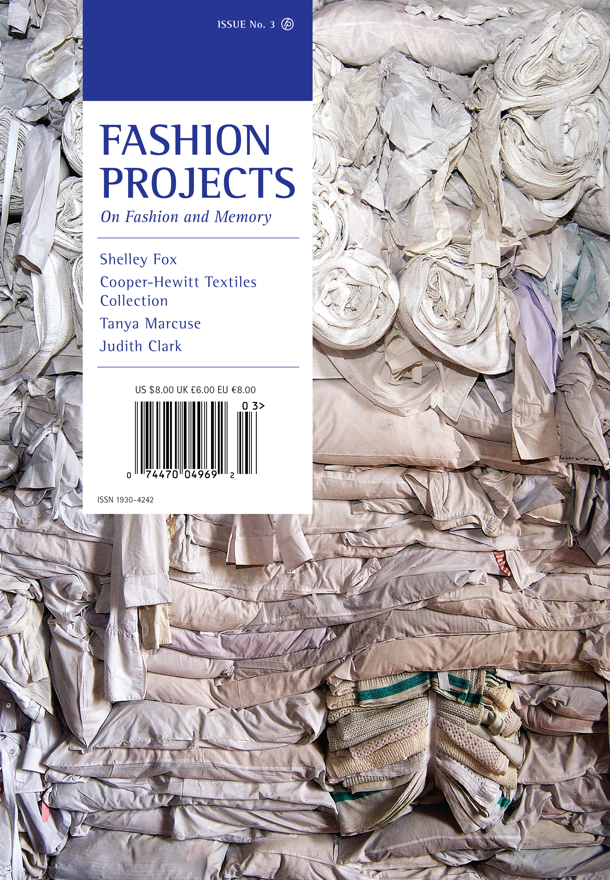


Fashion Projects #5 is devoted to fashion curation, examining the meteoritic rise in relevance of fashion exhibitions.
It features interviews with an eclectic assortment of leading practitioners from different corners of the world. The issue includes long Q&As with Harold Koda, the longtime, recently retired curator of the Met’s Costume Institute, as well as the Museum at FIT’s veteran leader Valerie Steele. It also features interviews with curators in Antwerp (the ModeMuseum’s Kaat Debo), Toronto (Royal Ontario Museum’s Alexandra Palmer) and Venice (Maria Luisa Frisa); academics studying the field (Hazel Clark, Annamari Vänskä, and Alistair O’Neill); and, giving an on-the-ground perspective, the Met’s head conservator, Sarah Scaturro. The issue’s cover stars Greer Lankton’s sculptural representation of legendary Vogue editor and Costume Institute doyenne Diana Vreeland, who continues to loom over the field years after her death.
Table of Contents
Introduction
Showmanship and History: An Interview with Harold Koda by Francesca Granata
Woman of Steele: An Interview with Valerie Steele by Lisa Santandrea
Exploring Fashion’s Openness: An Interview with Kaat Debo by Alex Esculapio
London, After a Fashion Curator: An Interview with Alistair O’Neill by Alexis Romano
Curation and Conservation: An Interview with Sarah Scaturro by Mae Colburn
Reflections on Fashion Curating
An Interview with Hazel Clark and Annamari Vänskä
Fashion in the Vast Museum: An Interview with Alexandra Palmer by Ingrid Mida
Restless Curating: An Interview with Maria Luisa Frisa by Marco Pecorari