Indisciplined Curation-Recording
/by Francesca Granata For those who missed the panel, you can view a recording of it here or below:

Avant-garde Fashion, Art, Visual Culture, Fashion Theory, Fashion Exhibitions, Fashion Museums, Fashion Exhibition, Fashion Museum
by Francesca Granata For those who missed the panel, you can view a recording of it here or below:
by Francesca Granata
 Figure 1
An incredibly exciting day of talks characterized the Italian symposium “Diana Vreeland After Diana Vreeland: The Discipline of Fashion Between Museum and Curating,” which was organized by Maria Luisa Frisa and Judith Clark at the Universita` Iuav di Venezia. Most of the morning talks touched upon the great relevance of Diana Vreeland for fashion curating—thus bringing a commentary to the wonderful exhibition “Diana Vreeland After Diana Vreeland,” curated by Clark and Frisa at Palazzo Fortuny in Venice.
One of the most directly relevant talks was by Harold Koda—curator-in-charge at the Costume Institute, the Metropolitan Museum of Art—who started his career assisting Diana Vreeland and spoke about how Vreeland brought a certain glamour and theatricalization to fashion exhibitions, often at the cost of historical accuracy. Koda, however, traced the ways curators (including himself) eventually engaged in the balancing act of retaining the dynamic quality of display and presentation brought forth by Vreeland’s approach while keeping historical accuracy in the way the garments were exhibited.
 Figure 2
Another theme which transpired was the relation between the process of editing and curating, one which was obviously central to the proceedings, since Vreeland started consulting at the Costume Institute only after having been famously fired from Vogue, which she had glamorized in a similar vein.
The exhibition engaged in re-appropriating and re-interpreting Vreeland’s curatorial innovations. Frisa said the idea for the title came to her while visiting Sherry Levine’s exhibition in New York, as it is—as the title suggests—a very reflective exhibition: an exhibition about exhibition-making. Among Vreeland’s curatorial vocabulary that the exhibition decoded and recoded was her love for armor, and for horses—boldly presented at Palazzo Fortuny by a horse covered in toile. Another visually engaging re-appropriation of Vreeland’s vocabulary was her use of tights or elaborate wigs to cover the mannequins’ heads.
 Figure 3
Among the most interesting point which Judith Clark made in relation to the relationship between exhibitions and magazines was the idea that in the context of a magazine you can play with proportion and dramatize a detail of a dress simply through close-up, whereas in the context of an exhibition you have to do it through lights or props—something Vreeland certainly mastered. Another idea which places on a continuum Vreeland’s work as consultant for the Costume Institute and of editor was the fact that meaning is not always best communicated through the gown itself—something which is certainly true for fashion photography.
Drawing a parallel between the Met’s Costume Institute and the Victoria and Albert Museum, Amy de la Hay brought an interesting and very little known example of an early take on dynamic and dramatic fashion exhibitions, which predated Vreeland: The 1969 “Fashion: An Anthology,” curated by Cecil Beaton. Once again equating magazines to exhibitions, de la Hay pointed out how fashion exhibitions became more dynamic and less static at the same time fashion photography did. Equally fascinating was Alexandra Palmer’s discussion of the early curators at the Costume Institute: Polaire Weissman, and later, Stella Blum. Blum was the curator while Vreeland consulted for the Institute, and Palmer discussed Blum’s difficult job of negotiating between Vreeland’s input and her own role as curator.
 Figure 4
A particularly thought-provoking intervention was provided by a discussion IUAV Professor Mario Lupano had with Stefano Tonchi. The latter, who was editor of the New York Times’s T Magazine and currently edits W, equated processes of curation to those of editing. Both involved selection as a form of narrative. Among the various themes Tonchi discussed was the centrality of fashion to contemporary culture and particularly visual culture—its connection to the other arts, cinema, and design, which he explored with Frisa in his exhibition “Excess: Fashion and the Underground in the 1980s.” Another important point brought up by Tonchi was the analogy between theater and exhibitions, as both are involved in the creation of a spectacle. (Tonchi was speaking in Italian, thus using the word “spettacolo,” which does not have the same implication as the Debordian word “spectacle.”) Another important point, which is tied to the metaphors of exhibition as a form of theater is that of the audience—one which was surprisingly not discussed by curators. The idea of integrating other media in the process of curation, as well as of magazine making, is one that Tonchi introduced and was fortuitously fully unpacked by Kaat Debo (Director of the ModeMuseum in Antwerp) in her discussion of the various exhibitions done at the museum—the multi-media experimentations culminating with their collaboration with SHOWstudio on occasion of Walter Van Beirendonck’s exhibition.
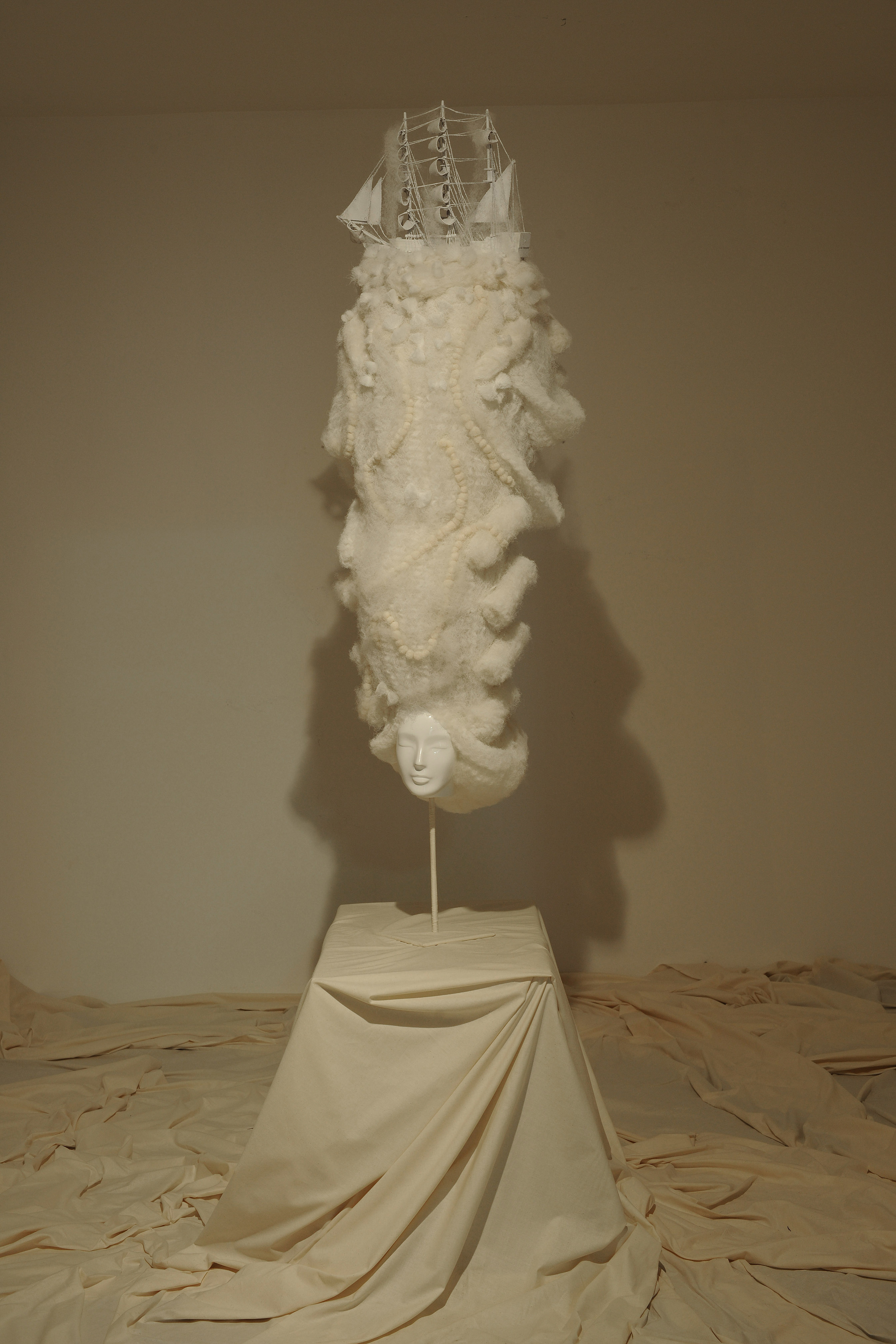 Figure 5
The final panel, chaired by the tireless Marco Pecorari and Louise Wallenberg of the Centre for Fashion Studies in Stockholm (and including myself), discussed the idea of academic curation. Pecorari discussed the great divide which characterized academic and museum professionals up through the 1990s—one which, as the symposium pointed out, has been overcome. Gabriele Monti and Jenna Rossi-Camus, curatorial assistant to the Vreeland’s exhibition discussed their experience as emerging curators, while Marie Riegels Melchior brought some very interesting points on the differences and tensions between dress and fashion curation I was asked about the process of teaching curation, something which is integral to the new masters in Fashion Studies at Parsons, for which I teach. The masters offers courses in fashion curation and conservation—two intimately related areas—by Shannon Bell Price (Associate Research Curator at the Costume Institute) and Sarah Scaturro (Textile Conservator at Cooper-Hewitt). I also briefly touched on my interest in placing fashion in the context of greater visual and material culture. This interest is very much informed by Frisa’s and Tonchi’s work and their thought-provoking books and exhibitions, thus I am starting to wonder whether there might be something culturally specific in placing fashion in greater visual and material culture.
These ties between fashion, design and art are something I am hoping to bring up again in a forthcoming panel on Tuesday, April 17th at Parsons. Titled “Indisciplined Curation,” the panel focuses on curatorial practices that do not fit neatly within discreet categories of fashion, art, and design. It includes Harold Koda (Curator-in-Charge of the Costume Institute at the Metropolitan Museum of Art), Sarah Lawrence (an academic curator and dean of the School of Art and Design History and Theory at Parsons the New School for Design), and Sabrina Gschwandtner (a New York-based artist, writer and curator).
All Photos: Francesco de Luca
fig. 1 Exhibition View
fig. 2 DIANA VREELAND’S ARCHIVE. Collection of Michael H. Berkowitz, Fondazione Ottavio e Rosita Missoni Museo di Palazzo Mocenigo - Centro Studi di Storia del Tessuto e del Costume, Venezia, The Diana Vreeland Estate, Maria Luisa Frisa, Kenneth Jay Lane, Katell le Bourhis Collection. Luigino Rossi
fig. 3 Semi-formal robe, China, first half of the XIX secolo. Collezione privata Cecilia Matteucci Lavarini Peacock (Pavo cristatus). Collezione Museo di Storia Naturale di Venezia
fig. 4 Henri Matisse, Costumes for the Ballets Russes de Le Chant du Rossignol di Igor Stravinsky, 1920. Martin Kamer, Svizzera
fg. 5 THE EIGHTEENTH-CENTURY WOMAN. Wig, Angelo Seminara: a reference to Diana Vreeland's Exhibition, The Eighteenth-Century Woman (16 dicembre 1981-5 settembre 1982)

by Francesca Granata
I am incredibly excited to having been invited to participate to the symposium "The Discipline of Fashion between the Museum and Curating," which will take in place in Venice on March 10, and promises to be one of the most interesting and wide-ranging symposium to have ever been organized on the topic
The symposium coincides with the opening of the exhibition "Diana Vreeland After Diana Vreeland" curated by Judith Clark and Maria Luisa Frisa at Palazzo Fortuny, which will be on view from March 10 to June 25, 2012.
"Organized by the Università Iuav di Venezia and the London College of Fashion (University of the Arts London) in collaboration with the Centre for Fashion Studies (Stockholm University), the symposium aims to discuss the evolving discipline of fashion curating, and brings together prominent voices from the field. The conference will use Diana Vreeland's exhibitions and experience as Special Consultant to The Costume Institute at The Metropolitan Museum of Art in New York (1972-1989) as a starting point from which articulate reflections on the relationships between fashion, exhibitions and museums.
Specialist panel sessions will focus on Diana Vreeland’s legacy and the principal themes brought forth by her work at the Costume Institute including: the display of fashion in museums; the definition of fashion exhibition and the relation between fashion curating and exhibition making; the relationship between the roles of fashion curator and fashion editor; the role of fashion curating in academia."
Among the many notable speakers are Harold Koda, Akiko Fukai, Alexandra Palmer, Kaat Debo, Mario Lupano and Stefano Tonchi. My contribution will be to a panel titled "Fashion Curation & Academia: New Insights," which is chaired by Louise Wallenberg, Director of the Centre for Fashion Studies, Stockholm University and Marco Pecorari also from the Centre for Fashion Studies.
For a full programme please visit their site
Below are some installation photos at Palazzo Fortuny. More to come...
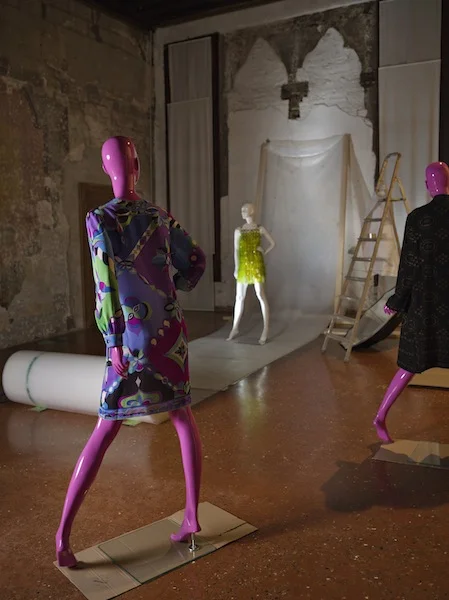
Miniabito con dischi e frange in plastica gialla, Paco Rabanne, seconda metà anni sessanta; Soprabito in seta ricamata, Chanel, etichetta “Cannes-31 Rue Cambon-Paris-Biarritz”, n. 5046, anni venti (appartenuto a Eleonora Duse). Estate of Simone Valsecchi ARCHI-V-E

Abito ottomano in velluto blu con ricami oro, fine XIX secolo; Cappa da sera in taffetà di seta rossa, Biki, fine anni sessanta-primi anni settanta (appartenuta a Maria Callas); Semi-formal robe femminile in satin verde acqua con farfalle e fiori applicati, Cina, prima metà XIX secolo; Redingote in velluto nero foderata in taffetà nero, Balenciaga, haute couture, n. 33191, circa 1948. Collezione Cecilia Matteucci Lavarini
Fotografie Francesco de Luca
Styling Francesco Casarotto
Manichini La Rosa Mannequins

by Francesca Granata Leigh Bowery at the 1994 Lucian Freud Exhibition at the Metropolitan Museum of Art, Photograph by Don Pollard
This Thursday, January 26, I am giving a talk titled "Fashioning the Grotesque Body," at the Visual Arts Center of New Jersey, in which I will discuss the work of Leigh Bowery and Rei Kawakubo. The talk, which is taking place in conjunction with the exhibition Textility, is free and open to the public. Below is some more information on the center and the talk:
"The Visual Arts Center of New Jersey will feature Francesca Granata, ADHT Professor of Fashion Studies, in their Spring 2012 season of Thursday Evening Salon Series on January 26. The series, now in its fifth season, functions as a forum for current topics in the arts, humanities and the social sciences with artists, curators, philosophers and writers.
Dr. Granata’s discussion, called “Fashioning the Grotesque Body,” will focus on the proliferation of grotesque images of the body within contemporary fashion and will explore the link between art and fashion through the work of experimental designer Rei Kawakubo of Comme des Garçons to the designer and performance artist Leigh Bowery."
Thursday Evening Salon Series Visual Arts Center of New Jersey Spring 2012 Season: January 12-May 17 7:30pm-9:00pm 68 Elm Street, Summit, NJ Free to the public. Seating is limited and reservations are required. Phone: 908.273.9121

Red Babydoll dress. Jeremy Scott, fall 2009, Photo courtesy of the Jeremy Scott Studio.
I am happy to announce that students at NYU Steinhardt's Visual Culture: Costume Studies Program (some of whom I have taught in the past), in collaboration with Shannon Bell-Price (Associate Research Curator at the Metropolitan Museum of Art's Costume Institute), have curated an exhibition of contemporary fashion designs. Titled "Imprint (NYC): The Evolution of Motifs in Fashion," it opens January 12.
"Polka-dots, stripes, camouflage, novelty/conversational prints, houndstooth, plaid, animal prints, and “digital rococo” will all be represented in Imprint (NYC) by current and emerging designers from the New York metropolitan area including Thom Browne, Norma Kamali, Diane von Furstenberg, Marc Jacobs, Proenza Schouler, Jeremy Scott, Anna Sui, and Jason Wu."
The exhibition, which runs through February 4 at NYU Rosenberg Gallery, explores the critical history, potent symbolism, and iconic contemporary use of popular motifs in fashion. Imprint (NYC) will have an opening reception Thursday, January 12 from 6 to 8pm. An exhibition symposium will be held Wednesday, January 25 from 6 to 8pm. (preceded by a reception at 5pm). The Rosenberg Gallery is located in NYU’s Barney Building, 34 Stuyvesant St. (between Second and Third Avenues). The exhibition is free and open to the public. Gallery hours: Wednesday through Saturday, 2 to 8pm; Sunday noon to 6pm.
Francesca Granata
Fashion Projects is a journal focusing on fashion, art and visual culture.
This issue is devoted entirely to the subject of fashion criticism—the first such study devoted to the cultural field. It features extended interviews with leading practitioners of fashion criticism including W editor Stefano Tonchi, International Herald Tribune critic Suzy Menkes, The New Yorker’s Judith Thurman, New York Times writer Guy Trebay, and Robin Givhan, the first fashion critic to receive a Pulitzer Prize.
Table of Contents
Transdisciplinary Practices: An Interview with Stefano Tonchi by Francesca Granata
Fashion Criticism—A Critical View: An Interview with Robin Givhan by Michelle Labrague
This Is Not a Fashion Critic: An Interview with Guy Trebay by Jay Ruttenberg
“Women’s Work”: An Interview with Judith Thurman by Francesca Granata
Bill Cunningham Multimedia Man by Jay Ruttenberg
Fashion Criticism as Political Critique: An Interview with Lynn Yaeger by Sarah Scaturro
The Critic as Artist: An Interview with Mariuccia Casadio by Marco Pecorari
On Fashion Futures: An Interview with Suzy Menkes by Lucy Collins
Table of Contents 00— Editorial Letter
01— Fashion as Expanded Practice: An Interview with Shelley Fox by Francesca Granata
02— Experiments in Fashion Curation: An Interview with Judith Clark by Sarah Scaturro
03— Televisual Memories: An Interview with Eugenia Yu by Erin Lindstrom
04— Reflections on Absence Photo Essay: Cooper-Hewitt Textiles Collections Written by Sarah Scaturro; Photographed by Keith Price
05— American Industrial Past: Ohio Knitting Mills by Lisa Santandrea
06— Ready Made Memories: Erica Weiner’s Jewelry by Francesca Granata
07— Imprints of the Body: An Interview with Tanya Marcuse by Tamsen Schwartzman
The second issue of Fashion Projects covers fashion and art collectives, as well as collaborative projects between artists and fashion designers. It’s meant as a reminder of the inherently collaborative nature of fashion which is often forgotten as, particularly at the higher ends of the industry, so much rides on the “individual” designer.
Table of Contents
00. Editorial Letter
01. Elsewhere: Between Art Collaborative and House of Wonder by Francesca Granata
02. Ephemeral Conversations: Simon Periton’s Collaborations with Raf Simons, Philip Treacy and Junya Watanabe by Sonya Mooney
03. Elegant Subversions: An Interview with Cat Chow
04. Show Me Your Reality and I’ll Show You Mine: An Interview with Penny Martin, editor-in-chief of SHOWstudio.com by Patty Chang
05. Studio 5050’s Fuzzy Fashion by Sarah Scaturro
06 Boundless Practice: An Interview with Susan Cianciolo by Sonia Mooney
07 At the Forefront of Austrian Fashion: An Interview with UNIT F
08 Serpica Naro: The Great Fashion Swindle by Francesca Granata
09 Clashing Hues: European Protests Movements and Costume by Lidia Ravviso
10 Pierre Bourdieu Goes to Town by Jay Ruttenberg
The Subtleties of Cross Dressing: An interview with Anne-Sofie Back by Patty Chang
The Red Shoe Delivery Service by Francesca Granata
Reflections on “Meta-Design” with Mary Ping by Chyntia Leung
Rosa Mosa: Walking the Line Between Tradition and Zeitgeist
Exploring Kawaii: An Interview with Yumiko Inada by Tae Yano
Indie Fashionista in Fort Greene
La Voleuse: The Book Bag Revisited
Forgery and Appropriation in the Accessory Industry by Francesca Granata
© Fashion Projects 2016 All rights reserved.



Fashion Projects #5 is devoted to fashion curation, examining the meteoritic rise in relevance of fashion exhibitions.
It features interviews with an eclectic assortment of leading practitioners from different corners of the world. The issue includes long Q&As with Harold Koda, the longtime, recently retired curator of the Met’s Costume Institute, as well as the Museum at FIT’s veteran leader Valerie Steele. It also features interviews with curators in Antwerp (the ModeMuseum’s Kaat Debo), Toronto (Royal Ontario Museum’s Alexandra Palmer) and Venice (Maria Luisa Frisa); academics studying the field (Hazel Clark, Annamari Vänskä, and Alistair O’Neill); and, giving an on-the-ground perspective, the Met’s head conservator, Sarah Scaturro. The issue’s cover stars Greer Lankton’s sculptural representation of legendary Vogue editor and Costume Institute doyenne Diana Vreeland, who continues to loom over the field years after her death.
Table of Contents
Introduction
Showmanship and History: An Interview with Harold Koda by Francesca Granata
Woman of Steele: An Interview with Valerie Steele by Lisa Santandrea
Exploring Fashion’s Openness: An Interview with Kaat Debo by Alex Esculapio
London, After a Fashion Curator: An Interview with Alistair O’Neill by Alexis Romano
Curation and Conservation: An Interview with Sarah Scaturro by Mae Colburn
Reflections on Fashion Curating
An Interview with Hazel Clark and Annamari Vänskä
Fashion in the Vast Museum: An Interview with Alexandra Palmer by Ingrid Mida
Restless Curating: An Interview with Maria Luisa Frisa by Marco Pecorari