Christian Joy at AVA

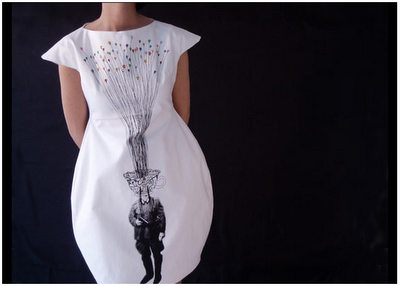
Christian Joy, "Nightmare Catcher," 2009.

Another designers’ exhibition, which occurred in conjunction with fashion week, was Christian Joy’s The Visitors Must be Amused. It took place at Audio Visual Arts—a new gallery in the East Village, where it will be on view unti March 8. The premise for the exhibition is that Joy disposed of nine years of left-over, unwanted material in her studio and repurposed it into extravagent representations of female beings through garments. In a further twist, Joy based each sculpture/creation on descriptions given to her by a friend or family member who, in turn, had to incorporate Joy’s finished piece in their own photograph or creation. Among the collaborators were the Yeah Yeah Yeahs's Karen O and Nick Zinner.

The descriptions gave range to an array of seemingly disparate results running the gamut of a Thierry Mugler–inspired cyborg suit to a black body suit. The latter was reinterpreted into a funny night scene, where the black-clad wearer became reminiscent of the early-twentieth century proto catwoman Irma Vep.

One of the costumes involved a video projection, which seemed to be a commentary on a turn-of-the-century trans-Atlantic voyage, while what was perhaps the most interesting costume was “Nightmare Catcher”—a vaguely scarecrow-like attire made of stripes of burlap and gingham fabric.

It’s great to see more and more small exhibitions of experimental New York designers popping up around the city—a trend which will hopefully continue!

Francesca

Christian Joy, The Visitors Must be Amused, Installation View
Other Fashion Weeks Part 1: The Foundry

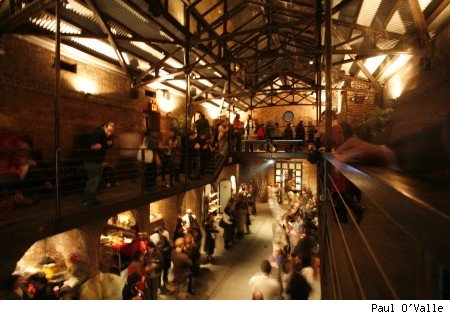
New York Fashion Week was book ended by alternative fashion week events, which were, unfortunately, scarcely written about. Prior to the official beginning of fashion week, a number of independent designers staged a show in Long Island City inside a great industrial space—a repurposed foundry.

I was late to the show—and, oddly, was admitted to the backstage area as opposed to the actual venue. Despite its timely nature, the format of the show seemed similar to a traditional fashion show (at least judging from the view from backstage). It was organized by a boutique-cum-gallery in Queens called Subdivision, whose mission is to promote designers working across media; it hosts performances as well as art shows and carries an array of clothes and design wares.

Dress, Death by Drones

Among the most interesting designers were Feral Childe, the artist/designer duo of Moriah Carlson and Alice Wu, whose whimsical prints adorn their detailed garments. Another interesting designer, the young Brooklyn-based duo Death by Drone, was equally print-heavy. I had been meaning to write about them on occasion of their graduation exhibition at Parsons, where they hung their mostly black and white, heavily printed dresses from white and black balloons.

The palette for their work in the Foundry show was equally minimal. The prints adorning their clothes are deceivingly child-like. Upon closer look, they reveal disturbing, slightly perverse undercurrents. Their work reminds me of the Japanese artist Yumiko Inada, who was featured in the very first issue of Fashion Projects. Their pieces are similarly toying with the category of cuteness and turning it on its head. In addition to their clothes, their standalone Ubi Roi-esque illustrations "Tiny People" are not to be missed!

Andy Warhol Screen Tests

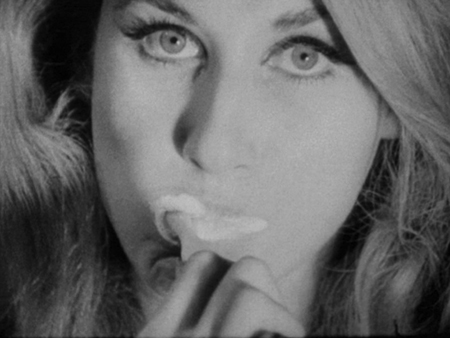
Jane Holzer Screen Test courtesy of the Andy Warhol Museum

This past Saturday, Dean Wareham and Britta Phillips, previously of Luna, performed 13 Most Beautiful…Songs for Andy Warhol’s Screen Tests at the Allen Room as part of Lincoln Center’s American Songbook series. Dean and Britta, backed by a drummer and guitarist, performed to Warhol's Screen Tests of Factory regulars from the mid-60s.

Here is what (our seldom contributor) Jay Ruttenberg had to say about the evening for Time Out New York:

"At the Allen Room, Dean & Britta performed 13 songs, one for each screen test, both covers and originals. Some songs were vague, while others explicitly matched their subjects—say, a handsome rendition of “I’ll Keep It with Mine,” which Bob Dylan wrote for Nico and which the band played to accompany Nico’s screen test. The films themselves remain fascinating, whether portraying Warhol sycophants (Edie Sedgwick, whose brief performance displayed more range than Sienna Miller did in Factory Girl) or future Entourage cameos (Dennis Hopper).

As Dean & Britta played, the ’60s most fabulous Manhattanites gazed at the audience, raising the notion of aloof cool to new and never-again-seen heights. This notion culminated in the filmed portrait of a young and potentially evil Warhol favorite, his eyes shielded in dark sunglasses, staring down the camera as he sipped from a glass-bottled Coca Cola. The sitter was, of course, Lou Reed, and for his screen test Dean & Britta played the Velvet Underground obscurity “Not a Young Man Anymore.” The song could not have been more appropriate. From the middle of the audience, his sunglasses replaced with spectacles, sat New York City’s top concert-goer, Lou Reed himself, staring into his screen test with the rest of the crowd, a young man no longer."

For a full account of the performance, please visit Jay's blog at Time Out New York

Henrik Vibskov "The Visit" at MU

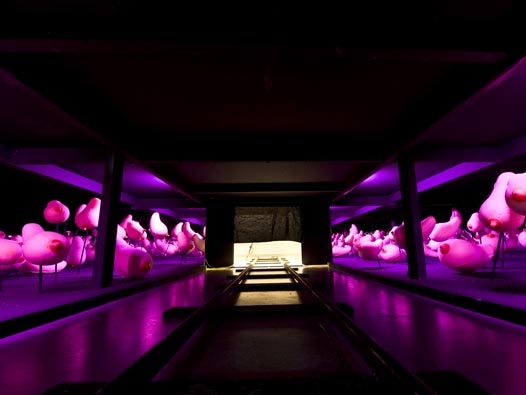
Installation shot, Henrik Vibskov, "The Visit" at MU

A retrospective of the Danish designer Henrik Vibskov has just opened at MU in the Netherlands. An interesting space featuring art design and fashion exhibitions, MU has previously shown installations and performances by Cosmic Wonder and Susan Cianciolo.

In its unorthodox approach to exhibiting fashion, Vibskov’s exhibit entitled, “The Visit,” focuses on the designer's fashion presentations. More akin to performance art than traditional fashion shows, the presentations remind us of the increasingly blurred line between the two, particularly when it comes to avant-garde fashion. As a result, the exhibition-goer—or, according to the title of the exhibition, "the visitor"—becomes the performer of Vibskov's installation. Those are often interactive displays, that invite a range of activities, from music-generating cycling to lying down surrounded by disembodied giant breasts!

Thus, “The Visit”—an exhibition dedicated to the fashion show as opposed to actual dress—is a further reminder not only of the blurred line between fashion and performance, but of the centrality of image and spectacle in contemporary fashion. Francesca

Interactive Installation, (Music-bycicling and other instruments), Henrik Vibskov, "The Visit" at MU

Calder’s World

Alexander Calder, Jealous Husband Necklace, 1940

At the entrance of Alexander Calder’s jewelry exhibition at the Metropolitan Museum of Art is “the Jealous Husband” Necklace. A seemingly witty reference to chastity belts, the piece sports spikes across the neck opening to stave away potential suitors. This necklace encapsulates the spirit of Calder’s jewelry, which appears witty and whimsical yet, at times, reads as constricting. Suggestions of boundedness and containment seem to transpire in some of the pieces—particularly a number of chocker-style necklaces. These are overlaid with Surrealist influences, as well as references to medieval and non-Western jewelry traditions.

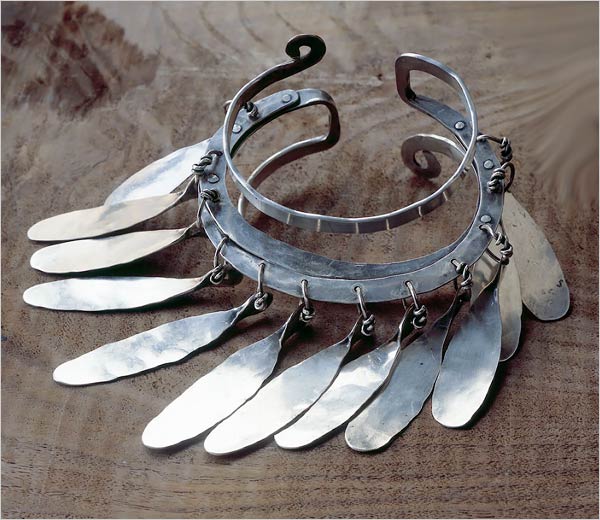
Alexander Calder, Silver Bracelet, 1948

The majority of Calder’s jewelry pieces are reminiscent of his work with wire. Some, like a number of pieces on display a short walk away at the Whitney Museum of American Art, are abstract representation of animals through a continuous sculpted line. Other pieces make more subtle references to the rest of his oeuvre: some of the jewelry pieces are reminiscent of the ankle and arm bracelets worn by Josephine Baker in her Parisian performances, while the pointed wire structures Calder devised to represent Baker’s breasts resurface here in a bracelet. (It is interesting to note how Calder’s rendition of Baker’s breast is highly reminiscent of Jean Paul Gaultier’s conical bra, famously worn by another era’s pop star, Madonna, in the early 1990s. One is left to wonder whether Gaultier might have been directly influenced by Calder’s work. )

Alexander Calder’s “Josephine Baker IV"

Additionally, much of the jewelry entered the realms of wearables, as with a chain mail necklace, which in its size and shape is more akin to a see-through metal “waistcoat” than a necklace (and, once again, brings to mind later fashion designs: Paco Rabanne’s chain mail wearables from the 1960s). Also, of notice are a number of hats and tiaras, which show Calder’s interest in clothing and garments, in addition to jewelry. This interest is perhaps most evident in the circus exhibition at the Whitney, where one can admire the beautifully and painstakingly rendered miniaturized clothes the artist created for the circus’ performers. And, at least in one instance, the clothes take center stage as one of the performers is revealed to be wearing an innumerable numbers of jackets in a Russian doll-style disrobing act, which is part of Calder’s circus performance.

Francesca Granata