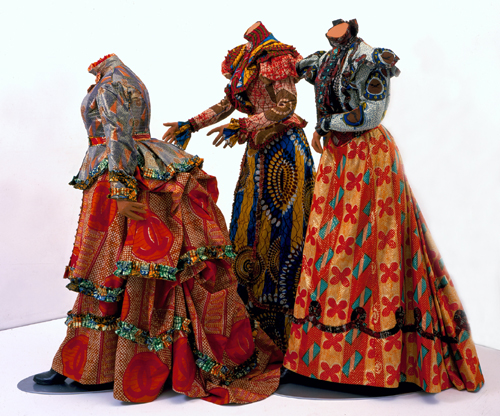
Yinka Shonibare, Three Graces.
Textile patterns and dress provide a rich visual vocabulary of encoded information and aesthetic expression. They have the ability to exploit or subvert the commercial allure of the “exotic”, and how it is called upon to reference cultural or national identities or even recast the vernacular. The exhibition Pattern ID, which is currently on view at the Akron Art Museum, queries just how straight forward patterns and dress inform our understanding of cultural identities. The multimedia exhibition entitled, Pattern ID, features the works of Mark Bradford, iona rozeal brown, Nick Cave, Willie Cole, Lalla Essaydi, Samuel Fosso, James Gobel, Brian Jungen, Bharti Kher, Takashi Murakami, Grace Ndiritu, Yinka Shonibare MBE, Mickalene Thomas, Aya Uekawa, and Kehinde Wiley. Many of these contemporary artists have migrated from one culture to another, be it national, ethnic, racial, socioeconomic, political or religious. Rather than trade one identity for another, the artists reveal ways in which identity can be cumulative, employing a patchwork of textile patterns and dress as meaningful vehicles to locate one’s place in society against a backdrop of globalization. Taking a range of approaches from humor to irony and formal beauty, these artists borrow from popular culture, world history, and art history to transform and redefine the cultural meanings of patterns.
For instance, the use of African textiles as props and backdrops in the works of Yinka Shonibare, Samuel Fosso, and Grace Ndiritu play not only on traditional and modern forms of representation, but also on cultural myths, politics, and ideas of post-colonialism, reclamation, and subjugation. The headless mannequins in Shonibare’s Three Graces fashioned in elaborate Victorian garb made out of atypical ‘African’ fabrics and arranged as a tableau satirizes the notions of authenticity and identity. The installation relies as much on the Dutch wax-print cloth ‘ethnicizing’ the space as on the references to 18th and 19th century masterpieces of European art. However, it is the textile that is a testament to cross-cultural interactions brought about by mercantile trade, having undergone a series of replication, transformations, redefinitions, and repackaging for different markets and tastes. Although linked by ideas of post-colonialism and identity, his works are not necessarily contained by them.






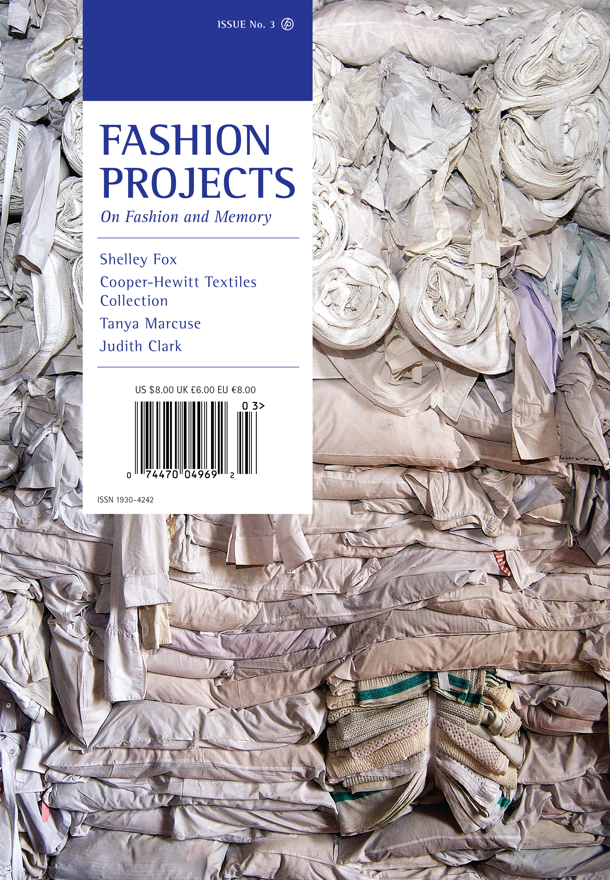


Fashion Projects #5 is devoted to fashion curation, examining the meteoritic rise in relevance of fashion exhibitions.
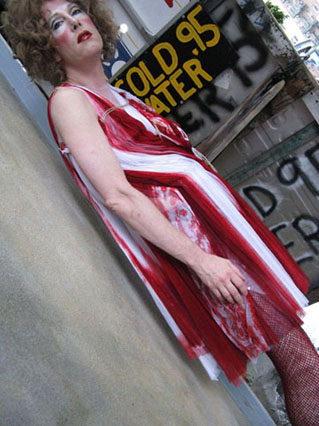
It features interviews with an eclectic assortment of leading practitioners from different corners of the world. The issue includes long Q&As with Harold Koda, the longtime, recently retired curator of the Met’s Costume Institute, as well as the Museum at FIT’s veteran leader Valerie Steele. It also features interviews with curators in Antwerp (the ModeMuseum’s Kaat Debo), Toronto (Royal Ontario Museum’s Alexandra Palmer) and Venice (Maria Luisa Frisa); academics studying the field (Hazel Clark, Annamari Vänskä, and Alistair O’Neill); and, giving an on-the-ground perspective, the Met’s head conservator, Sarah Scaturro. The issue’s cover stars Greer Lankton’s sculptural representation of legendary Vogue editor and Costume Institute doyenne Diana Vreeland, who continues to loom over the field years after her death.
Table of Contents
Introduction
Showmanship and History: An Interview with Harold Koda by Francesca Granata
Woman of Steele: An Interview with Valerie Steele by Lisa Santandrea
Exploring Fashion’s Openness: An Interview with Kaat Debo by Alex Esculapio
London, After a Fashion Curator: An Interview with Alistair O’Neill by Alexis Romano
Curation and Conservation: An Interview with Sarah Scaturro by Mae Colburn
Reflections on Fashion Curating
An Interview with Hazel Clark and Annamari Vänskä
Fashion in the Vast Museum: An Interview with Alexandra Palmer by Ingrid Mida
Restless Curating: An Interview with Maria Luisa Frisa by Marco Pecorari