
The Sustainability Equation: Ethics and Aesthetics in Contemporary Fashion
/
Slow and Steady Wins the Race at Ethics + Aesthetics
Coming up Tuesday January 26th is a panel in conjunction with the exhibition Ethics + Aesthetics, which I co-curated at the Pratt Institute Manhattan Gallery. The panelists include Julie Gilhart, senior vice president, fashion director of Barneys New York; Mary Ping, designer and founder of Slow and Steady Wins the Race; Caroline Priebe, designer and founder of Uluru and it will be moderated by Sarah Scaturro and I
The Sustainability Equation: Ethics and Aesthetics,” will examine what constitutes sustainability within the American fashion system and will explore the sustainable fashion practices of American fashion designers including “Ethics + Aesthetics” designers Ping and Priebe.
“Ethics + Aesthetics = Sustainable Fashion” is on view now through February 20, 2010 and features work by artists and designers including Alabama Chanin, Bodkin, Loomstate, SANS, Slow and Steady Wins the Race, SUNO, and ULURU, Susan Cianciolo, Kelly Cobb, Zoë Sheehan Saldaña, and Andrea Zittel and Tiprin Follet.
A full color catalog of the exhibition will be available at a discounted price made possible by a generous grant from the Coby Foundation, Ltd. To order the catalog click here. The catalogue would include a smock pattern from Andrea Zittel's smockshop project.

Uluru at Ethics + Aesthetics
Francesca Granata
Below are the participants' bios:
Julie Gilhart is senior vice president, fashion director of Barneys New York, a high-end luxury specialty store based in the United States. In spring 2007, she spearheaded the development of an all-organic collection of casual, sexy clothes that are available in every Barneys New York store in the country. She has inspired many designers to develop “sustainable” products and was instrumental in the creation of Barneys’ 2007 holiday campaign titled “Have a Green Holiday,” which focused on environmentally-conscious fashion products. Gilhart believes there is an essential need to increase awareness of the development of sustainable products and how the customer makes buying decisions. She works to instill changes in the fashion business that leave a lighter footprint on the earth and promote more conscious consumerism.
Mary Ping’s Slow and Steady Wins the Race is an experimental “laboratory” line that stemmed from a desire to dissect the fashion vocabulary and led to an exploration of patterns of consumption and brand identities. The label’s mission is to “promote and produce interesting and significant pieces from the simplest fabrics and materials.” Following a product design model, the company is intent on slowing down the fashion cycle by creating non-seasonal pieces focused on specific and fundamental characteristics of clothing design. In addition, the designs are produced in limited numbers and sold at a contained price.
The garments of Uluru’s Caroline Priebe are tightly focused for maximum ecological impact and emphasize a “less is more” philosophy. For example, Priebe’s Westlake dress has only two seams, creating a sophisticated, simple look that is reversible and has pockets. The Kathleen coat, a classic design based on her grandmother’s coat, highlights the longevity of design and its relation to personal and historical memories. The recycled cashmere sweater, adorned with appliqués hand-sewn by the workshop of Alabama Chanin, underscores the collaborative nature common to sustainable fashion.
Coming up Tuesday January 26th is a panel in conjunction with the exhibition, which I co-curated at the Pratt Institute Manhattan Gallery. The panelists include Julie Gilhart, senior vice president, fashion director of Barneys New York; Mary Ping, designer and founder of Slow and Steady Wins the Race; Caroline Priebe, designer and founder of and will be moderated by Sarah Scaturro and Francesca Granata.


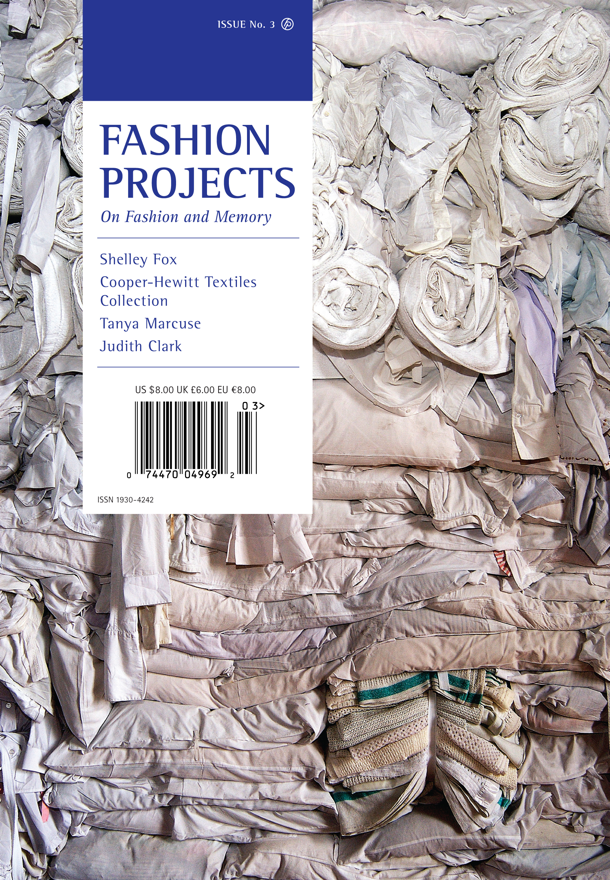


Fashion Projects #5 is devoted to fashion curation, examining the meteoritic rise in relevance of fashion exhibitions.
It features interviews with an eclectic assortment of leading practitioners from different corners of the world. The issue includes long Q&As with Harold Koda, the longtime, recently retired curator of the Met’s Costume Institute, as well as the Museum at FIT’s veteran leader Valerie Steele. It also features interviews with curators in Antwerp (the ModeMuseum’s Kaat Debo), Toronto (Royal Ontario Museum’s Alexandra Palmer) and Venice (Maria Luisa Frisa); academics studying the field (Hazel Clark, Annamari Vänskä, and Alistair O’Neill); and, giving an on-the-ground perspective, the Met’s head conservator, Sarah Scaturro. The issue’s cover stars Greer Lankton’s sculptural representation of legendary Vogue editor and Costume Institute doyenne Diana Vreeland, who continues to loom over the field years after her death.
Table of Contents
Introduction
Showmanship and History: An Interview with Harold Koda by Francesca Granata
Woman of Steele: An Interview with Valerie Steele by Lisa Santandrea
Exploring Fashion’s Openness: An Interview with Kaat Debo by Alex Esculapio
London, After a Fashion Curator: An Interview with Alistair O’Neill by Alexis Romano
Curation and Conservation: An Interview with Sarah Scaturro by Mae Colburn
Reflections on Fashion Curating
An Interview with Hazel Clark and Annamari Vänskä
Fashion in the Vast Museum: An Interview with Alexandra Palmer by Ingrid Mida
Restless Curating: An Interview with Maria Luisa Frisa by Marco Pecorari