Why did you choose not to document your interaction with the structures?
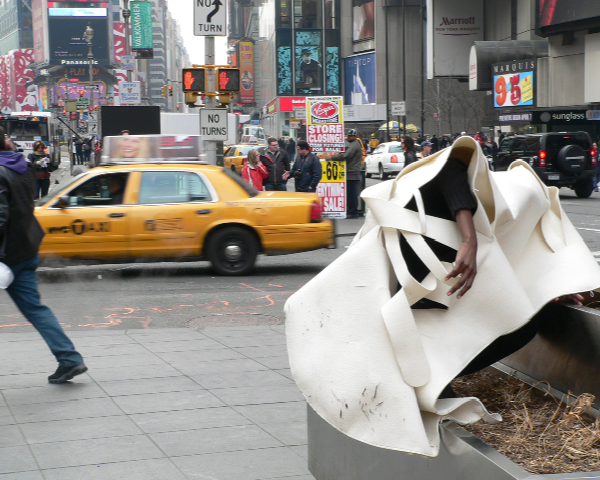
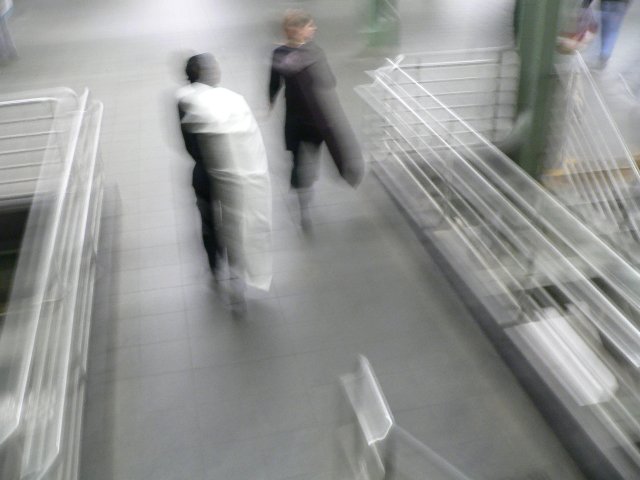
For me my own interaction with the structures is basically the process of the "Making". During the three months that I worked on the Public Receptors, I continuously documented the design and production process, using different techniques, my camera, camcorder, computer and sketchbooks. For the exhibition at Van Alen Institute it was very important not to show only the textile structures and "final" images. In the whole exhibition you can find traces of the process, to be shown as films on small screens (e.g. the sewing process as short film or me interacting with the objects while figuring out the best strategic way to fold them) or in the little booklets that are distributed in the gallery space on specific locations. The two sketchbooks that you find in the gallery space as well, document my whole thinking process from the last one year, which now manifested itself in the production of the objects themselves.
Are you planning on continuing working with felt? Are there any other textiles that interest you?
I think that felt will definitely continue to play and essential role in my future work. On the other hand I am very curious to explore other materials as well, such as other textiles but also completely different materials. How for instance could I create a transformable object out of a rather static material? I am on a continuous search for new possibilities and am curious about different materialities in general.
The relationship between designing and making requires a certain body of knowledge that resides in the space and time of the working process. Spatial techniques and their established relations may be based upon a beautiful way of ordering elements by defining an open, but clearly defined, system that is able to transform. At the same time the system´s behavior is very much related to its constituent elements, their materiality and their spatial organization. It is fascinating that even flexible elements have the potential to collectively rigidify, when brought together in a certain geometrical order and hierarchy - to be found, for instance, in spatial formations of textile techniques. Open spatial systems that are generated physically and on a material level, hold a great potential to explore unexpected links between those relations. Those tectonic structures possess the ability to adapt, are open for appropriation, and at the same time interact with the environment and enable a constant change of bodies and spaces. This design model stands against a loss of the living body and its senses in the design process and looks beyond humanist practices to consider the body as fixed and static. The rebirth of the tactile, the transformative potential of space and matter determine that action and perception become one.
Photographs courtesy of Gabi Schillig
Interview by Sarah Scaturro





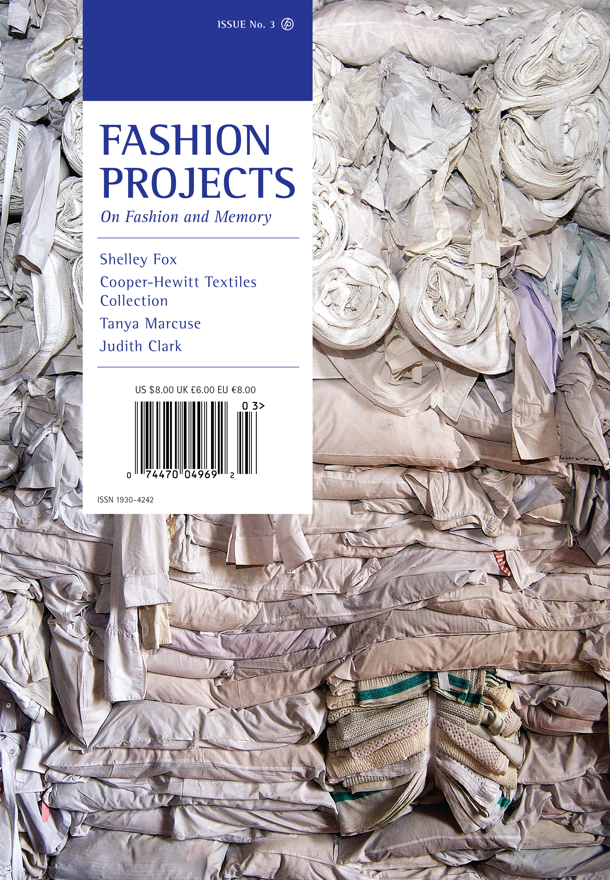


Fashion Projects #5 is devoted to fashion curation, examining the meteoritic rise in relevance of fashion exhibitions.
It features interviews with an eclectic assortment of leading practitioners from different corners of the world. The issue includes long Q&As with Harold Koda, the longtime, recently retired curator of the Met’s Costume Institute, as well as the Museum at FIT’s veteran leader Valerie Steele. It also features interviews with curators in Antwerp (the ModeMuseum’s Kaat Debo), Toronto (Royal Ontario Museum’s Alexandra Palmer) and Venice (Maria Luisa Frisa); academics studying the field (Hazel Clark, Annamari Vänskä, and Alistair O’Neill); and, giving an on-the-ground perspective, the Met’s head conservator, Sarah Scaturro. The issue’s cover stars Greer Lankton’s sculptural representation of legendary Vogue editor and Costume Institute doyenne Diana Vreeland, who continues to loom over the field years after her death.
Table of Contents
Introduction
Showmanship and History: An Interview with Harold Koda by Francesca Granata
Woman of Steele: An Interview with Valerie Steele by Lisa Santandrea
Exploring Fashion’s Openness: An Interview with Kaat Debo by Alex Esculapio
London, After a Fashion Curator: An Interview with Alistair O’Neill by Alexis Romano
Curation and Conservation: An Interview with Sarah Scaturro by Mae Colburn
Reflections on Fashion Curating
An Interview with Hazel Clark and Annamari Vänskä
Fashion in the Vast Museum: An Interview with Alexandra Palmer by Ingrid Mida
Restless Curating: An Interview with Maria Luisa Frisa by Marco Pecorari