Upcoming Fashion Events (and Corrections)

34172-large.jpg

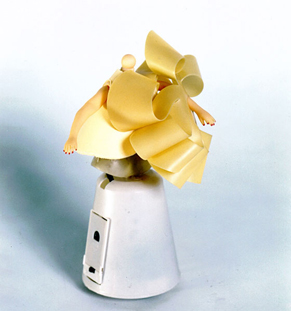
As Four, Puppencouture, 2000 (from New York Fashion Now)

The Spring always brings with it a frenzy of activities in the city. Here are some fashion-related events coming up which we think might be of interest:

The Williamsburg Fashion Show is taking place May 4 through May 6, and features an evening organized by art/fashion boutiques Sodafine and Treehouse. Titled Cherry Blossom Circus and taking place on Friday May 4th around 8pm at Secret Project Robot (10 Kent Ave. at Metropolitan Ave), it includes performances by Feral Childe and a number of other Brooklyn-based designers.

NYU’s Interactive Telecommunications Program is also staging their end of the year show on May 8 and 9 (5-9pm). Though it’s not specifically a fashion event, it will include an array of projects dealing with the interaction between garments and technology. Under the stewardship of Despina Papadopoulos, who teaches at ITP, the New York community of people experimenting at the brink between fashion and technology seem, in fact, to be in expansion.

Last but not least, there will be an author event at on May 8 (at the Barnes & Noble Bookstore at 227 West 27th Street from 5 to 6:30pm) with Sonnet Stanfill for the catalogue she wrote concomitantly with the exhibit she recently curated at the V&A in London. Currently on view and titled New York Fashion Now, the exhibit and its accompanying catalogue cover the various strands of emerging New York designers. (Among the featured designers is Fashion Projects favorite Mary Ping, along with Three As Four, Cloak, and a great number of others.)

Museums, Art, Fashion and Commerce

yamamotostairs.jpg

MoMu Museum, Antwerp

With a slew of fashion exhibits being staged across the United States and often outside the boundaries of traditional costume and fashion museums (the Museum of Fine Arts, Boston; The Meadows Museum in Dallas; the Museum of Contemporary Art in Los Angeles) discussions about the relevance and appropriateness of fashion within the museum come up once again. Virginia Postrel has written an interesting article on the topic in this month’s Atlantic Monthly. Titled “Dress Sense,” the article debates why fashion stirs up such strong reactions both positive and negative, once it’s placed in the museum. Postrel argues that the uneasiness surrounding fashion and museums is ultimately an uneasiness about markets. She also points out how recurrent discussions of fashion’s appropriateness in museums (particularly art museums) end up preventing more interesting and critical discussions on the validity of the exhibits themselves. A similar point was also made by Christopher Breward in an article on the British staging of the controversial Armani exhibit (Guardian 2003), in which the British scholar also notes how criticism often arose primarily from the strong associations between fashion and commerce. This association remains perhaps most problematic within the art museum, where the relation between art, commerce and the museum however strong and well-established tends to be, if not hidden, at least de-emphasized. Thus, the embattled relation between fashion and the museums (particularly of the art variety) could be partially attributed to the fact that by entering the art museum, fashion ("tainted" by the commercial) functions as a mirror of sorts, and “unveils” the preexisting ties between museums, markets and commerce.

Francesca Granata

Fashioning an Ethical Industry Conference

logo.gif

This post is long in the making. In March, I attended the Fashioning an Ethical Industry Conference at the Zandra Rhodes Museum, in London. Organized by Labour Behind the Label the conference focused on different ways to achieve an ethical fashion industry and featured a range of speakers, from Ineke Zeldenrust (one of the founders of the Clean Clothes Campaign) to Trish Clarke (who works on corporate social responsibility at Topman) to Kate Fletcher (a freelance sustainable consultant and promoter of slow fashion). Interviews with a number of the speakers can now be found on the conference site.

Concomitantly with the conference was an installation by the Amsterdam-based artist Siobhan Wall titled the Clothes She Wears. It consisted of eight outfits, which constituted the clothes worn by eight different woman working in the garment district in different countries. Each outfit was accompanied by a tag describing the women's relation to the outfits, as well as with the garment industry. Partially founded by the Clean Clothes Campaign, the installation was subtle and moving. (You can find a small catalogue of the exhibit on the Clean Clothes Campaign website.)

Francesca

Martin Munkacsi and Action Fashion

munkacsistrandlaeuf.jpg

Lucile Brokaw on Long Island Beach, 1933. By Martin Munkacsi.

Without Martin Munkacsi, fashion photography could have been a boring medium. In the 1920s and 30s, Munkacsi's dynamic shooting style caught the increasing speed and vitality of modern life. His photographs were integral to the development of action photography, and gave fashion its first glimpse at photographs that showed the synergy between clothing, body, and motion.

In the early 1930s, he began shooting for Harper's Bazaar, the results of which are now on display at the International Center of Photography in NYC. The exhibition "Martin Munkacsi: Think While You Shoot" is up until April 29th. A comprehensive grouping of his work, we see his optimism and joy at the modern age gradually sink into darker, probing images that, by the 1940s, question humankind. Also on display are two other exhibitions for the fashion scholar - Henri Cartier-Bresson's scrapbook and Louise Brooks and the "New Woman" in Weimar cinema.

ICP Museum Gallery
1133 Avenue of the Americas at 43rd St.
New York, NY 10036
www.icp.org

Sarah Scaturro

A Walk in the Wardrobe

422892145_6a3ba5f6c4.jpg

Photo from Poireton

"A Walk in the Wardrobe" is a suggestive exhibit recently organized by the MA in Fashion Curation at the London College of Fashion. (The group that put it together goes by the name Glasscasecuration.) The exhibit, which was unfortunately up for only a week, at the Ada Street gallery, explored the intimate relationship between fashion and memory. Trying to go beyond the visual, it set out to trigger lost and forgotten memories through the sense of sound and smell. A soundscape comprised of muffled noises—of what seemed to be people walking and rummaging through closets—was paired with bygone scents (the smell of moth and lilac) reminiscent of one’s grandmother’s wardrobe. The exhibit is comprised of two rooms: One is dedicated to the "masculine" wardrobe, with walls lined by black top hats. The other is dedicated to the "feminine" one, featuring a number of white dresses from different eras hung from the ceiling through a system of fishing wires. The color of the dresses, combined with the eerie and ghostly quality that empty clothes evoke, seem to perfectly illustrate Peter Stallybrass’s perceptive assessment that: "There is, indeed, a close connection between the magic of lost clothes and the fact that ghosts often step out of closets and wardrobes to appall us, haunt us, perhaps even console us."

Francesca