Fashion Shows

Still from a 1920s fashion reel (from British Pathé archives)

This season (hopefully with Sarah’s help) I’ll try to review some experimental fashion shows and sustainable ones taking place in New York, since we both live here. The fact that (alas) a relatively small number of New York shows fall into those categories makes the task relatively more manageable, although I am sure we’ll cover a very partial list, due to time constraints….

I should add the disclaimer that personally I am not a huge fan of the fashion show format. They often read as a highly non-participatory and slightly alienating spectacles. My boyfriend, who sometimes comes with me to the shows, had the interesting comment that they seem like extremely cheap weddings, where all you get is the ceremony. It’s interesting to note that in the Paris couture salons, where the format of today’s shows originated, the presentation would last significantly longer and would be repeated several times per season for various groups of clients. For an excellent article on the history of the fashion show and its relation to modernity, see Caroline Evans, “Multiple, Movement, Mode, Model” in the anthology she co-edited with Christopher Breward Fashion and Modernity, while for highly entertaining footage of 1910 and 1920s fashion reels (which include some early fashion shows) you can visit the British Pathé archives.

Francesca

Old, New, Borrowed, Blue

“Old, New, Borrowed, Blue: Yesterday's Modern Bride" is an exhibit curated by Elyce Tetorka, in occasion of The Manhattan Vintage Clothing Show, which will take place at the Metropolitan Pavillion on February 8 and 9th. The exhibition shows how wedding dresses followed the current styles of the time. The examples included span from the 1900 when art nouveau was the leading design aesthetic to a late1970s mini-maxi gown. One of the exhibition’s highlights, is a 1920s bias-cut short gown inspired by Chanel and Vionnet. For more information, visit the show’s site.

Fragments: Photographs by Alex Salinas

Fragments, an exhibition of the work of Belgian photographer Alex Salinas, just opened at the Soho Grand gallery, where it will be on view through April 30. I first encountered Salinas' work in the 2006 issue of +1 Magazine, which included a series he staged at Saint Augustinus Hospital. The images combined orthopedic casts and other medical gear with corsets, implants, and intricate jewelry in ways which seemed to comment on the prosthetic body and alternative standards of beauty.

Francesca

Interview with Kaat Debo; "Bernhard Willhelm: Het Totaal Rappel"

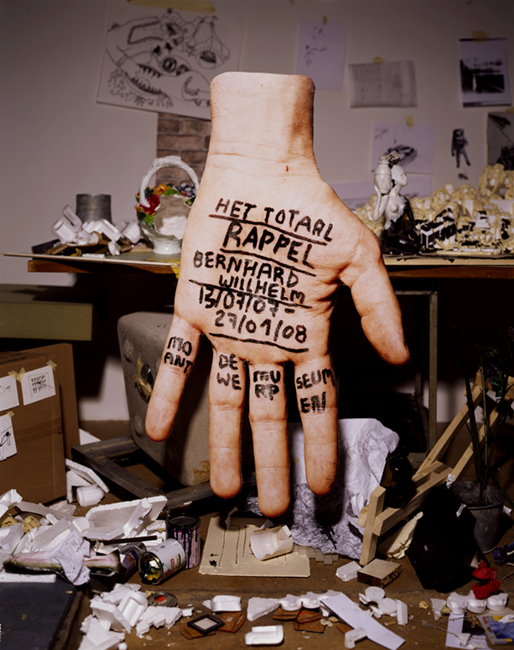
The Mode Museum in Antwerp recently presented a comprehensive retrospective of the work of the German, Belgian-trained designer Bernhard Willhelm. Titled "Bernhard Willhelm: Het Totaal Rappel" (Total Recall), it marked the designer’s donation of his entire archives to the museum.

Following MoMu’s common practice of enlisting the designers themselves as curators, the exhibition articulates Willhelm’s aesthetics across its scenography, which was completed by the Swiss artists Taiyo Onorato and Nico Krebs. Curated by Willhelm in collaboration with the museum’s artistic director Kaat Debo, the exhibition presented his various collections separately. Each collection was staged in an environment which Onorato and Krebs built specifically for the exhibition, starting with the visuals contained in the respective lookbooks. Via its elaborate installation, Het Totaal Rappel underlined the collaborative spirit inherent in Willhelm’s approach (and in the creation of a designer house and its style more generally) by featuring works by artists who are the designer’s long standing collaborators alongside Willhelm’s own.

Upon visiting the museum this past month, I was given an informal yet very informative tour of the exhibition by MoMu’s artistic director Kaat Debo. What follows is an abbreviated and illustrated transcript of the tour. If you miss the exhibition, the extensively illustrated catalogue can be found (in North America) at Ooga Booga.

KD: The way Taiyo and Nico work with the scenography is an extension of their own work. For the installation they worked a lot with throw-away materials, left-over materials. That’s probably one of the reasons he [Bernard Willhelm] invited them, because their work has lots of similarity with his work. Bernhard is also very interested in trash and throw away materials…

KD: We presented each collection in separate installations. We didn’t mix collections. We tried to keep the collections together. For most of the installation, Taiyo and Nico started with the idea of the look book. For this collection [Spring/Summer 2003] the lookbook conveys the idea of building houses and of constructing weird houses with left-over materials. For the exhibition, they created a sort of old attic…

FP: It also looks like a shanty-town.

KD: It’s also interesting how in his earliest collections there were a lot of nature or flower motives. Nature was really inspiring to him. When he was a child, he was very interested in biology and chemistry.

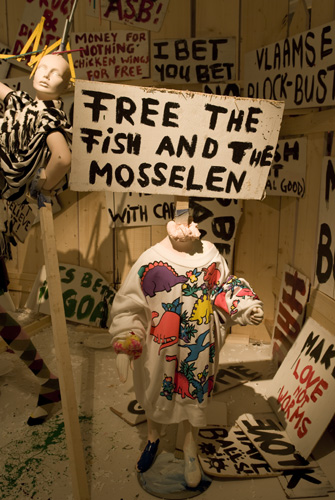
Protest Room, Autumn/Winter 2002/2003, All Photos: Ronald Stoops, courtesy of MoMu

KD: And for this one [an installation identified as Protest Room, where Willhelm’s Spring/Summer 2003 collection is housed] Taiyo and Nico created hybrid figures: this mannequin has four legs and that one two upper bodies and four legs and arms. [They are holding placards with misspelled sentences and literally translated proverbs.] All of our staff was free to paint slogans and everybody was painting and it was an interactive experience.

KD: Here we had the toy train [going through the mountain-like structure]. It had a camera at its front and it made a recording of what it saw, but it’s not working at the moment. Girl with Mobile Phone Collection, Autumn/Winter 2006/2007

Inside the cave-like structures various collections were shown. The walls were covered with toy animals. The toy animals were placed in explicit sexual positions

FP: I love the lewd toy animals!

KD: And then there are the writings like in public toilets [which Bernhard asked the staff to write]. We are now in the “Girl with Mobile Phone Collection” (Fall/Winter 2006). This collection was inspired by Shibuya—a shopping neighborhood in Tokyo, where girls are dressed in extreme style. One of the trends that were popular at the time this collection was conceived was the “ganguro” girls. [“Artificially sun-tanned with pale lipstick, brightly coloured eye shadow and sporting a cellular phone.”]

Tiger Collection, Autumn/Winter 2005/2006

KD: And here you see a cardboard mountain that Taiyo and Nico made for one of his [Willhelm’s] collections.

FP: So they did work with Willhelm before. It’s great how he often collaborates with artists in his work.

KD Yes, I also think he collaborates with them in interesting ways. They try to find similarities between his work and their work and then they make something new.

KD: This is Bernhard himself. Pointing to a print from his Tiger Collection (Fall Winter 2005) depicting a photograph of a 19th century wall clock with the designer himself as a small decorative figure in black makeup and with a skirt of golden banana leaves.

FP: He is in black face…The prints seem a revisitation of colonial motives.

KD: Yes, but Bernhard also often disguises himself. Here he is supposed to be a black chief. In another collection he dressed as a 1970s porn-star. There is one picture where he is dressed like a Tyrolean guy…

KD: This print is also nice. It is a picture of all the people who worked with Bernhard at the time, all of his all staff, and they made a print of it, using the African tradition of the wet print…

Often what he does is not really explicitly political. For instance, in this next collection [Spring/Summer 2006, titled “I Am the One and Only Dominator”] there is a stars and stripes motif. Yet Bernhard would never in an interview say anything anti-American. When I asked him about it, he said: “Well everybody looks good in stars and stripes.” I like the way he is never explicit in his statement…

This [referring to the display of the Spring/Summer 2006 collection] was one of his first ideas. “I want these seventies mannequin guys with their pants down,” he asked.

FP: He was on the first cover of Butt, wasn’t he?

KD: And the model in the photos at the end of the exhibition is a very famous French porn star François Sagat.

Tirolean Room, Spring/Summer 2007

KD: This is the Tyrolean collection. Hingeborg [Harms] wrote about the construction of this collection in her essay for the catalogue. If you see the pattern of these kinds of dresses they are following traditional pattern making traditions.

This instead is an installation, that Taiyo and Nico had done prior to the exhibition. The sound is Yodel music. The artists are from Switzerland and Bernhard is German. Yodeling is a tradition against evil spirit. They [the Yodelers] go in little groups from farm to farm. This installation is also made primarily of recycled material.

Here instead is an installation by Carmen and Elle [Carmen Freudenthal and Elle Verhagen]. They are responsible for most of Bernhard’s lookbooks.

Trashed Room, Autumn/Winter 2004/2005 “The collection is presented in an installation of a teenager’s bedroom which has been completely destroyed by three girls. A video recording of the trashing session is included in the presentation.”

KD: We had the video two days before the opening and the girls had chain-saws and I was so scared they would hurt themselves. Bernhard wanted two girls with a punk gothic look. So, we asked one of the girls who worked here and has that kind of look to come and be in the film, and she recruited another girl.

Collection inspired by traditional attire of the black forest, Autumn/Winter 1999/2000

This is the very first collection. The hats are based on traditional hats and the blouses are very tailored. Sometimes people don’t really realize it, but his clothes are always well made and his patterns are really very thought-through, but you don’t often see it. You notice it when you wear it. Whenever we dressed a mannequin, it always worked very well. The blouse has a little monkey in the color of the coat. Bernhard’s label is the hand of a monkey. He had a toy monkey when he was little, so he uses the hand of the monkey for each collection. Also supposedly he is referring to the name of the city. There is a myth that the name Antwerpen comes from Ant Werpen throw-a-hand, because in the Middle Ages, Antwerp was threatened by a giant who didn’t allow the ships to come through. There was a hero who cut out the hand of the giant and threw it in the river, so Antwerp was saved from the giant, and thus the name.

This is the custom he made for Bjork for her new album cover. He made the wardrobe for her tour and also for her brass bands.

This is the superman collection (or superwomen rather). That mannequin has a neoprene skirt with a diamond motives on it and it’s displayed flying hung from the ceiling. It was really hard to install, but this way you understand his world better.

This other collection was inspired by cocaine, amphetamine, and black style. In the look book there is a cocaine dealer. In the Olaf Breuning video [which he made for the Spring/Summer 2004 collection] he also used some drug references. Some people were quite shocked by it. Francesca Granata

Ghosts, Spring/Summer 2004 (Staircase to the exhibition)

Rock Style in the Eighties

Upcoming at Parsons on January 30th is a lecture by Paper editor Steven Blush on 1980s Rock Style. Part of the “Form Follows Fashion” series curated by Jessica Glasscock, the lecture seems to take an American perspective on 1980s rock style, focusing on hardcore and heavy metal as opposed to the more British Glam. The lecture is free and open to public and will take place at Parsons Midtown Auditorium, Parsons Fashion, on 560 Seventh Avenue, from 6 to 8pm. Following is the event’s press release

In the 1980s, the contemporary music genres of hardcore and heavy metal each exerted considerable influence over popular graphic design, product design, and fashion. The varying philosophies of each genre engendered wholly differing aesthetics. Hardcore music was characterized by a DIY style: roughly collaged, hand-lettered posters copied at the local Kinko’s, homemade record packaging glued together in basements, and ripped and distressed t-shirts markered with professions of allegiance to a favorite band. Heavy metal was an unapologetically corporate enterprise and the culmination of two decades of rock-and-roll fantasies transformed into mass-marketed signifiers of rebellion: slickly produced logos created by professional graphic designers, success-minded musicians willingly made over as glam gods by Hollywood make-up artists, and multicolored silk-screened t-shirt available for a considerable price at stadium concerts. Somehow in the early 2000s, both styles have beaten a path to the malls of America.

Guest speaker Steven Blush will examine the creation, distribution and overall influence of hardcore and heavy metal in the 1980s and in the present. Blush has been a participant and historian of punk and rock since the early 1980s, when he promoted hardcore shows in Washington, D,C. He is the author of American Hardcore: A Tribal History and American Hair Metal, a senior editor at Paper magazine, and a rock DJ in New York City.