Edward Steichen In High Fashion

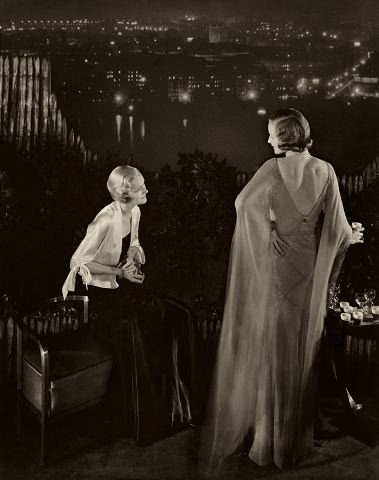
Models Claire Coulter and Avis Newcomb wearing dresses by Lanvin and Chanel at 1200 Fifth Avenue, 1931.

Don’t miss the recently published book Edward Steichen In High Fashion: The Condé Nast Years, 1923-1937, which discusses and re-publishes Steichen’s fashion photography and celebrity portraits. The images—all from the Condé Nast archives—were originally published in Vanity Fair and Vogue, and illustrate Steichen’s contribution to the burgeoning field of fashion photography and celebrity portraiture. That these two fields did not sit in high regard within the fine arts and photography realms with which Steichen had been previously associated, made his choice controversial and, to some extent, unusual. However, as Tobia Bezzola—one of the book’s authors—explains, his previous work as a painter and a fine art photographer clearly informed his “commercial” work—particularly in his rendition of clothing, as well as his choice of poses for his subjects.

The lavishly illustrated book, published by W.W. Norton, developed as a result of research that curators William A. Ewing and Todd Brandow completed in the Condé Nast Archives for the exhibition “Edward Steichen: Lives in Photography.Steichen in High Fashion undoubtedly benefits from their extensive knowledge of the photographer’s work, which allowed them to fully contextualize this aspect of Steichen’s output within the rest of his career.

Spanning a period of 15 years, it is interesting to notice how the early prints from the 1920s--featuring theater actors alongside fashion models and silent film actors--are more painterly in their softer lights and greater gradation of grays in comparison to his later works, which feature a more stark contrast of black and whites and geometric shapes. (One of the book’s authors, Carol Squiers, describes this as Steichen’s “evolution from pictorialism to modernism.”)
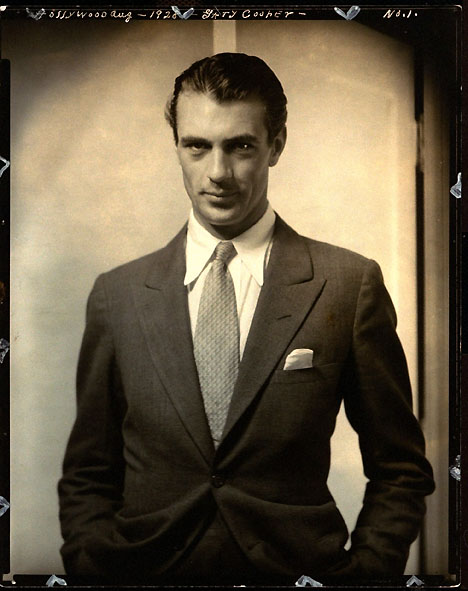
Gary Cooper, 1930

Among the most iconic portraits included are those of actress Gloria Swanson and Pola Negri, and, later, Greta Garbo and Anna May Wong alongside those of dancers as Martha Graham, as well as Winston Churchill and Walt Disney.

An accompanying exhibition on Steichen’s photographic work is currently on view at the Kunstmuseum, Wolfsburg through January 1st, 2009, and will be traveling to the International Center for Photography in New York on January 16, 2009. (For a full exhibition schedule, please visit the Foundation for the Exhibition of Photography.)

Francesca

Fashion For Action

Don't miss Housing Works' yearly benefit and sample sale. A venerable nonprofit organization—known for their pioneering work on behalf of the HIV-positive—is hosting their annual benefit at the Rubin Museum on Thursday November 13th. (The entry fee starts at $100—a relatively affordable benefit ticket!).

The organization is also known for its keen fashion sense as shown by the intriguing window display in their thrift stores across the city and their incredibly knowledgeable volunteer force, many of whom sport impressive fashion industry and editorial credentials. So make sure not to miss the sample sale on Friday November 14th at their Chelsea store location, which will feature designs by Philip Lim, Paul Smith, Yves Sain Laurent, Marc Jacobs and many others.

Sarah Palin: How Post-Feminism turned into Pre-Feminism

Sarah Palin's Red Shoes

Sarah Palin’s much publicized fashion choices and, now, fashion budget make for an interesting argument about how the post-feminist look can be appropriated in ways which are antithetical to what the look was originally meant to portray. If we understand post-feminist fashion as a reappropriation of symbols of femininity—high-heels, form-fitting skirts and colors which have traditionally being coded as feminine—by a “sexually liberated woman,” we can see how the vice presidential hopeful has been sporting some tenants of that look against the grain, as she is campaigning on a platform critical of sexual liberation altogether.

Post-feminism is best exemplified (as media theorist Angela McRobbie has pointed out) by media representation of women, such as Sex and the City and the Bridget Jones’ Diaries. Ultimately, the fact that the Republican nominee is embracing at least some central elements of the look not only goes to show the popularity of such representations, it also stands as evidence that the longstanding criticism of post-feminism as reactionary might, in this case, be accurate.

Francesca

Panel on Gothic: Dark Glamour

Riccardo Tisci for Givenchi, 2006

Don't miss the lecture series at FIT running concomitantly to the Gothic: Dark Glamour exhibition currently on view at the Museum at FIT. Of particular interest is the panel on October 30th, for which a number of participants from various disciplines will discuss the splintering of gothic subcultures into various niche styles.

The list of panelists includes Fred Berger, photographer and creator of Propaganda magazine; Julia Bloodgood Borden, cultural anthropologist; Angel Butts, lecturer and PhD candidate; Myke Hideous, artist and musician; and Evan Michelson, owner of Obscura Antiques and Oddities. It will be moderatered by the exhibition curator Valerie Steele.

For more information on pre-registration visit FIT site.

Martin Margiela Exhibition

A retrospective of Martin Margiela’s work just opened at The ModeMuseum (MoMu) in Antwerp on occasion of the 20-year anniversary of the Maison. Curated by MoMu creative director Kaat Debo in collaboration with Bob Verhelst and the Maison itself, the exhibition captures Margiela’s exacting aesthetic in its design and installation.

As is often the case with MoMu exhibitions, the strength lies in the fact that they go beyond the display of objects and incorporate installation, photography, video and film to fully convey a designer’s aesthetic. This multi-media approach makes the exhibition particularly current and engaging as fashion-as-image occupies an ever-increasing centrality in the world of fashion. (This fact was recently highlighted by Suzy Menkes’s article in The International Herald Tribune, about the proliferation of fashion films.)

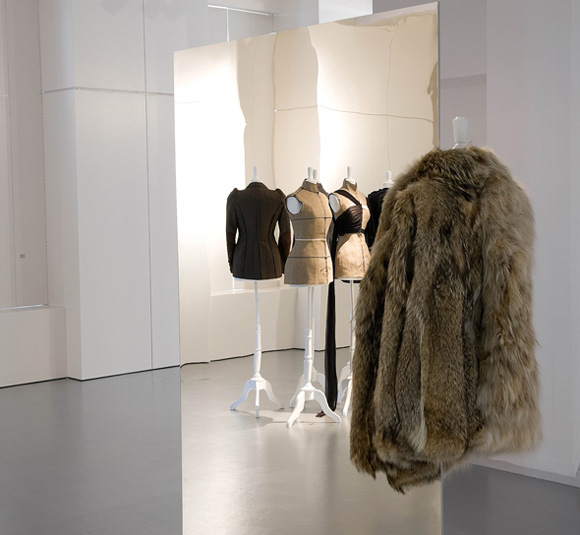
The MoMu exhibition opens with a cardboard cutout representing the employees of the Maison, whose faces, like Margiela’s, remain blank and, as the exhibition text points out, thus remain incognito. It continues with a series of garments from various collections and a number of Margiela’s variation on his signature shoe: the Tabi Shoe (derived from the Japanese tabi socks). The garments and accessories in the first room are covered with a layer of silver and white paint. The abundance of silver is reminiscent of Warhol’s Factory, while the white paint—a staple of Margiela’s aesthetic—cracks alongside the garments creases and register signs of wear. Thus, in one of the first of a series of subversions, the whitewash usually employed as a way to erase aging becomes a reminder of the passage of time.

The white layer covering the garments returns in the exhibition space, which is white-washed with the exception of enlarged photographic prints of the exhibition interior superimposed on some of the walls. This superimposition is meant to remind one of the tromp-l-oeil effects that pervade Margiela’s stores, offices and garments. This technique is most evident in Margiela’s headquarters in rue Saint Maur in Paris, where photographs of their previous offices are superimposed on doors and walls to instill the “new” spaces with the history of the Maison. This complicated relation to time and history is also evident in his clothes which are often pre-aged and combine garments from different periods together with Margiela’s own past work.

Time is, in fact, one of the two main themes of Margiela’s work and it imbues the entire exhibition, but is perhaps most evident in the installation exploring Margiela’s Spring/Summer 1996 collection where he printed photographs of old clothes onto new ones. The photographs and thus the resulting prints had also been artificially aged, acquiring a sepia tone and the out-of-focus look of old black and white prints. This gave a an artificially created nostalgic, melancholic look to the new garments. The simultaneous exploration and denial of nostalgia is common perhaps to the exhibition as a whole, where enigmatic white spaces, muted colors and a lyrical aesthetic is undercut by witty subversions.

This is perhaps most evident in the collection and exhibition sections exploring the themes of the body. For instance, all white and black dress forms illustrating Margiela’s changing vocabulary become reminiscent of a frozen army in their stillness. On the other hand, enlarged collections and collections derived from doll clothes not only question standardized body size, but bring us back to a world of childhood play (the Barbie dolls) and fairy tales (the giants). A number of these clothes are in fact enlarged versions of Barbie’s clothes, which retained all the disproportion of the original. Thus, Margiela’s doll clothes appear doubly ironic, as they unveil the inherent “disproportions” of garments belonging to a model body—that of Barbie—metonymically calling into question the idealized body of the doll. Other collections which he produced at the turn of the millennium instead explore clownish proportions alongside the designer’s more common tropes of inside-out and seemingly unfinished garments.

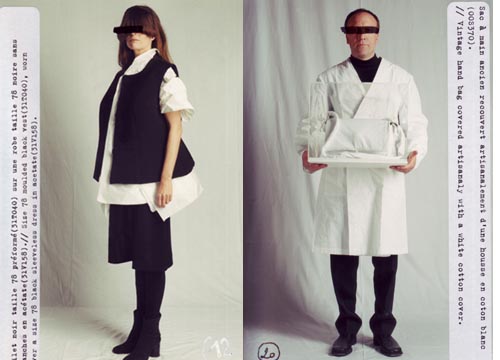
Photo Ronald Stoops. Make-up Inge Grognard

At the end of the exhibition space there is a circular room containing fashion shows alongside fashion films and photographs, which the Maison produced throughout the year (a selection of which can also be bought at the Museum store). This is perhaps the section that most fully explicates the importance of collaboration to the Maison. The way the Margiela aesthetic has developed thanks to an array of photographers (Ronald Stoops, Anders Edström), designers (Bob Verhelst, who was also the exhibition designer), make-up artists (Inge Grognard) and countless others. Most interesting are perhaps the early videos of his work and fashion films, also because they are the least available. A short, grainy super-8 film looks much like an experimental film from the 1970s inspired by early silents and showing women wearing Margiela’s clothes while engaging in simple daily activities. Like many Margiela’s models throughout much of his career (with the exception of his most recent collections), they are often “regular” women—middle-age, young women with their children, or pregnant women. This short makes for a touching film, which encapsulates Margiela’s lyrical tone where a certain quietness and silence is cultivated, and where much remains unsaid or only lightly suggested—a rare strategy in the over-saturated world of image and fashion.

Francesca