Lowbrow Reader Variety Hour at Housing Works Bookstore Cafe

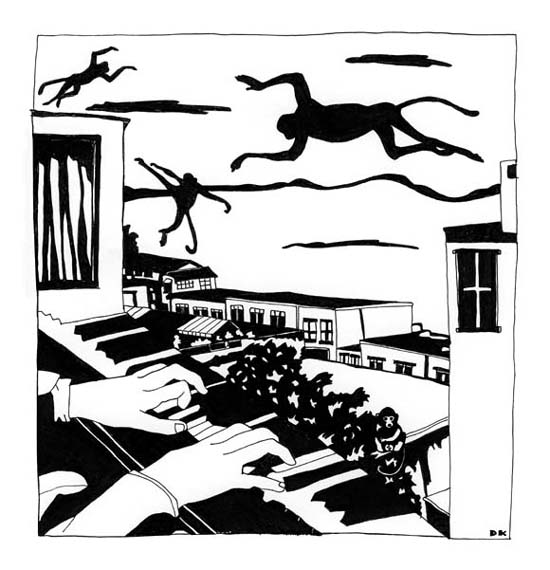
Illustration for Gilbert Rogin's Lowbrow Reader story by Doreen Kirchner

Fashion Projects contributor Jay Ruttenberg is organizing a launch event for the new issue of the Lowbrow Reader, his Manhattan-based comedy journal. The Lowbrow Reader is a small, lushly illustrated comedy magazine edited by Jay Ruttenberg. Its new issue, #7, includes work by Shelley Berman (Curb Your Enthusiasm), David Berman (Silver Jews; no relation) and Sam Henderson (Magic Whistle). Much of the issue is devoted to the novelist Gilbert Rogin, including an assessment of his work by Jay Jennings and the first piece of fiction by Rogin to be published since 1980. It is available online, and in smart stores everywhere.

The event will take place at the Housing Works Bookstore (126 Crosby Street in Soho) on Wednesday July 22nd from 7 to 9 and promises to be an exciting and diverse night. The show will feature short acoustic performances from three great musical acts: The Fiery Furnaces, Peter Stampfel and the Ether Frolic Mob, and Larkin Grimm. There will also be an incredibly funny comedian, John Mulaney, and a reading by Gilbert Rogin, a retired New Yorker writer whose work appears in the new Lowbrow Reader. There is a cover charge of $10 to $5 on a sliding scale, and all of the money raised will go to Housing Works—one of our favourite charities that did pioneering work on AIDS.

For more information on the bands and the event please visit the Housing Works event site.

Update! Below are some photos from the event:

The Fiery Furnace playing at Housing Works as part of the Lowbrow Reader Variety Show. Photo by Jesse Chan-Norris

Larkin Grimm playing at the Lowbrow Reader Variety Hour. Photo by Jesse Chan-Norris

Peter Stampfel and Ether Frolic Mob at Housing Works. Photo by Jesse Chan-Norris

Author Gilbert Rogin reading at Housing Works. Photo by Jesse Chan-Norris

Song Dong's Waste Not at the MoMA

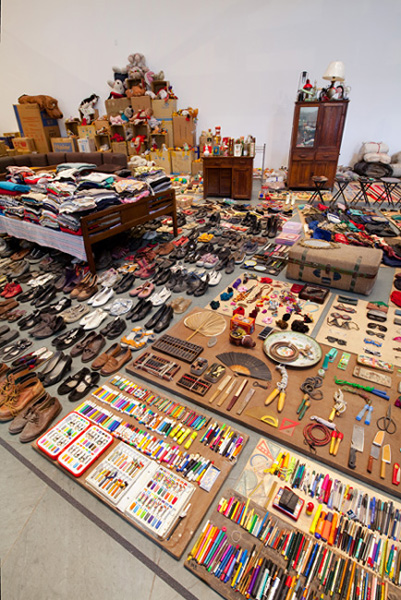
Installation view of Projects 90: Song Dong. The Museum of Modern Art, NY, 2009. Photo: Jason Mandella.

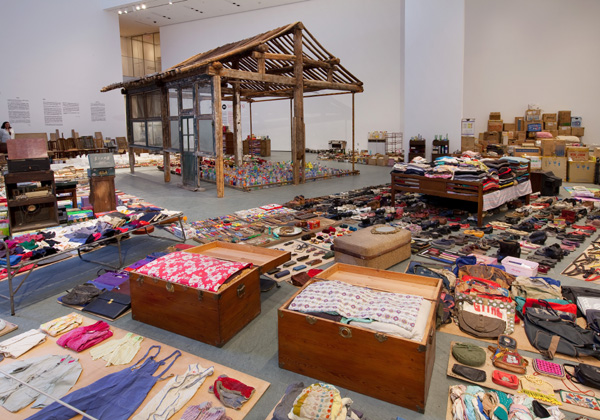
A moving installation titled Waste Notby the Beijing-based conceptual artist Song Dong currently occupies the MoMA's Atrium. Organized by Barbara London and Sarah Suzuki, it consists of the entire belongings of Song Dong's mother spread out across the floor of the atrium—including the frame of her small wooden house. Raised during the cultural revolution and following its wu jin qi yong, or "waste not" dictum, the artist’s mother seems to have thrown very little away during her lifetime—a fact that, while effective within the restrictions and scarcity of the early years of the Cultural Revolution, became problematic as the country entered a period of relative affluence and a greater range of goods became available.

It is touching to observe the scraps of fabric dutifully preserved alongside little bits of thread and heavily used shoes of her now-adult children. Alongside the wall of the exhibition, Song Dong’s mother’s writings make for a poignant description of the process of doing the laundry in 1950s Beijing, where soap was rationed—a fact that led her to save soap bars throughout the years. “Some of the soap [that is included in the exhibition] is older than Song Dong,” she declared.

The careful preservation of what to most Westerners and a later generation of Chinese would appear as junk brilliantly exemplify what amounts to a completely different relation to the material world—one where every single object shows the signs of heavy wear and is saved no matter its value.

Update: Holland Cotter just wrote a beautiful review of the piece in the New York Times, which I strongly recommend!

Francesca

Installation view of Projects 90: Song Dong. The Museum of Modern Art, NY, 2009. Photo: Jason Mandella.

Mono Kultur on Dries Van Noten

Mono Kultur no. 20. Cover Image by Kai von Rabenau.

I recently found an interesting and imaginative publication while visiting the X Initiative "No Soul for Sale: A Festival of Independents", that took place at what used to be Chelsea's Dia Art Foundation. Appropriately titled Mono Kultur, it consists of a single interview with an art or design practioner. The publication is based in Berlin and its most recent issue features a long and engaging interview with the Belgian designer Dries Van Noten accompanied by images of his work by Kai von Rabenau. Past issues have featured interviews with Miranda July, David LaChapelle, Maurizio Cattelan, Massimilano Gioni and a number of others.

Francesca

Fashions: Business Practices in Historical Perspective

A Lucien Lelong coat on the cover of the August 1925 issue of Tres Parisian, located in the Special Collections department of the Gladys Marcus Library at FIT. Photo by Sarah Scaturro.

The recent Business History Conference in Milan, Italy had a robust program featuring a large number of important fashion scholars. Thematically, the conference centered around the role of business in fashion, as well as the "fashions" that occur in business practices. At first it seemed a somewhat disjointed group of participants (it was easy to distinguish the fashion historians from the business historians due to their, er, more fashionable dress), but soon after the conference began, everyone could sense a unique cross-pollination beginning.

The Fashion Institute of Technology had a strong contingent present, as they were also sponsoring some of the conference events. Significantly, Karen Cannell, the new Head of Special Collections at FIT's library, was actively encouraging scholars to use this amazing resource, which contains not only historical fashion periodicals and sketches, but also important documentation regarding the business end of the garment industry. Operating at minimal capacity with restricted access over the past few years, many fashion scholars are relieved that this important asset is once again accepting research appointments.

One session with a strong New York and FIT affiliation was titled "Innovation in the Business of Fashion, 1900-1940". FIT Professor Lourdes Font started off the thematically unified session by tracing the beginnings of a globalized fashion industry with a paper titled "International Couture: Expansion and Promotion in the Early Twentieth Century." Lewis Orchard and FIT alum Rebecca Jumper Matheson followed up with papers on the topics of merchandising and the self-promotion of female designers, respectively. Associate Curator at the Museum at FIT, Molly Sorkin ended the session with her paper titled "The Limits of Expansion: Contraction and Collapse in the Haute Couture, 1920-1940," which effectively placed the end of the first real "globalization" period of fashion at the beginning of World War II.

Another extremely strong session was "From Vionnet to Dior: Strategies of Exclusivity and Dissemination of Paris Haute Couture." Featuring influential fashion historians and scholars such as Caroline Evans, Alexandra Palmer, and Dilys Blum, this session also had a thematic undercurrent about the rise of a globalized fashion industry. Véronique Pouillard started off the session with an interesting paper tracing the problems of copyrighting French fashion designs in the USA, an issue which is still very much a problem today. Alexandra Palmer, Senior Curator at the Royal Ontario Museum, followed up with her paper on the importance of Christian Dior's global reach, which was a tantalizing peek at just one aspect of her forthcoming book, Dior. The session ended with Caroline Evans' research on Jean Patou's "Américainisme," which was an entertaining view of how Patou embraced American rationalization and the American "look" to market his designs and grow his business. The influence of emerging American fashion business practices on the French couture industry was also explored in my paper on the French couturier Lucien Lelong that I presented during the "Entrepreneurs and Fashion" session.

Other engaging papers included Rebecca Arnold's on The Fashion Group in 1930s New York City and Phyllis Dillon's thorough explanation of the influence of German Jews on the American apparel industry. Naturally, there was a session on the ethics of fashion, which was to include papers on the toxicity of beauty products and the sustainably-minded brand Comme-il-Faut. Unfortunately, neither of these presenters showed up. However, Efrat Tseëlon's paper "In Search of the "Ethics" of Ethical Fashion" provocatively challenged the current notion of what constitutes sustainable and ethical fashion. She contends that today's version of ecofashion effectively fetishes and oversimplifies certain issues (such as the use of organic cotton), thus merely reinforcing the current fashion paradigm. She suggests holistic and inclusive investigations into the meaning of what constitutes ethical (such as issues of toxicity in products and the skinniness of models), as well as actively searching for a new fashion paradigm that could challenge the current one based on consumption.

This engaging conference demonstrated that fashion studies could definitely use more of business history thinking - one of the leading scholars out there combining these two areas is Regina Blaszczyk, who just happened to be the co-chair of the conference. I hope that more professional history associations begin to seriously consider fashion as an important theme, as the interdisciplinary nature of fashion studies lends itself to many fruitful collaborations.

Sarah Scaturro

Centre for Fashion, the Body and Material Cultures

From poster for Caroline Evans' talk at FBMC

I recently attended a lecture presented by the Research Centre for Fashion, the Body and Material Cultures, in London . Unique in its kind, the center opened in 2005 as a joint project between Central Saint Martins and the London College of Fashion (both members of the University of the Arts London). It covers under its umbrella theorists, historians and practioners which, as the title suggests, are interested in a broader view of fashion, clothes and their interactions with the body. Among its members are dance historians (director Helen Thomas), curators (Amy de La Hay and Judith Clark), as well as a number of practioners, including fashion designer Shelley Fox and artist Lucy Orta. (Full disclosure: I am currently a member as well, as I am completing my PhD at Central Saint Martins.)

Caroline Evans kicked off the summer lecture series—organized by one of the center’s directors, Alistair O’Neil—with a talk on her current research on the early history of the fashion show and the way it related to other quintessential modern cultural forms like early cinema and highly choreographed revues such as the Ziegfeld Follies. Her talk was titled “Mirrors, Magic and Multiplication: Early Twentieth Century Fashion Shows.” To follow will be Pamela Church-Gibson’s talk on “Fashion and Celebrity.” The center also organizes a yearly symposium, which this year revolved around the topic of “Magic and Fashion.”

Francesca