Conference Review: Finding Our fashion Footing

by Marco Pecorari

What is the Future of Fashion studies? If one year ago affirmed fashion scholars met in Warwick to find an answer (McNeil 2010), “Finding Our Fashion Footing” was the occasion for Phd students to discuss their research future as a possible answer to such challenging question.

Organized the last 19th March by the research students at London College of Fashion and the Center for Fashion Studies – Stockholm University, this first International Fashion Phd workshop was hosted by LCF. The presentation of each project was the occasion to discuss, problematize and individualize personal experiences, methodological issues and future research connections. As the title of the meeting suggests, it was also an opportunity for placing each individual work in a global geography of Fashion research.

The one-day meeting started with a session on Style and Youth Culture that saw the presentation of "The Indie Project: style and youth culture in London" by Rachel Lifter. Her research cuts across three diverse trajectories: the London fashion environment, theoretical style's approaches and contemporary youth culture. Despite the diverse disciplinarian affiliation, Lifter's use of Foucault's discourse is shared by Pecorari's Phd that aims to argument an archeology of the fashion discursive formation on contemporary ephemera through three different but generative dimensions of such discourse: academia, museum and designers.

Dries Van Noten, Press Release, Autumn/Winter 1999/2000 (pertaining to the PhD Research of Marco Pecorari)

In the same section, Promoting Designer Identity, Maria Sacchetti presented her analysis of the minimal aesthetic through a case study of the flagship store of Helmut Lang, showing how the retail space embodied in tandem the principles of the architect and the fashion designer’s aesthetic. Presentations proceeded with a section dedicated to Swedish Fashion History. Hanne Eide introduced the case of Augusta Lundin problematizing the Swedish translation of French fashion couture in the first part of the last century. In the same section Ulrika Berglund questioned how haute couture was interpreted within a social democratic country as Sweden (1930-1960), investigating the formation of a Swedish national identity far before the advent of the mass-market.

In the afternoon the section dedicated to Contemporary Fashion Media and Trends was opened by Jessica Conrah's "MTV- Fashion, Technology and Music Videos: The 1980s through a Critical and Phenomenological Approach." Conrah presented the case of MTV, reading it as a an important visual medium for fashion, style and image creation as well as a distribution site for advertising and consumer goods. Successively Ane Lynge Jorlén discussed her research on Contemporary Fashion Niche Magazine, such as Self Service, Ten, A Magazine.... Illustrating the production and consumption of such fundamental independent media, Lynge Jorlén addressed a fundamental fashion phenomenon that academic studies have neglected until now. The last presentation of this section was Chitra Buckley's "In-season Fashion Trend Information: implications for decision-making in own brand fashion retailers operating in the UK." Buckley examined the interaction in retail buying teams, during the processes of analyzing fashion change and developing clothing collections in the fast-moving, high street context.

The last session was dedicated to Gender Ambiguity and hosted the paper by Geraldine Biddle-Perry and Philip Walkander. Biddle-Perry presented the development and adoption of new forms of outdoor recreational leisure clothing in the aftermath of the First World War. Warkander examines his research, "Looking Queer," that concerns materiality, queer theory, issues of agency and power regulations. Working with 'queer' informants, Warkander aims to study aesthetics created in opposition with normative expectations, analyzing how looks and styles are produced, maintained, questioned or supported.

A final and fertile discussion pointed out a common will for fashion fashion research to move beyond those approaches that inevitable forced fashion within pre-fixed theoretical cages, claiming for an academic recognition but, too often, mortifying the phenomenon. The perspectives seem to change: from a pre-existing theory applied to fashion to a theory of fashion. However we must remember that this change has been initiated by fashion scholars' works which have opened academics doors to a discussion on fashion and on a theory of fashion. These fundamental interventions formed Phd students' disciplinarian awareness in recognizing their selves as Fashion Phds rather than sociologists, art historians, anthropologists... Despite this strong affiliation, a mutual difficulty emerged in defining fashion as a discipline or a field of research, testifying a common need for a terminological clarity reachable through the discussion of the past, present and future of study fashion. “Finding Our Fashion Footing” was an important step in this direction and the forthcoming related publication will contribute to formulate new scenarios.

Acknowledgment The author would like to thank: London College of Fashion, and in particular Ane Lynge Jorlén, Geraldine Biddle-Perry and Rachel Lifter, for the organization and for hosting the Phd group of the Centre for Fashion Studies (Stockholm University); and Philip Warkander for having contributed to the realization of this important dialogue.

References McNeil, Peter. 2010. “Conference Report: 'The Future of Fashion Studies'” Fashion Theory 14 (1): 105-110.
Fashion Projects Launch/Screening Event!

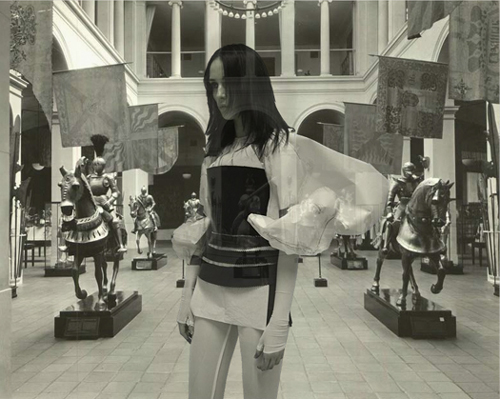
Boudicca, Film Still, Essay, 2009

The M.A. Fashion Studies At Parsons The New School for Design presents:

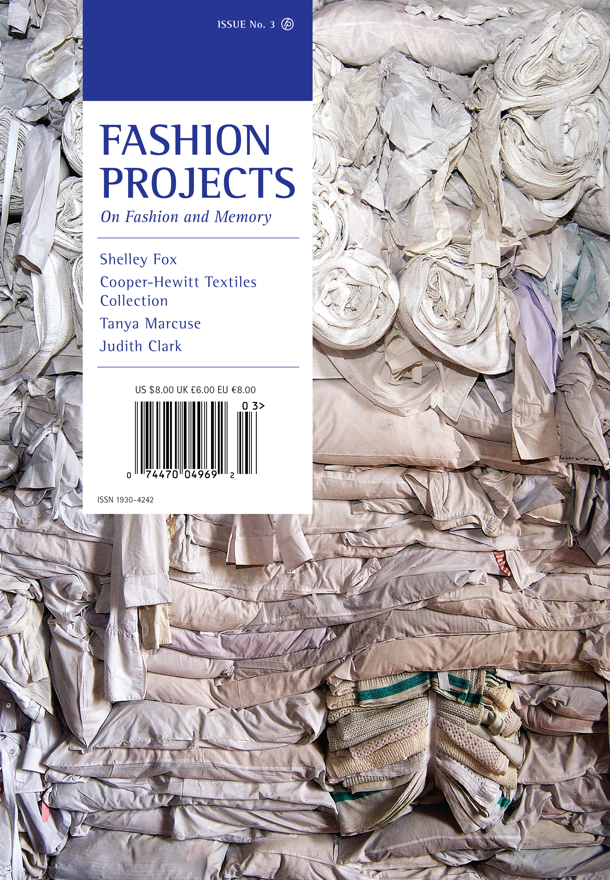
A screening to celebrate the new issue of Fashion Projects. The screening features a range of short experimental films on the topic of fashion and memory--the topic of the new issue. They include films by the British-based fashion design duo Boudicca, Dutch photographer Erwin Olaf, designer Shelley Fox, and fashion photographer Laura Sciacovelli. The screening is curated by Tamsen Schwartzman and Francesca Granata.

The screening will take place Friday the 23rd of April at 6 pm in the Wollman Hall, 65 West 12th Street. (PS: It will start promptly!). A reception will follow the screening.

The event is free and open to the public. Below is the official flyer: Feel free to circulate it.

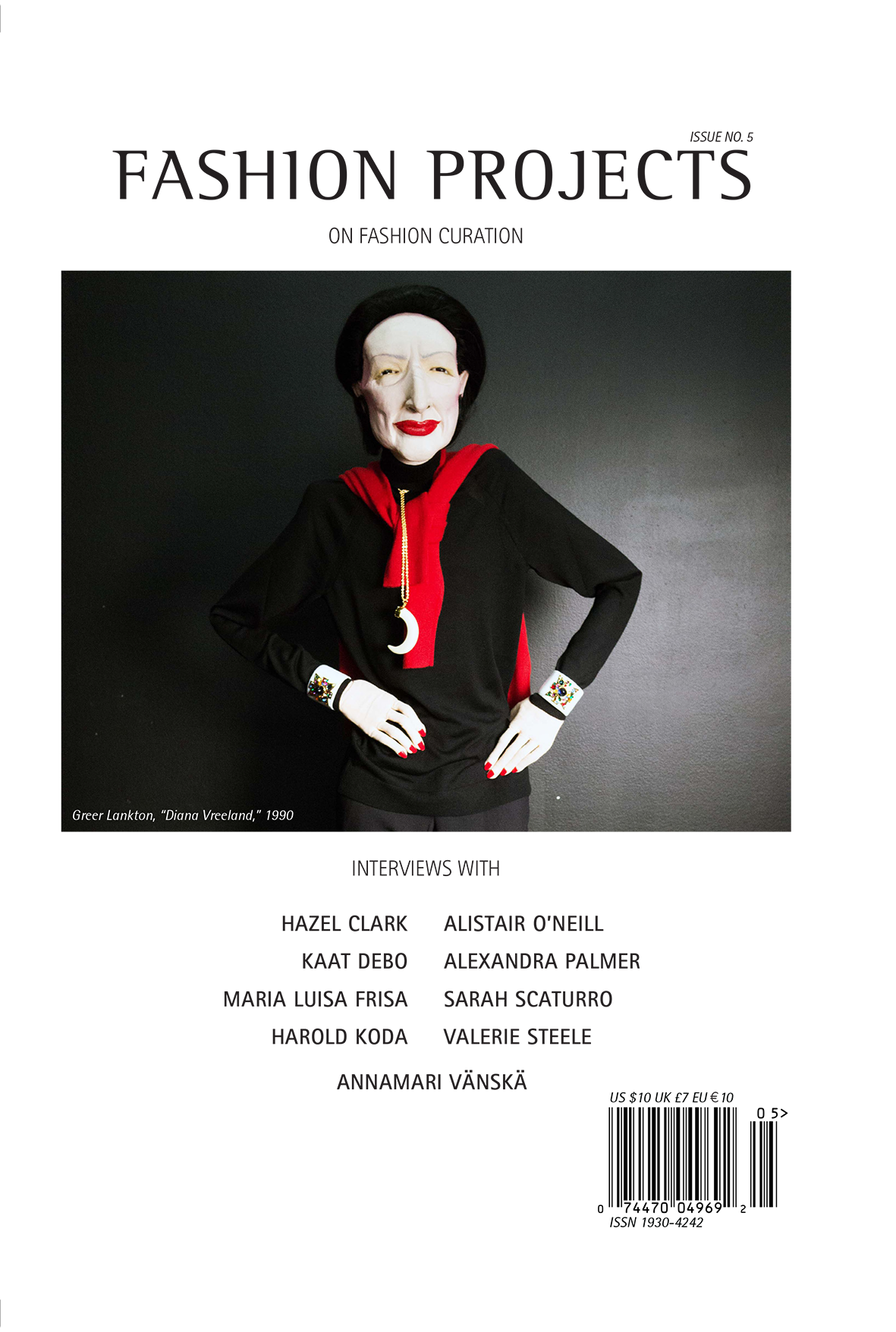
SP10 PDF Fashion Projects

SP10 PDF Fashion Projects Event Invite

Spring Fashion Events around NYC

Jane Fonda in Klute

by Sarah Scaturro

This spring there are a lot of events occurring around NYC with fashion as the main focus. Here is a breakdown of the ones that I’ve been able to find, and they are all free! Please leave a comment if I've left anything out.

April 9th - Richard Martin Visual Culture Symposium Tonight is the Annual Richard Martin Visual Culture Symposium at NYU, which allows the graduating students of the Visual Culture MA program to lecture on their thesis topic. Worn Through has a breakdown of the topics and schedule.

April 13th, 20th and 27th – Fashion In Film: New York City The brand new MA program in Fashion Studies at Parsons The New School for Design is hosting a fashion in film series for the entire month of April. Curated by Jeffrey Lieber, Assistant Professor of Visual Culture Studies, the series has some fashion classics - Annie Hall and Sabrina - but also some lesser-known films with impressive fashions, such as Klute (Jane Fonda) and On a Clear Day You Can See Forever (Barbara Streisand).

April 15th – 16th Bard Graduate Center Annual Symposium Bard Graduate Center is having their annual symposium on April 15-16th on the topic of Secondhand Culture: Waste, Value, and Materiality. I can’t wait for to hear Senior Curator of Costume at the ROM Alexandra Palmer speak on “Back to Back: Retro-fitting Fashion within the Museum.” There will also be a screening of the film “Secondhand.”

April 19th – Anna Wintour Lecture According to NY MAG Anna Wintour is giving a free lecture on the 19th at 6 pm at Pratt Institute.

April 22nd – FIT’s 4th Annual Sustainable Business & Design conference This year’s theme is Redesigning for a Sustainable Future. Go here for more information.

April 27th – Mannequins in the Museum: Perspectives on Curating Fashion The lecture I’m most excited for is by Joanne Dolan Ingersoll, a truly talented curator from RISD. She will be giving a lecture for SVA’s Design Criticism MFA lecture series on a topic I have great interest in due to my work: “Mannequins in the Museum: Perspectives on Curating Fashion.”

April 29th – Predicting Color Trends in Fashion FIT is hosting the seriously hardworking historian Reggie Blaszczyk on April 29th when she’ll give a lecture on the history of predicting color trends. I was fortunate enough to meet her at the Business History conference last year in Milan - I had just read her article on Dorothy Liebes called “Designing Synthetics, Building Brands” in the Journal of Design History. As someone who studies synthetics and has handled Liebes’ textiles, the article about blew my mind.

May 4th – Towards Sustainable Fashion Symposium In conjunction with the Scandinavian House’s Eco-Chic exhibition, there will be a panel discussion featuring Marcus Bergman, Karin Stenmar, Sass Brown and Eviana Hartman, and moderated by Hazel Clark, Dean of the School of Art and Design and Theory, Parsons: The New School for Design.

May 8th – FIT’s Annual Fashion and Textiles Symposium This year’s topic for FIT’s Annual Fashion and Textiles Symposium on May 8th sounds great - Americans in Paris: Designers, Buyers, Editors, Photographers, Models, and Clients in Paris Fashion.

May 21st and 22nd - Costume Collections: A Collaborative Model for Museums The Brooklyn Museum and the Costume Institute are hosting a 2-day symposium about their new costume collaboration. I’m looking forward to seeing both exhibitions this spring!

Entangled Global Patterns of Cultural Identity

by Patty Chang

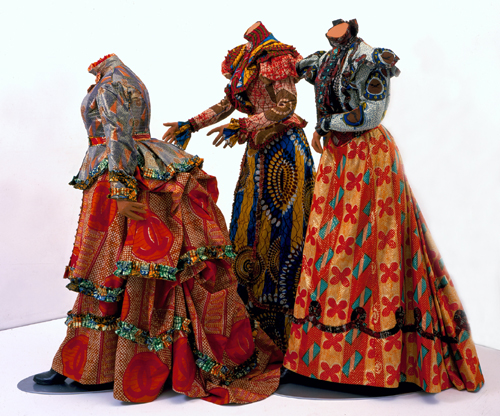
Yinka Shonibare, Three Graces.

Textile patterns and dress provide a rich visual vocabulary of encoded information and aesthetic expression. They have the ability to exploit or subvert the commercial allure of the “exotic”, and how it is called upon to reference cultural or national identities or even recast the vernacular. The exhibition Pattern ID, which is currently on view at the Akron Art Museum, queries just how straight forward patterns and dress inform our understanding of cultural identities. The multimedia exhibition entitled, Pattern ID, features the works of Mark Bradford, iona rozeal brown, Nick Cave, Willie Cole, Lalla Essaydi, Samuel Fosso, James Gobel, Brian Jungen, Bharti Kher, Takashi Murakami, Grace Ndiritu, Yinka Shonibare MBE, Mickalene Thomas, Aya Uekawa, and Kehinde Wiley. Many of these contemporary artists have migrated from one culture to another, be it national, ethnic, racial, socioeconomic, political or religious. Rather than trade one identity for another, the artists reveal ways in which identity can be cumulative, employing a patchwork of textile patterns and dress as meaningful vehicles to locate one’s place in society against a backdrop of globalization. Taking a range of approaches from humor to irony and formal beauty, these artists borrow from popular culture, world history, and art history to transform and redefine the cultural meanings of patterns.

For instance, the use of African textiles as props and backdrops in the works of Yinka Shonibare, Samuel Fosso, and Grace Ndiritu play not only on traditional and modern forms of representation, but also on cultural myths, politics, and ideas of post-colonialism, reclamation, and subjugation. The headless mannequins in Shonibare’s Three Graces fashioned in elaborate Victorian garb made out of atypical ‘African’ fabrics and arranged as a tableau satirizes the notions of authenticity and identity. The installation relies as much on the Dutch wax-print cloth ‘ethnicizing’ the space as on the references to 18th and 19th century masterpieces of European art. However, it is the textile that is a testament to cross-cultural interactions brought about by mercantile trade, having undergone a series of replication, transformations, redefinitions, and repackaging for different markets and tastes. Although linked by ideas of post-colonialism and identity, his works are not necessarily contained by them.

Grace Ndiritu, Still Life

Similarly, Samuel Fosso’s photograph Le Chef: celui qui a vendu l’Afrique aux colons (The Chief: The One Who Sold Africa to the Colonizers) is part of a series of self-portraits created in 1997 for the Parisian department store Tati, that depict the photographer in little else other than leopard skins, holding sunflowers, and draped in gold jewelry seated against a backdrop and foreground of Dutch wax-print fabrics. The contrasting patterns form a subversive portrait of corrupt African leadership and the regalia of indigenous kingship. The camp imagery deliberately projects an ‘exotic' Africa as the world sees it. Moreover, Grace Ndiritu’s Still Life depicts four video installations inspired by Matisse and his love for the female nudes and African textiles. Inverting the colonial gaze, she transforms the female nude from a passive decorative object into an active subject. The African textiles wrapped and draped around her models are used to elicit countervailing emotional stereotypes of repression and sexual freedom.

Samuel Fosso, Le Chef: celui qui a vendu l’Afrique aux colons

Elsewhere in the exhibit Aya Uekawa and Kehinde Wiley incorporate highly stylized decorative pattern motifs within their portraits, while also referencing the realism of Dutch and Flemish 16th and 17th century painters, and the styles of European portraitists such as Reynolds, Gainsborough and Titian, respectively. Although Wiley has used models in the past from West Africa, he mainly works with African-American models as a symbol of hybridization and globalization through the African diaspora. In many instances, cultural identity is lifted out of its traditional anchoring in a particular locality and redefined in a hybrid context that is still coherent and intensely beautiful. One of my personal favorites is the variation of Soundsuits by Nick Cave, who created elaborate costumes out of fiber textiles and found objects to be worn by dancers as a vehicle for sound and movement. The suits have an ethereal quality reminiscent of a fusion of Leigh Bowery’s performance pieces and certain body-hiding masks and ceremonial costumes from African, South Pacific, and Caribbean cultures.

Nick Cave, Soundsuits, Installation View, Akron Art Museum.

One of the major divides on globalization today is whether the increased speed, scale and volume of international trade is imposing cultural homogenization or in fact, working to enrich and preserve culture through expanded access to the internet and increased cross-cultural contact. Interestingly, many of the works featured in this exhibition assert a more complex, multivalent understanding of our contemporary condition, namely one that takes into account hybrid forms of cultural expressions that are not entirely global or local, indigenous or imported, or Western or non-Western. As historian Benedict Anderson suggests, a passport may come to signify permission to work someplace more than a connection to any essential collective identity or pledge of national allegiance.

Nick Cave, Soundsuits

*Pattern ID: International Artists Fashion their Global Identities is on view at the Akron Art Museum through May 9, 2010.

Fashion at Large

We are pleased to announce a new regular contributor to Fashion Projects: Rizvana Bradley is currently completing her Ph.D. in the Literature Program at Duke University. She is working to develop a variety of critical approaches to fashion and contemporary design, focusing on the ways in which technology is integrated into various artistic practices. Putting fashion in dialogue with the arts at large, her work also touches on video art, dance, architecture, and concept clothing. She has taught courses at Duke University that foreground fashion as a singular artistic practice specifically placing it at the critical intersection of current discussions about art, media and the body. Her writing has appeared in Hint Magazine. Look for her interviews, general coverage of lectures and exhibits, as well as other pieces for Fashion Projects.