by Sarah Scaturro
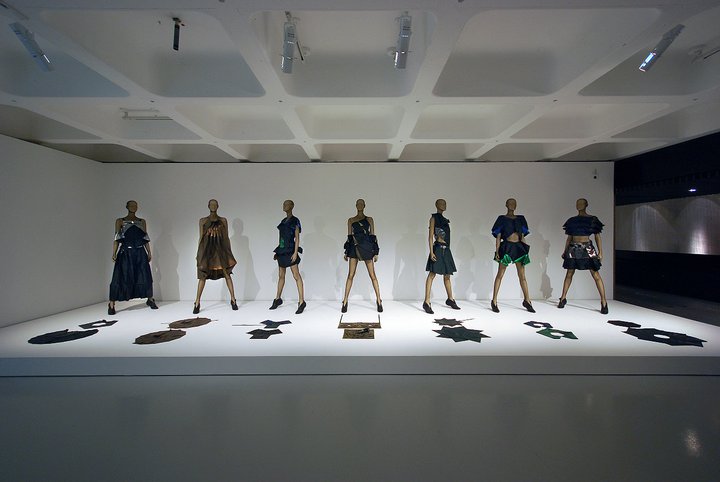 Issey Miyake's new 132 5 collection as displayed in the Barbican Art Gallery's exhibition "Future Beauty: 30 Years of Japanese Fashion." Photo by Barbican Art Gallery.
We all know that fashion is an expression of the zeitgeist – a style or trend can explode out of seemingly nowhere, with disparate tribes and geographies adopting it simultaneously. Fashion exhibitions are no different. The past few years have seen many exhibitions mounted on similar topics (colors, sustainability, glamour, etc). Currently there are two very different exhibitions on display about Japanese fashion. The first is “Japan Fashion Now” at the Museum at the Fashion Institute of Technology (MFIT) in New York City, and the second is “Future Beauty: 30 Years of Japanese Fashion” at the Barbican Art Gallery in London.
There are some obvious similarities between these exhibitions – both are curated by top curators in the field (Valerie Steele at MFIT and the Kyoto Costume Institute’s Akiko Fukai at the Barbican). Both focus on Japanese fashion designers and celebrate their contributions to the Western fashion system. Both show looks dating back to 30 years ago and pay attention to contemporary Japanese sub-cultures. But that’s it. Their interpretations, exhibition design and overall approaches are radically different.
I first visited the MFIT exhibition “Japan Fashion Now” when it opened - having seen almost all MFIT exhibitions over the past 6 years, I figured I knew what to expect. I was happily surprised to see that the first gallery of the show had been enlarged and was dedicated exclusively to early works by the groundbreaking designers who were the first to put Japanese fashion on the map: Rei Kawakubo, Issey Miyake, Hanae Mori, and Yohji Yamamoto were among this group. This immediately made a lot of sense, since the thesis of the show was about what is happening now in Japan, rather than in the 1980/90s. I asked a close friend of mine what she thought about this first room after visiting it on her own. “They look like dead, headless corpses in a cemetery” she replied, citing the dark room, low ceilings and headless white mannequins wearing somber colored garments as the main issue. Now, she isn’t familiar with the challenges of the introductory gallery space and fashion exhibition display in general (low ceilings, low light levels, stiff mannequins, etc.), but she did have a point, especially when contrasted to the main exhibition space with its J-Pop music, vibrant colors, and soaring walls vinyled in a Tokyo-like cityscape. She also could have been reacting to the severity and deconstructed qualities of the garments on display in the first gallery – I could only imagine how shocking they must have seemed at the time when they were first shown decades ago. I personally thought the first gallery was a meditative moment, and was a nice contrast to the main exhibition space.
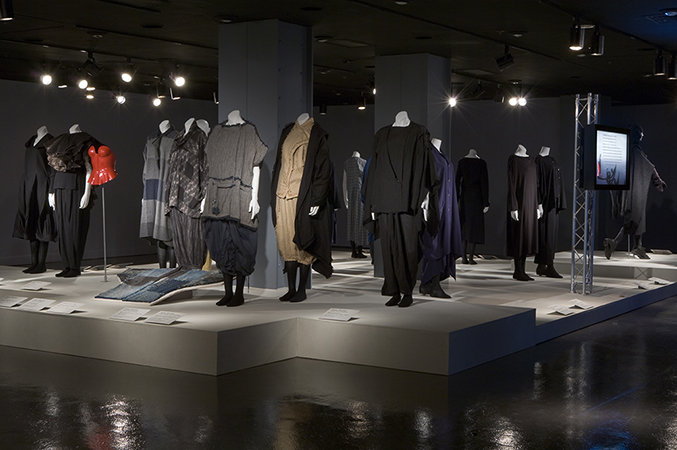 The first gallery in the "Japan Fashion Now" exhibition at MFIT. Photo by MFIT.
Entering into the main exhibition gallery, I was dynamically swept into a miniature city landscape. MFIT really used the gallery’s too-high ceiling to their advantage, creating a sort of mini-Harujuku by stitching together photos of Tokyo buildings and enlarging them to cover all the gallery walls. This mise-en-scène held more recent looks from designers also shown in the first gallery, but focused mainly on the contemporary generation of Japanese fashion designers. The platform featuring menswear designers was especially insightful, as it succinctly displayed a lot of what Japanese fashion is known for: technology, heritage, authenticity, gender-bending, punk, deconstruction, playfulness, elegance, etc. I really wanted to like the section on subcultures and street fashion, but it just didn’t resonate with me. The scary teenage girl mannequins were one problem, but the main reason was that part of the success of the subculture movement is that it is about a fantastical (and powerful) sense of individualism and performance. Without seeing the actual girl wearing the clothes, with her movements, voice, hair, shoes, etc, I just didn’t buy it – they looked more like costumes for Halloween than street-fashion. Although, maybe that was the point. It was nice to see MFIT touch upon the tribal, or “zoku,” subcultures (I remember being infatuated with the style of the Bosozoku [motorcycle gangs] when I lived in Japan a decade ago) as well as the never-ending search for “authenticity,” particularly concerning Japanese denim.
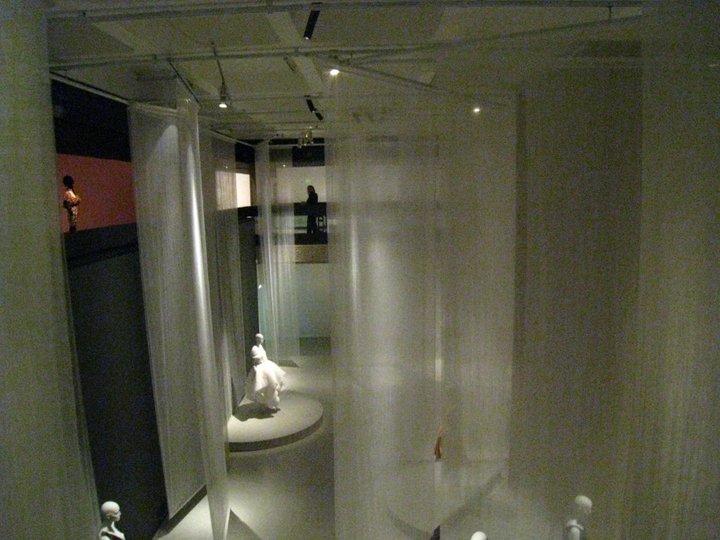 View of the first floor gallery from the second floor of the "Future Beauty" exhibition.
Photo by Sarah Scaturro
View of the first floor gallery from the second floor of the "Future Beauty" exhibition.
Photo by Sarah Scaturro
The joyful cacophony of color, styles and sound at the MFIT exhibition contrasts sharply with the white, almost Zen-like design of the Barbican show. “Future Beauty” is broken up into two floors, with the second floor essentially a square with an open center, looking down onto the first floor gallery. Just like MFIT exploited the high ceilings of their main gallery, the Barbican used the high ceilings of the first floor to hang sheer white silk-like panels of fabric. As a design element, these fabric panels served several purposes - they made a pathway through the exhibition, they delineated themes, and they created small, intimate moments in which to view the garments, sometimes only a single look. The show itself was broken into several themes, with the first floor exploring “In Praise of Shadows,” “Flatness,” “Tradition and Innovation,” and “Cool Japan.” My favorite section on the first floor was “Flatness,” which displayed Miyake’s A Piece of Cloth and Pleats concepts in a dynamic and inventive way, and also included a separate display of Kawakubo’s garments shown on mannequins coupled with Naoya Hatakeyama’s photos of the same garments flattened out. As Fukai in the Gallery Guide points out, “the interstices between fabric and figure…represent an expression of ‘ma’ – the Japanese concept which views the void between objects as a rich, energized space.” The “Cool Japan” section was the only nod to street fashion and sub-cultural styles in the exhibition. Interestingly, whereas MFIT showed actual street fashion garments, the Barbican displayed only high fashion garments inspired by street fashion, anime and “zoku” style (designers included Ohya, Zucca, Jun Takahashi and Tao Kurihara). Fukai mentions that these designers were “eschew[ing] the visual overload common to Tokyo street fashion in favor of a simpler, more iconic use of manga characters.” I think this comment can be extended to describe the two exhibition design approaches in general – one is about visual overload, while the other is about restraint.
The second floor featured small vignettes of the work by the most well-known (and presumably most important) Japanese designers, including Miyake, Yamamoto, Takahashi, Kurihara, Watanabe, and Kawakubo. It also included a section on Mintdesigns, a duo who use print and graphics in an almost “fetishistic” manner, as well as another section on “The Next Generation,” which included work by Chitose Abe, Tamae Hirokawa and Akira Naka. Honestly, after seeing all other sections before, I was underwhelmed by the choices included in “The Next Generation” – they seemed a lot like rehashings of ideas already expressed by earlier generations of Japanese designers. The section on Kawakubo was especially touching, as it showed several looks from her revered 1997 Spring/Summer collection Body Meets Dress, Dress Meets Body, as well as a video showing the actual runway show. I had never actually seen the runway show, so I had no idea that the audience was rapturously clapping as each model appeared and walked down the runway.
The titles to the two exhibitions give the most overt clue to their fundamental difference – the MFIT show focuses on celebrating the here and now of Japanese style, whereas the Barbican show leaves a distinct feeling that the glory years of Japanese fashion are mostly in the past (even though its title ironically includes the phrase "Future Beauty.") I left the MFIT show with a sense that Japanese fashion was fun, quirky, youth-oriented and democratic, whereas the Barbican show seemed to elevate all of Japanese fashion into the cerebral realm of art (I think the fact that the MFIT exhibit was free whereas the Barbican show cost around $18 also contributed to that mindset.)
A large part of the disconnect between the two exhibitions has to do with the fact that the Barbican exhibit was curated by a Japanese fashion insider, whereas the MFIT show was organized by an outsider looking in at contemporary Japanese culture. This inside/outside dichotomy can’t be overstressed, as it plays into every aspect of interaction Japan has with outside cultures – even fashion. (As someone who has lived in Japan, I am very aware of having always been considered a “gaijin,” which means “alien.”) Fukai even presented a run of fashion show invitations from Miyake that she had actually received, further emphasizing her own inclusion, and by extension authority, in the realm of Japanese fashion. Precise and tightly-edited, “Future Beauty” is the exact vision and message of Japanese fashion that Fukai wants the rest of the world to know – no more and no less. Steele, perhaps cognizant of her American audience (as well as the FIT student body), has presented her own interpretation of Japanese fashion that is in many ways more in-line with American values and tastes through its emphasis on youth, democracy and individuality. Ideally, a visit to the MFIT exhibition would be coupled with a visit to the Barbican exhibition. The two exhibitions, with their disparate foci and approaches actually complement each other, bringing a fuller understanding of just how revolutionary and influential Japanese fashion was, and still is, both inside and outside of Japan.
Japan Fashion Now is on display until April 2, 2011.
Future Beauty: 30 Years of Japanese Fashion is on display until February 6, 2011.
Sarah Scaturro