It seemed like it would be an impossible task to match the Costume Institute’s McQueen blockbuster of last summer with an equaling compelling and aesthetically engaging display. Nonetheless, curators Andrew Bolton and Harold Koda achieved the impossible in their latest exhibition called Schiaparelli and Prada: Impossible Conversations. In this witty and provocative installation, they have set a new bar for curation of fashion by their creative use of technology and their innovative juxtaposition of fashion from the past and the present.
Waist Up - Waist Down Gallery
Although Elsa Schiaparelli (1890-1973) and Miuccia Prada (b. 1949) came from different eras, they both challenged cultural norms and expressed their unconventional ideas about beauty and femininity through fashion. Koda and Bolton developed themes that reflected the two women’s shared interests and visual aesthetics, but also identified their different approaches to design by creating imagined conversations between the two designers. It is in this novel approach to animating the exhibition, which reminds us that garments reflect the ideas and attitudes of their creators and are designed for living bodies.
Surreal Body Gallery
Taking inspiration from Miguel Covarrubias’s “Impossible Interviews” for Vanity Fair in 1930s, the imagined conversations are presented in the context of a dinner party with Miuccia Prada sitting at one end of the dining table and Elsa Schiaparelli at the other. The script for their conversations was developed from the text from the 1950s autobiography by Schiaparelli and from interviews with Prada that suggest a real-time response. Schiaparelli’s part is played by an actress and Prada responds as herself. Their imagined conversations seem like good-natured arguments between two friends, infusing the installation with whimsy and a cheeky playfulness.
The exhibition has a modernist, clean aesthetic and includes ninety designs and thirty accessories from the two designers. In general, the rooms are dark putting a spotlight on the video presentations, and creating focal points through selective lighting of the outfits on display. Mannequins act as blank canvases for the garments and are organized in thematic groupings of Waist Up/Waist Down, Hard Chic, Ugly Chic, Naif Chic, and aspects of the Dressed Body. There is an aesthetic coherence to the four rooms, providing a unifying element for what could easily have become a chaotic mess without the tight editing and restraint that Koda and Bolton have demonstrated in this visually appealing installation. Although Schiaparelli’s lobster dress and skeleton dress are not on display, the exhibition cleverly makes reference to these iconic garments and conveys the whimsy, irony and unconventional nature of these important designers.
Exotic Gallery View
In another stroke of brilliance, the curators commissioned Guido Palau to make customized masks for the mannequins. These masks, each unique and exquisitely embellished, add an element of surreal fantasy to the display, as well as unifying the presentation. These masks often play off the design elements within the garments themselves. For example the mask accompanying the gown for the Tear Dress, 1938 by Schiaparelli and Dali, includes a Dali moustache.
Naif Chic Gallery View
As a whole, the exhibition gives the viewer cause to consider the nature of fashion and art. At the press preview Thomas P. Campbell, Director and CEO of the Metropolitan Museum of Art, said “Schiaparelli’s collaborations with Dali and Cocteau as well as Prada’s Fondazione Prada push art and fashion ever closer, in a direct, synergistic, and culturally redefining relationship.” There are also direct references to the two designer’s opinions on the topic and it is clear that this is a point of difference between the two. In the Ugly Chic gallery, Schiaparelli said: “Dress designing…is to me not a profession but an art.” To this Prada responded: “Dress designing is creative, but it is not an art…. But to be honest, whether fashion is art or whether even art is art doesn’t really interest me. Maybe nothing is art. Who cares!” The exhibition closes with an animated conversation between Prada and Schiaparelli on the nature of fashion and art, in which the designers conclude by agreeing to disagree. This part of the exhibition caused me to smile. It seemed to provide another connection to my interest in the intersection of fashion and art, and I recalled my conversations with Harold Koda and other curators on this topic. Imagining my own conversation with Miuccia Prada, I would have suggested to her that instead of “Maybe nothing is art”, maybe everything is or could be art. To that, no doubt she would have responded like she did in the installation: “The term [artist] itself seems old-fashioned. It’s a term that does not relate to modern times. And it’s too confining. What I love about fashion is its accessibility and its democracy. Everyone wears it, and everyone relates to it.” And on that point, we would have agreed.
Prada and Schiaparelli: Impossible Conversationsopens to the public at the Costume Institute of the Metropolitan Museum of Art in New York City on May 10, 2012 and will run until August 19, 2012.
Photo credits: All photos provided courtesy of the Costume Institute of the Metropolitan Museum of Art and are subject to copyright.
Ingrid Mida is a Toronto-based artist and writer who is interested in the intersections between fashion, art and history. She has a show called “Constructions of Femininity” opening at Loop Gallery in Toronto on May 26, 2012 and will be speaking at Fashion Tales 2012 in Milan in June 2012 on “The Metaphysics of Blogging”.
Next Tuesday May 15 I will participate in a panel in conjunction with the exhibition “Schiaparelli and Prada: Impossible Conversations” at the Metropolitan Museum of Art, Costume Institute. The panel Defining Chic: Then & Now is moderated by Julie Gilhart (fashion consultant) with Leandra Medine (The Man Repeller), Scott Schuman (The Sartorialist), and Lynn Yaeger (Vogue.com Contributing Editor).
During the Salone del Mobile 2012 (Milan Design Week 16-22 April) la Rinascente, Milan’s most fashionable department store, is hosting ‘Hacked – Rebellious Imagination’(16-21 April). For those who don’t know already, hacking is a growing global movement, predicated on modification and customization. It’s about taking what exists and altering it in ways that create unexpected, dramatic or playful narratives. Hacking history draws on elements of Bauhaus, DIY, Arte Povera and Punk, combining it all with the excitement of new technology.
Over the course of 100 hours laRinascente has been radically altered inside and out to become an interactive expermental lab space. Following a contemporary concept of appropriation, alteration and transformation which pervades art, design, web and technology, Hacked is an experimental programme curated by Beatrice Galilee which includes live activities and events, installations, performances and workshops. Temporary, site-specific works by artists, architects and designers include a monumental hack of t laRinascente colonnaded façade by CarmodyGroarke; a flexible, movable ‘HackedLab’ stage by EXYZT; and – very briefly – a scale model of Large Hadron Collider.
The hacked lab programme is intended to provide a platform for young designers whose work exists outside of the parameters of conventional exhibition-objects and across various disciplines. One of the most interesting installation staged by EXYZT is TAP TAP, an installation inspired by the ‘Taxi Bush’ – the Haitian taxi, famed for their beautifully decorated exteriors, set up by Alexander Romer, a berlinese architect based in Paris. TAP TAP is a van organized into a modular system that, after its first stop at laRinascente will travel around Italy, promoting performance and participation from the public. The first opening event of Hacked on Monday, Botanica, the workshop from Studioformafantasma has taken place into this TAP TAP van and is a homage to plastic and its future.
laRinascente has long been known for promoting new designers in Milan.
Promoting new designers has long been one of laRinascente’s main aims. Hacked celebrates brilliantly the store’s 150 years of activities and its strategy for the future. Tiziana Cardini fashion director, commented that laRinascente wants to give to young designers the possibility to experiment with new ways of conceiving a product – no only for its functionality only, but also for its quality of participation, expression and performance. As Beatrice Galilee stressed, Hacking is about building bridges between different industries: design, architecture, fashion, art and performance. It also raises questions about creativity, independent design and the relations with mainstream consumer culture.
I have interviewed for Fashion Projects both Beatrice Galilee, the curator of the event and Tiziana Cardini, laRinascente fashion director.
Simona Segre Reinach is Contract Professor at Bologna University, Italy. She also teaches at Domus Academy and MFI (Milan Fashion Institute). She is in the advisory board of Fashion Theory and of Dress Cultures Series by I. B.Tauris and a member of MIC (Moda Immagine Consumi) a center for Fashion Studies at Università Statale of Milan. Her latest book, Un mondo di mode. Il vestire globalizzato, is published by Laterza (2011).
SSR In which ways did Milan Design Week and la Rinascente inspire your project Hacked?
BG This is my first time working in a shopping mall, and I found a lot of enthusiasm from the people here in Milan. The shopping mall is an exciting place to involve people in the events, which is exactly what ‘hacking’ is about. For me, having to organize so many events, three times a day for the duration of the Milan Design Week is, of course, both challenging and inspiring.
I particularly liked the idea of working during the Salone del Mobile (Design Week) because people come in person to the Salone. They want to be present. People make reservations, buy train and air tickets, they like to really participate in the event. I like the idea of people wanting to be there and to do things. We devote one of the days of the Design Week to laRinascente customers and to the people who will call, everybody is invited to participate. Performances such as ‘make your own thirsty plant detector’ and ‘build your own musical instrument’ are examples of design participation and creative experiments.
SSR What’s the relation beteween art, design and fashion nowadays?
BG They are all cultural fields although they involve different roles. But they have a lot of things in common too, interesting forms of collaborations between art, design and fashion are emerging – nowadays it is really about exploring boundaries among different fields. Artists, architects, fashion designers and designers are influenced by each other more and more.
SSR Is hacked somehow questioning also the concept of copyright? Is there any difference between design and fashion concerning copyright (as in fashion you can protect a logo/brand but you cannot protect a style)?
BG This is an interesting question. I think that copyright is becoming less and less important. The whole idea of Author with a capital A is undergoing severe change, challenged by the very act of the creative process. Products are becoming a completely open source. In a way this is liberatory, but, of course, it entails a lot of changes in the way we think about design. The relation between author, producer and buyer (consumer) is no longer a neatly separate one, but there is continuous interchange between these three elements of the process. Traditional authorship of course still exists, I would say it runs in parallel with these new forms of creativity in which the roles are constantly redefined, to set a new form of commerce and patronage. Take for example kickstarter.com – it is an interesting platform devoted to all new ways of funding and following creativity. You can design a dress and then find somebody there who can create it according to your and his or her ideas about making and distributing. You customize the ways in which you can put that dress on the market. For a new generation of designers, the idea of a ‘product’ to be manufactured, distributed and sold in the traditional way is no longer interesting. Using hacking, strategy, fiction, technology, science, performance, play and collaboration as tools of their trade, collections of emerging agents of design have demonstrated a different way to exhibit and experience contemporary design.
SSR La Rinascente has often hosted events during the Salone del Mobile of Milan. This year it looks as if you want to be more involved in the actual co-production of an event. How did this develop ?
TC: This is the first time laRinascente is totally in charge of a big event. Before we just had partnerships with the likes of Interni.This time we thought that the time was right, we were ready to be part of the excitement of the city during the Salone. We have a strong heritage of relationships with the Milanese designers starting with the 50s and 60s Compassodoro and we have worked in the past with big talents like Bruno Munari, Gio Ponti etc.
SSR: Why hack?
TC: We wanted to choose a concept which crosses art, design and technology and is part of the language of design today and could be understood by today’s design community. It is also a concept that is very of the moment for the artistic community in general. Transforming a reality into something else. It’s a tool. A way of being in a relationship with the creative process.
SSR: Why Beatrice Galilee?
TC: Because she is one of the coolest and most relevant young curators today. She has a great knowledge about today’s trends and design, not to mention she’s very well connected within the design community.
SSR It is a shared idea that the Salone del Mobile (and more generally design) is an open system, which endorses participation from the public – whereas the fashion weeks are the very opposite: elitarian and selfcontained. Is the Hacked event meant to bridge/connect the two worlds – fashion and design –both very well represented at la Rinascente?
TC: No, not really. We wanted to do something really specific about the process of creating design. And we wanted to do something where people can really participate. We weren’t really thinking about working on a different scale, or creating a new relationship with fashion. That wasn’t the aim.
SSR: What does such an event mean for la Rinascente?
Exhibiting fashion photographs in museum and gallery settings has become increasingly common in recent years. Combining two fields that have had difficulty being accepted as ‘fine arts’, fashion photography only moved off the page and onto the wall within the last 15 years — the 2004 Museum of Modern Art show “Fashioning Fiction in Photography since 1990” was their first exhibition of fashion photography. As iconic fashion photographs have become part of the museum cannon, auction prices for such works have soared with Irving Penn’s Woman in Moroccan Palace (Lisa Fonssagrives-Penn), Marrakech (1951) selling for a record-breaking $409,740 at Christie’s last December. It can be of little surprise that museums all over the world are exhuming the archives of a variety of fashion photographers for retrospective shows.
Jean-Paul Goude’s “Animatronic Grace”
The multi-talented Jean-Paul Goude, whose accomplishments in photography, film and video, art direction, illustration and brand development over his 40 year career have made him an icon of consummate creativity, is the focus of a retrospective exhibition at the Musée des Arts Décoratifs in Paris. The first such show of his work, “Goudemalion,” covers many aspects of his multi-faceted career. Opening with elements from his most ostentatious creation, the Bicentennial parade in Paris commemorating the 200th anniversary of the French Revolution on July 14, 1989, the visitor is first greeted by a life-size spinning doll and then, in the main hall, a giant locomotive that journeyed down the Champs-Elysées. While the side galleries start with his early fashion illustrations in the 1960s, it is with his increasing interest in photography in the 1970s, when he was working as the art director at Esquire, that his inimitable style becomes solidified. Known primarily for his work with muse and former girlfriend, the Jamaican-American singer Grace Jones, his pre-Photoshop cut-and-paste images of her, which distort her body into impossible, intimidating forms, are shown in both the original (spliced and refigured) and the final (airbrushed into unknown perfection). His fashion photographs are crammed onto the black walls of four smaller rooms — simply mounted and unframed, they range from the overtly sexy images of the ‘70s to the more obviously stylized and surreal photographs of later decades. One wall is given over to the fun series he has been taking since the 1980s of fashion designers — including Azzedine Alaïa, Valentino and Jean Paul Gaultier. Bright and colorful, the images pop against the black walls and low lighting. As this retrospective includes sculpture, performance art, animatronics and television adverts for clients such as Chanel, it goes far beyond just fashion photography – but by incorporating all of these different media, this retrospective helps to show how one singular vision can be adapted and translated across many fields, and also marks his influence in defining the brash, surrealistic photographic style of post-modernism in the 1980s. Read the rest of this entry »
Tuesday April 17th, I am chairing a panel on curation at Parsons the New School for Design. I hope you will be able to attend!
Focusing on curatorial practices that do not fit neatly within discreet categories of fashion, art, and design, the roundtable discusses the process of curation across a variety of platforms and disciplines, from the three-dimensional spaces of museums to the pages of magazines and from the public sphere to online platforms. The panel investigates how the meaning of curation has drastically changed: How the term “curator” went from identifying the keeper of a collection to describing a wider range of activities across a variety of sites. Borrowing W.T. Mitchell’s concept of “indiscipline”—“a moment of breakage or rupture”—it seeks to show how these shifts have occurred across disciplinary boundaries and have questioned such boundaries in the process.
The roundtable participants include Harold Koda (Curator-in-Charge of the Costume Institute at the Metropolitan Museum of Art), Sarah Lawrence (an academic curator and dean of the School of Art and Design History and Theory at Parsons the New School for Design), and Sabrina Gschwandtner (a New York–based artist, writer and curator). It is chaired by Francesca Granata, Assistant Professor of Fashion Studies in the School of Art and Design History and Theory.
The panel takes place on April 17th from 6:30–8:00pm in the Kellen Auditorium at 66 Fifth Avenue (at 12th street). The event is free and open to the public, but seating is limited.
An incredibly exciting day of talks characterized the Italian symposium “Diana Vreeland After Diana Vreeland: The Discipline of Fashion Between Museum and Curating,” which was organized by Maria Luisa Frisa and Judith Clark at the Universita` Iuav di Venezia. Most of the morning talks touched upon the great relevance of Diana Vreeland for fashion curating—thus bringing a commentary to the wonderful exhibition “Diana Vreeland After Diana Vreeland,” curated by Clark and Frisa at Palazzo Fortuny in Venice.
One of the most directly relevant talks was by Harold Koda—curator-in-charge at the Costume Institute, the Metropolitan Museum of Art—who started his career assisting Diana Vreeland and spoke about how Vreeland brought a certain glamour and theatricalization to fashion exhibitions, often at the cost of historical accuracy. Koda, however, traced the ways curators (including himself) eventually engaged in the balancing act of retaining the dynamic quality of display and presentation brought forth by Vreeland’s approach while keeping historical accuracy in the way the garments were exhibited.
Figure 2
Another theme which transpired was the relation between the process of editing and curating, one which was obviously central to the proceedings, since Vreeland started consulting at the Costume Institute only after having been famously fired from Vogue, which she had glamorized in a similar vein.
The exhibition engaged in re-appropriating and re-interpreting Vreeland’s curatorial innovations. Frisa said the idea for the title came to her while visiting Sherry Levine’s exhibition in New York, as it is—as the title suggests—a very reflective exhibition: an exhibition about exhibition-making. Among Vreeland’s curatorial vocabulary that the exhibition decoded and recoded was her love for armor, and for horses—boldly presented at Palazzo Fortuny by a horse covered in toile. Another visually engaging re-appropriation of Vreeland’s vocabulary was her use of tights or elaborate wigs to cover the mannequins’ heads.
Figure 3
Among the most interesting point which Judith Clark made in relation to the relationship between exhibitions and magazines was the idea that in the context of a magazine you can play with proportion and dramatize a detail of a dress simply through close-up, whereas in the context of an exhibition you have to do it through lights or props—something Vreeland certainly mastered. Another idea which places on a continuum Vreeland’s work as consultant for the Costume Institute and of editor was the fact that meaning is not always best communicated through the gown itself—something which is certainly true for fashion photography.
Drawing a parallel between the Met’s Costume Institute and the Victoria and Albert Museum, Amy de la Hay brought an interesting and very little known example of an early take on dynamic and dramatic fashion exhibitions, which predated Vreeland: The 1969 “Fashion: An Anthology,” curated by Cecil Beaton. Once again equating magazines to exhibitions, de la Hay pointed out how fashion exhibitions became more dynamic and less static at the same time fashion photography did. Equally fascinating was Alexandra Palmer’s discussion of the early curators at the Costume Institute: Polaire Weissman, and later, Stella Blum. Blum was the curator while Vreeland consulted for the Institute, and Palmer discussed Blum’s difficult job of negotiating between Vreeland’s input and her own role as curator.
I am incredibly excited to having been invited to participate to the symposium “The Discipline of Fashion between the Museum and Curating,” which will take in place in Venice on March 10, and promises to be one of the most interesting and wide-ranging symposium to have ever been organized on the topic
The symposium coincides with the opening of the exhibition “Diana Vreeland After Diana Vreeland” curated by Judith Clark and Maria Luisa Frisa at Palazzo Fortuny, which will be on view from March 10 to June 25, 2012.
“Organized by the Università Iuav di Venezia and the London College of Fashion (University of the Arts London) in collaboration with the Centre for Fashion Studies (Stockholm University), the symposium aims to discuss the evolving discipline of fashion curating, and brings together prominent voices from the field. The conference will use Diana Vreeland’s exhibitions and experience as Special Consultant to The Costume Institute at The Metropolitan Museum of Art in New York (1972-1989) as a starting point from which articulate reflections on the relationships between fashion, exhibitions and museums.
Specialist panel sessions will focus on Diana Vreeland’s legacy and the principal themes brought forth by her work at the Costume Institute including: the display of fashion in museums; the definition of fashion exhibition and the relation between fashion curating and exhibition making; the relationship between the roles of fashion curator and fashion editor; the role of fashion curating in academia.”
Among the many notable speakers are Harold Koda, Akiko Fukai, Alexandra Palmer, Kaat Debo, Mario Lupano and Stefano Tonchi. My contribution will be to a panel titled “Fashion Curation & Academia: New Insights,” which is chaired by Louise Wallenberg, Director of the Centre for Fashion Studies, Stockholm University and Marco Pecorari also from the Centre for Fashion Studies.
Below are some installation photos at Palazzo Fortuny. More to come…
Miniabito con dischi e frange in plastica gialla, Paco Rabanne, seconda metà anni sessanta; Soprabito in seta ricamata, Chanel, etichetta “Cannes-31 Rue Cambon-Paris-Biarritz”, n. 5046, anni venti (appartenuto a Eleonora Duse). Estate of Simone Valsecchi ARCHI-V-E
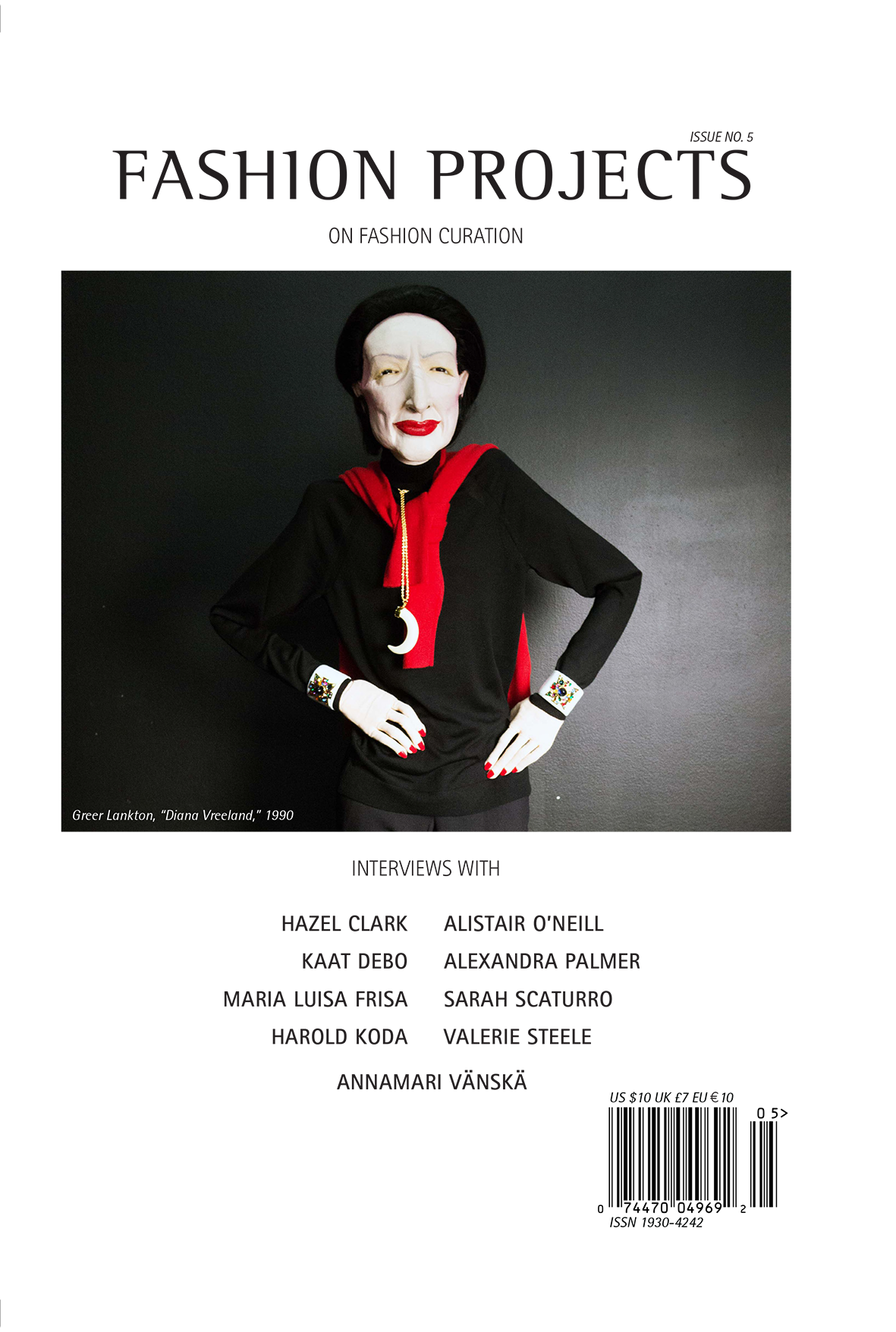
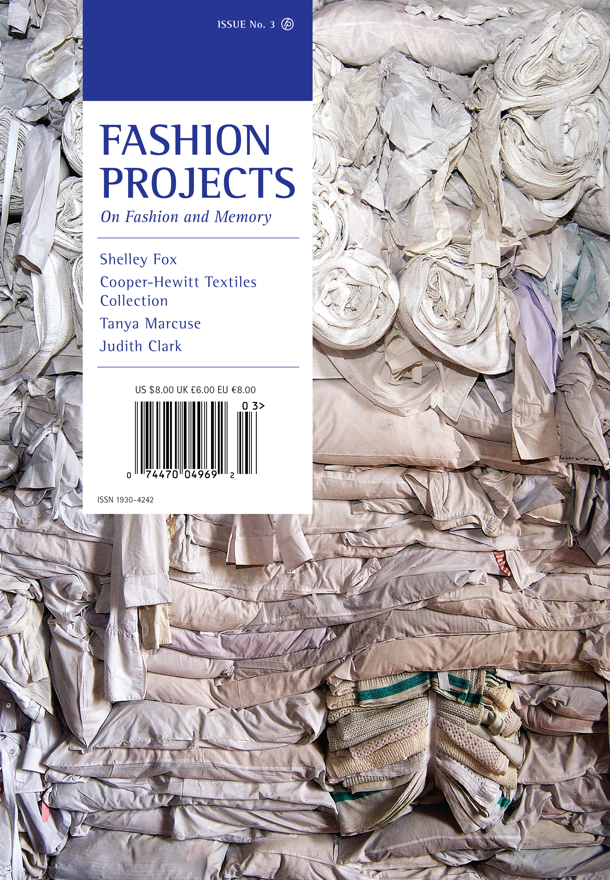
Fashion Projects began in New York in 2004, with the aim to create a platform to highlight the importance of fashion — especially “experimental” fashion — within current critical discourses. Through interviews with a range of artists, designers, writers and curators, as well as through other planned projects and exhibits, we hope to foster a dialogue between theory and practice across disciplines.
We are primarily a print journal, however we also publish web-based updates and interviews (a “digest” version of which you can receive by signing up to our mailing list or via our RSS feed) and are currently working on exhibits based on past and future issues. To order any of our issues visit our ordering page.
We are a nonprofit organization, which has previously received grants from the Lower Manhattan Cultural Council and the New York City Department of Cultural Affairs.
We are currently a sponsored project by the New York Foundation of the Arts, a 501(c)(3), tax-exempt organization. Contributions on behalf of Fashion Projects can be made payable to the “New York Foundation of the Arts,” and are tax-deductible to the extent allowed by the law. For more information please don’t hesitate to contact us.
For advertising and all other matters please email erin
Distribution
Fashion Projects is distributed in the U.S. and Canada through Ubiquity Distributors (tel. 718-875-5491, info [at] ubiquitymags.com) and in Japan through Presspop Inc. (info [at] presspop.com). It can be found in independent bookstores, Universal News, and other magazines stands across North American and in select stores in Japan and Europe. You can also order it on our site via paypal.
Contributors
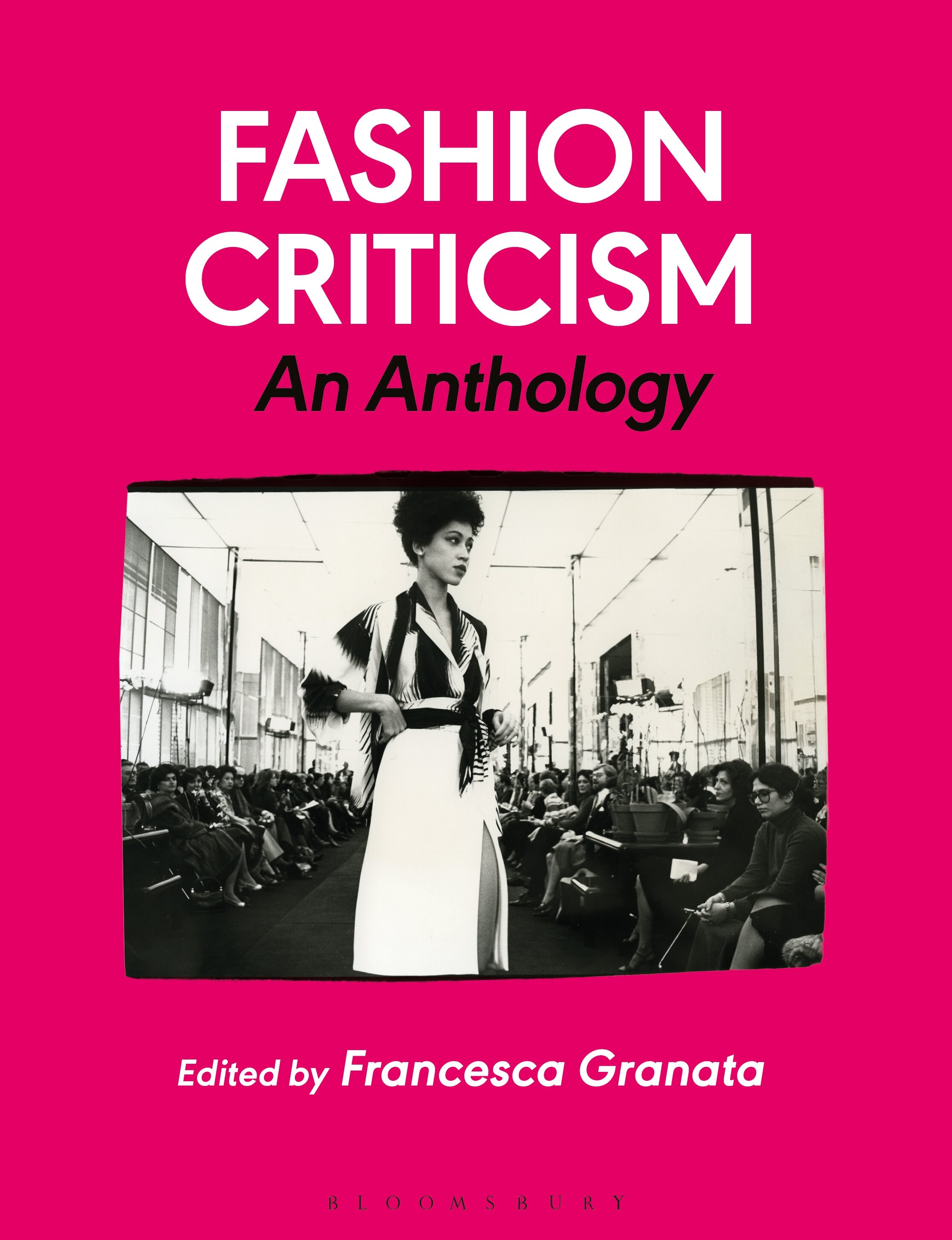
Editor: Francesca Granata is Assistant Professor in the School of Art and Design History and Theory at Parsons the New School for Design. She holds a PhD from Central Saint Martins, University of Arts London, with a focus on experimental fashion, performance and gender studies. She has previously worked as a lecturer in the visual arts department at Goldsmiths, University of London and as a fellow at the Metropolitan Museum of Art, Costume Institute.
Art Directors: Shannon Curren (Issue #3) is a freelance graphic designer based in New York.
Jennifer Noguchi (Issues #1 and 2) is a freelance graphic designer based in New York. She has worked for several publications including Print.
Web Design/Development: John Golding is a software developer living in San Diego.
Writers and Photographers:
Shannon Bell Price is Associate Research Curator at the Costume Institute at the Metropolitan Museum of Art where she has worked since 2000. Price holds a masters from New York University and is pursuing her doctorate at the Bard Graduate Center.
Rizvana Bradley is completing her Ph.D. in the Literature Program at Duke University. She focuses on the ways technology is integrated into video art, dance, architecture, and concept clothing. Her writing has appeared in Hint Magazine.
Kim Burgas is a freelance web designer and artist based in New York (kimburgas.com). As a former model, she is interested in the role sustainability will play in fashion modeling in the future.
Patty Chang holds a PhD in political science from the University of Oxford. She has worked for UNDP and the UN Department for Political Affairs and is a lecturer at New York University.
Piper Carter is a New York–based photographer who for years worked as an assistant to Steven Klein. Her photographs have appeared in various publications, including British Elle and Spin.
Jessica Glasscock is a writer, college instructor and independent curator. Her first exhibition, a retrospective on Stephen Sprouse, is being presented through Deitch Projects. Her writings include the book Striptease: From Gaslight to Spotlight.
Amanda Haskins is a senior research assistant at the Costume Institute at the Metropolitan Museum of Art and is completing her master's at the Bard Graduate Center.
Cynthia Leung is a fashion writer based in New York and Berlin.
Erin Lindstrom is a graduate of the Fashion and Textile Studies program at FIT. She is currently working with the archives at Ralph Lauren.
Ingrid Mida is a Toronto based writer, researcher and artist whose work explores the intersection between fashion and art. (Fashion is My Muse)
Marco Pecorari is completing his Phd in Contemporary Fashion Theory at the Centre for Fashion Studies - Stockholm University, with a thesis entitled “The Show is not Enough: new trajectories for reading contemporary fashion”. He writes for several fashion, arts and cultural magazines.
Nicola Pietroluongo is a programmer and web developer based in Italy.
Keith Price is a photographer and graphic designer living in New York (www.pricephotostudio.com)
Lidia Ravviso is a journalist and filmmaker based in Rome.
Jay Ruttenberg is a staff writer for Time Out New York and editor of the Lowbrow Reader (www.lowbrowreader.com)
Sarah Scaturro is the textile conservator for the Cooper-Hewitt National Design Museum. She is researching fashionable camouflage, as well as the intersection of fashion technology and sustainability.
Tamsen Schwartzman is Associate Research Curator at The Museum at FIT, where she has curated and co-curated a number of exhibits.
Sonya Topolnisky has written about fashion and history for Montreal-based Worn fashion journal, and is currently completing her master's at the Bard Graduate Center.
Tae Yano is a software engineer. She is completing her PhD in computer Science at Carnegie Mellon.