Film
April 23rd, 2010
Fashion Projects Launch/Screening Event!

Boudicca, Film Still, Essay, 2009
The M.A. Fashion Studies At Parsons The New School for Design presents:
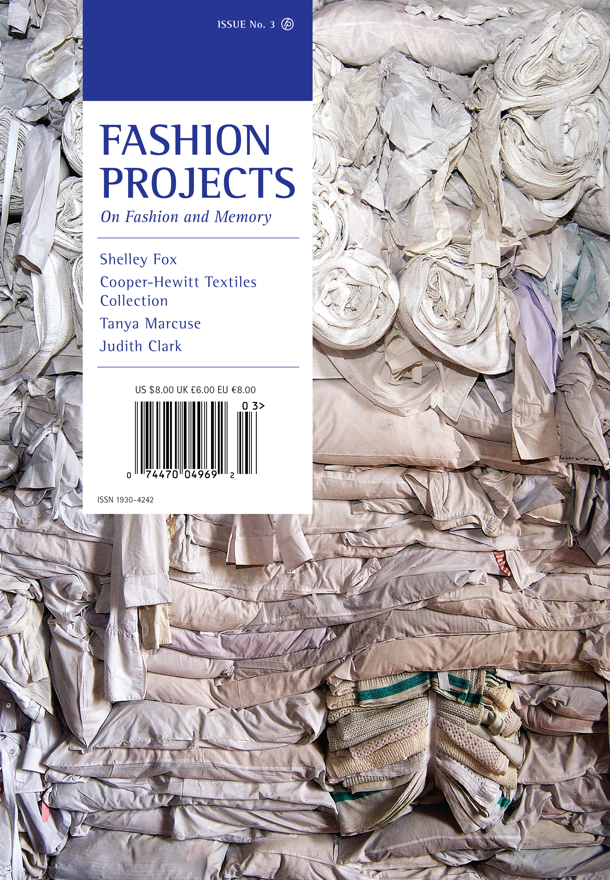
A screening to celebrate the new issue of Fashion Projects. The screening features a range of short experimental films on the topic of fashion and memory–the topic of the new issue. They include films by the British-based fashion design duo Boudicca, Dutch photographer Erwin Olaf, designer Shelley Fox, and fashion photographer Laura Sciacovelli. The screening is curated by Tamsen Schwartzman and Francesca Granata.
The screening will take place Friday the 23rd of April at 6 pm in the Wollman Hall, 65 West 12th Street. (PS: It will start promptly!). A reception will follow the screening.
The event is free and open to the public. Below is the official flyer: Feel free to circulate it.
SP10 PDF Fashion Projects
Read the rest of this entry »
Posted in Designers, Film, Issue #3, Performance, Publications
April 9th, 2010
Spring Fashion Events around NYC

Jane Fonda in Klute
by Sarah Scaturro
This spring there are a lot of events occurring around NYC with fashion as the main focus. Here is a breakdown of the ones that I’ve been able to find, and they are all free! Please leave a comment if I’ve left anything out.
April 9th – Richard Martin Visual Culture Symposium
Tonight is the Annual Richard Martin Visual Culture Symposium at NYU, which allows the graduating students of the Visual Culture MA program to lecture on their thesis topic. Worn Through has a breakdown of the topics and schedule.
April 13th, 20th and 27th – Fashion In Film: New York City
The brand new MA program in Fashion Studies at Parsons The New School for Design is hosting a fashion in film series for the entire month of April. Curated by Jeffrey Lieber, Assistant Professor of Visual Culture Studies, the series has some fashion classics – Annie Hall and Sabrina – but also some lesser-known films with impressive fashions, such as Klute (Jane Fonda) and On a Clear Day You Can See Forever (Barbara Streisand).
April 15th – 16th Bard Graduate Center Annual Symposium
Bard Graduate Center is having their annual symposium on April 15-16th on the topic of Secondhand Culture: Waste, Value, and Materiality. I can’t wait for to hear Senior Curator of Costume at the ROM Alexandra Palmer speak on “Back to Back: Retro-fitting Fashion within the Museum.” There will also be a screening of the film “Secondhand.”
April 19th – Anna Wintour Lecture
According to NY MAG Anna Wintour is giving a free lecture on the 19th at 6 pm at Pratt Institute.
April 22nd – FIT’s 4th Annual Sustainable Business & Design conference
This year’s theme is Redesigning for a Sustainable Future. Go here for more information.
April 27th – Mannequins in the Museum: Perspectives on Curating Fashion
The lecture I’m most excited for is by Joanne Dolan Ingersoll, a truly talented curator from RISD. She will be giving a lecture for SVA’s Design Criticism MFA lecture series on a topic I have great interest in due to my work: “Mannequins in the Museum: Perspectives on Curating Fashion.”
April 29th – Predicting Color Trends in Fashion
FIT is hosting the seriously hardworking historian Reggie Blaszczyk on April 29th when she’ll give a lecture on the history of predicting color trends. I was fortunate enough to meet her at the Business History conference last year in Milan – I had just read her article on Dorothy Liebes called “Designing Synthetics, Building Brands” in the Journal of Design History. As someone who studies synthetics and has handled Liebes’ textiles, the article about blew my mind.
May 4th – Towards Sustainable Fashion Symposium
In conjunction with the Scandinavian House’s Eco-Chic exhibition, there will be a panel discussion featuring Marcus Bergman, Karin Stenmar, Sass Brown and Eviana Hartman, and moderated by Hazel Clark, Dean of the School of Art and Design and Theory, Parsons: The New School for Design.
May 8th – FIT’s Annual Fashion and Textiles Symposium
This year’s topic for FIT’s Annual Fashion and Textiles Symposium on May 8th sounds great – Americans in Paris: Designers, Buyers, Editors, Photographers, Models, and Clients in Paris Fashion.
May 21st and 22nd – Costume Collections: A Collaborative Model for Museums
The Brooklyn Museum and the Costume Institute are hosting a 2-day symposium about their new costume collaboration. I’m looking forward to seeing both exhibitions this spring!
Posted in Exhibitions, Film, General, Lectures, Museums, Sustainable Fashion, Uncategorized
March 10th, 2010
Fashion+Film The 1960s Revisited

Still from Michelangelo Antonioni Blow Up.
Opening this Friday at the James Gallery of the CUNY Graduate Center is an exhibition on Film and Fashion, which celebrates the symbiotic relation the two enjoyed in the 1960s. Titled “Fashion+Film The 1960s Revisited,” the exhibition, which is curated by CUNY’s Professor Eugenia Paulicelli, is comprised of dress, photographs, and costume designers’ sketches, as well as screenings of film and TV commercials from the decade.
In concert with the exhibition, is a symposium taking place this Friday the 12th. The symposium, which brings together fashion and film academics with costume designers, will explore the impact these two culture industries had on the construction of individual and collective identities, with a particular focus on fashion and film of the 1960s.
Below is the symposium’s full schedule Read the rest of this entry »
Posted in Exhibitions, Film, Lectures
February 25th, 2010
Fashion as Expanded Practice: An Interview with Shelley Fox
by Francesca Granata

From Fashion Projects #3
The work of New York-based British designer Shelly Fox came to prominence shortly after her graduation from the famed Central Saint Martins MA in 1996. Her beautifully- crafted “scorched felt” pieces, which made up her graduation collection, were promptly acquired by Liberty, the London department store known for championing independent designers.
Initially known for her textile experimentation and innovative pattern-cutting techniques, Fox eventually began to expand her practice into installation and film, at first in conjunction with her fashion presentations and later—as she became a research fellow at Central Saint Martins and ceased to produce seasonal collections—as stand-alone research projects.
What characterizes the various permutations of her work is an attention to the materiality of the fabric and garments she creates. This often leads her to explore the connections between clothes, memory and history—an exploration which is backed by extensive research in archives and collections. Perhaps counterintuitively, she combines this interest in the physicality of the clothes with an engagement with a variety of media. Partially thanks to her numerous collaborations, she has expanded her practice into film, sound installations, photography and, through a project she produced together with SHOWstudio in 2002, digital media. This multimedia aspect of her work is matched by a multi-sensorial one, as the sound and smell of the clothes and the fabric often play an important role in her work.
Fox has recently been appointed Donna Karan Professor of Fashion and chair of the soon-to-be-launched MFA program in Fashion Design and Society at Parsons. This has prompted her move to New York, where she plans to convey this expansive idea of what it means to be a fashion designer to her students.
I met with Fox in the West Village coffee shop to discuss her past and present work.

Read the rest of this entry »
Posted in Designers, Exhibitions, Fashion Shows, Film, From the Magazine, Interviews, Issue #3
September 15th, 2009
Films and Installations: Alternative Fashion Presentations at New York Fashion Week

Tim Hamilton and Collier Schorr, Rope, 2009
I always find ways of presenting fashion design other than a typical fashion show interesting—particularly as a number of shows in New York are often streamlined events due to the nature of the industry and, at present, recessionary pressures. (For instance, I just returned from a Maria Cornejo’s show which was visibly paired-down both in terms of colors and looks.)
Among the non-model heavy presentations was Tim Hamilton’s event, which showed two short films by the New York–based artist Collier Schorr (best known for his portraits of adolescents) of a male model climbing a rope in various stages of dress in Hamilton’s pieces. The British designer Gareth Pugh also presented a number of films which he completed in collaboration with the filmmakers Ruth Hogben and can be viewed on SHOWstudio. (Both Hamilton’s and Pugh’s films, however, served as prelude to their upcoming fashion shows in Paris.)
Slow and Steady Wins the Race celebrated fashion week with an installation which opened last night at Saatchi and Saatchi, where it will be on view through September 18. This incorporated works from a range of other designers and artists (Andrew Kuo, Miranda July) alongside Ping’s own. (Talking with some of the British guests at the show, it was interesting to reminisce,in the midst of an artsy and, one assumes, progressive crowd, how Saatchi and Saatchi came to prominence through an advertising campaign for Margaret Thatcher.)
Read the rest of this entry »
Posted in Fashion Shows, Film, Photography
May 6th, 2009
A Matter of Style
by Patty Chang

A still from the documentary showing Papa Wemba playing a concert in Paris (Courtesy of NYAFF)
Among the noteworthy films featured this year at the New York African Film Festival at Lincoln Center was George Amponsah and Cosima Spender’s documentary, The Importance of Being Elegant, which examines the Congolese subculture centered around the worship of clothes (kitende) known as la Société des ambianceurs et personnes élégantes (the Society of Revelers and Elegant People), or in short, la Sape. The film follows internationally renowned Congolese soukous musician, Papa Wemba (né Jules Shungu Wembadio Pene Kikumba) and his coterie of expatriate Congolese supporters in Paris and Brussels shortly after his release on bail in 2003 on charges of importing 350 illegal immigrants (at a little over US$4000 per person) to pose as members of his band. Beset with legal fees and an impending criminal trial, Papa Wemba records a new album and prepares to launch an extravagant concert in Paris to try to piece his life back together and uphold his central position in the expatriate Congolese community. In the meantime, young immigrant Congolese in Paris and Brussels who embrace the sapeur lifestyle, ‘battle’ each other for the title of “Parisien”—the equivalent of an exceedingly stylish man—by flashing their labels in ritual dances in night clubs and mounting challenges through preening displays of label versus label. They also pay an exorbitant price for a “dedication” or the singing of their names by Wemba into his new album.

Still showing Papa Wemba and his Cavalli fur coat (courtesy of NYAFF)
As the quintessential king of the sapeurs, Papa Wemba found commercial success in the 1970s through the innovative style of fusing traditional Congolese rumba with Western pop and rock influences. His new found critical acclaim became his ticket out of his native Zaire. Along with a number of other Lingala musical superstars, Papa Wemba started a new life abroad in Paris, touring Japan and the US via Europe with Peter Gabriel, and returning home to Kinshasa occasionally to perform for his doting fans. Dressed in expensive designer labels, Papa Wemba elevated style to a form of religion, replete with high priests, archbishops, popes, and even saints (in this case, Cavalli, Versace, Gautier, Burberry, Comme de Garçons, Yamamoto, Miyake, and Watanabe). His worship of designer labels (or griffes) and the musical lyrics which praise them, entice impoverished Congolese young men to take the oneiric pilgrimage to France and Belgium to acquire designer clothes, and eventually to return home with the hopes of an improved social standing. The turbulent political and socio-economic history of the Democratic Republic of the Congo with its widespread poverty and 5.4 million excess deaths from the Second Congo War, sets a brutally sardonic backdrop for these young men who desire to escape from the harsh realities of Kinshasa only to end up enduring an increasingly harsh existence when they reach the streets of Château Rouge in Paris or the district of Ixelles in Brussels. Often without the legal documents to stay in the country, the sapeurs beg, steal, and hustle (although the specifics of these illicit activities remain ambiguous in the film) for money to be able to afford the designer clothes to keep up with Papa Wemba’s fashion ideology. In the documentary, one such sapeur named the “Archbishop” attempts to establish a name for himself in the Parisian Sape scene only to later come to the realization that the extravagant and flamboyant lifestyle has been nothing more than an illusion.
Read the rest of this entry »
Posted in Designers, Film
April 7th, 2009
Valentino: The Last Emperor

Valentino sourrounded by his work and pugs.
The Matt Tyrnauer-directed documentary, Valentino: The Last Emperor, which is currently playing at Film Forum, is rather touching, as it shows the swan song of the Italian designer. Most poignant is its depiction of Valentino’s relation with his life and business companion Giancarlo Giammetti, who seems to have patiently supported the designer throughout his career.
From a fashion historical point of view, the film remarks on the end of an era of finely hand-made couture gowns. One of the most interesting parts of the movie shows the highly skilled seamstresses draping and constructing the garments entirely by hand. It’s also significant to hear Valentino recount how his interest in fashion stemmed from watching Hollywood films such as the highly choreographed Busby Berkeley extravaganzas and the 1946 musical the Ziegfeld Follies—which was, in fact, a precursor to the fashion show as spectacle. Valentino, like many Italian designers of the post-war era, was thoroughly inspired by Hollywood glamour, especially by way of Via Veneto, which was famously immortalized by Fellini in La Dolce Vita. In the case of Valentino, this fascination with Hollywood met with an interest and a thorough knowledge of the Parisian haute couture.
Ultimately, the designer’s fondness for the art of dress-making, his attention to the details of the craft combined with his love of an opulent over-the-top lifestyle, put him at odds with the market forces at hand. His 45-year career, however, has extended an influence on generations of designers and consumers alike, while the man himself, in his studied mannerism, has certainly left a strong impression. As a kid, I remember my father recounting how in the early ’70s he shopped in Valentino’s menswear boutique, which was then in Rome’s Via Condotti, and was greatly flattered that the designer himself advised him on what to buy—a fact that to this day my father considers an undeniable stamp of approval on his style.

Valentino and his head seamstress at work in his atelier
Posted in Designers, Film
|
About Fashion Projects
Fashion Projects began in New York in 2004, with the aim to create a platform to highlight the importance of fashion — especially “experimental” fashion — within current critical discourses. Through interviews with a range of artists, designers, writers and curators, as well as through other planned projects and exhibits, we hope to foster a dialogue between theory and practice across disciplines.
We are primarily a print journal, however we also publish web-based updates and interviews (a “digest” version of which you can receive by signing up to our mailing list or via our RSS feed) and are currently working on exhibits based on past and future issues. To order any of our issues visit our ordering page.
We are a nonprofit organization, which has previously received grants from the Lower Manhattan Cultural Council and the New York City Department of Cultural Affairs.
We are currently a sponsored project by the New York Foundation of the Arts, a 501(c)(3), tax-exempt organization. Contributions on behalf of Fashion Projects can be made payable to the “New York Foundation of the Arts,” and are tax-deductible to the extent allowed by the law. For more information please don’t hesitate to contact us.
Mailing List
Contact
For editorial inquiries please email francesca
For advertising and all other matters please email erin
Distribution
Fashion Projects is distributed in the U.S. and Canada through Ubiquity Distributors (tel. 718-875-5491, info [at] ubiquitymags.com) and in Japan through Presspop Inc. ( info [at] presspop.com). It can be found in independent bookstores, Universal News, and other magazines stands across North American and in select stores in Japan and Europe. You can also order it on our site via paypal.
Contributors
Editor: Francesca Granata recently completed her PhD at Central Saint Martins, University of Arts London, with a focus on experimental fashion, performance and gender studies. She has previously worked as a lecturer in the visual arts department at Goldsmiths, University of London and as a fellow at the Metropolitan Museum of Art, Costume Institute. She currently lectures at New York University and Parsons, as well as working as an independent curator.
Art Directors:
Shannon Curren (Issue #3) is a freelance graphic designer based in New York.
Jennifer Noguchi (Issues #1 and 2) is a freelance graphic designer based in New York. She has worked for several publications including Print.
Web Design/Development:
John Golding is a software developer living in San Diego.
Writers and Photographers:
Shannon Bell Price is Senior Research Associate in the Costume Institute at the Metropolitan Museum of Art where she has worked since 2000. Price is also pursuing her doctorate at the Bard Graduate Center.
Rizvana Bradley is completing her Ph.D. in the Literature Program at Duke University. She focuses on the ways technology is integrated into video art, dance, architecture, and concept clothing. Her writing has appeared in Hint Magazine.
Kim Burgas is a freelance web designer and artist based in New York (kimburgas.com). As a former model, she is interested in the role sustainability will play in fashion modeling in the future.
Patty Chang holds a PhD in political science from the University of Oxford. She has worked for UNDP and the UN Department for Political Affairs and is a lecturer at New York University.
Piper Carter is a New York–based photographer who for years worked as an assistant to Steven Klein. Her photographs have appeared in various publications, including British Elle and Spin.
Jessica Glasscock is a writer, college instructor and independent curator. Her first exhibition, a retrospective on Stephen Sprouse, is being presented through Deitch Projects. Her writings include the book Striptease: From Gaslight to Spotlight.
Amanda Haskins is a senior research assistant at the Costume Institute at the Metropolitan Museum of Art and is completing her master's at the Bard Graduate Center.
Cynthia Leung is a fashion writer based in New York and Berlin.
Erin Lindstrom is a graduate of the Fashion and Textile Studies program at FIT. She is currently working with the archives at Ralph Lauren.
Marco Pecorari is completing his Phd in Contemporary Fashion Theory at the Centre for Fashion Studies - Stockholm University, with a thesis entitled “The Show is not Enough: new trajectories for reading contemporary fashion”. He writes for several fashion, arts and cultural magazines.
Nicola Pietroluongo is a programmer and web developer based in Italy.
Keith Price is a photographer and graphic designer living in New York ( www.pricephotostudio.com)
Lidia Ravviso is a journalist and filmmaker based in Rome.
Jay Ruttenberg is a staff writer for Time Out New York and editor of the Lowbrow Reader ( www.lowbrowreader.com)
Sarah Scaturro is the textile conservator for the Cooper-Hewitt National Design Museum. She is researching fashionable camouflage, as well as the intersection of fashion technology and sustainability.
Tamsen Schwartzman is Associate Research Curator at The Museum at FIT, where she has curated and co-curated a number of exhibits.
Sonya Topolnisky has written about fashion and history for Montreal-based Worn fashion journal, and is currently completing her master's at the Bard Graduate Center.
Tae Yano is a software engineer. She is completing her PhD in computer Science at Carnegie Mellon.
|
|