Interviews
January 16th, 2013
This is Not A Fashion Critic: An Interview with Guy Trebay
by Jay Ruttenberg
 Illustration by Nathan Gelgud
Guy Trebay, of the New York Times, defines himself as a cultural critic and even when working the traditional fashion beat, allows his attention to wander into that broader realm. Although he operates without a column, Trebay’s articles are easy to spot. Like some debonair newsman of Hollywood lore, he reports from exotic corners of the globe. He is cynical without being closed-minded or small, and writes about glamour with neither aspirational veneration nor wanton bloodlust. His writing on style betrays a love for the fashion world, yet he does not hesitate to shiv those who have it coming. Most conspicuously, his every sentence is spun with a panache that seems perhaps too opulent for newsprint, even that of the Times. “The lush mane was ratted and back-combed into a frowsy beehive, the kind in which hoodlums of legend used to conceal their razor blades,” he wrote about Amy Winehouse shortly after her death. “Her basic eyeliner became an ornate volute, a swath of clown makeup, a cat mask.”
Prior to landing at the Times’ Sunday Styles section, in 2000, Trebay spent two decades at the Village Voice. Where his current post finds him traipsing between Miami art parties and Milan menswear shows, his Voice column—anthologized in the 1994 book In the Place To Be: Guy Trebay’s New York (Temple University Press)—sent the writer to more humble quarters, often up in the Bronx. If his change of landscape follows the New York zeitgeist, Trebay’s history also lends his fashion writing an unavoidable socioeconomic undertone. “Once it starts to be just about clothes,” he says, “I’m out.”
Trebay met Fashion Projects in a small conference room at the New York Times building, sandwiching the interview between reporting trips to Europe and Los Angeles.
Fashion Projects: You’ve said that you don’t consider yourself a fashion critic, but a cultural critic.
Guy Trebay: That’s right. First of all, what is a fashion critic? What is that? I mean, it’s not a very developed critical discipline. It seems to me that for decades, it was a kind of business reporting. But somewhere along the line, in a very wholesome way, it evolved into getting some critical discipline. I guess it’s like movies. In the beginning, there were no movie critics. At a certain point in our period, fashion developed something of the valence, culturally, that movies had.
FP: When?
GT: I’d guess the ’80s, but I really don’t know. When I first started writing about this, it was in a much broader context. I was writing about the city for the Village Voice—I wasn’t writing about fashion, per say. But fashion shows would come to town like the circus, and it would change the atmosphere of the streets. You were aware that there was this population of people coming in from who knew where, and models like gazelles were leaping over sidewalks. And you were like, “Well, this is interesting.” But in those days, it was a small and very contained world. The knowledge wasn’t widely dispersed. That has changed so radically. I came to the Times in 2000 and by then, IMG had gotten into the business. IMG was a sports promotion company, as everybody knows. But Mark McCormack, the founder, looked at the landscape and said, “Where am I gonna find another thing that is as translatable across cultures and—without the necessity for language comprehension—can sell as an image language. That’s when they got heavily into fashion and started these fashion weeks. They bought into New York Fashion Week and it became this global plague of fashion weeks.
FP: Before that was it simply an industry event?
GT: It was a trade week. For all that I’ve poked fun at the proliferation of fashion week—the Bulgarian Fashion Week and whatnot—it’s very useful. There’s a circuit that people routinely follow in this business: New York, London, Milan, and Paris. Over time, people have talked about how it can all be done online, but that absolutely isn’t the case. The longer I’ve been around it, the more I’ve become aware of the way that information is transmitted through the tribes or the pack. It’s quite beautiful, actually.
FP: Why do you think it couldn’t work online?
GT: The same with everything else that has to do with person-to-person contact. It’s over mediated. For all that it’s so global, it’s pretty hermetic. Particularly with fashion, a lot of the cues, being visual, are too subtle.
FP: Do you mean not being able to see the texture of garments in fashion week slideshows?
GT: No, I think those are great. But I’ve always been interested in the sociology. And that’s a little more opaque online, which is more garment-based. Also, there’s another thing that happens online, which is the super narrativization around sites like the Sartorialist. That’s a very editorialized site. It’s one guy’s idea of what some kinds of people look like or should look like. It’s very successfully put across. But at the same time, when I look at the Sartorialist, I’m much less struck by the clothes—or whatever people think they are putting across with the clothes—than by the strings. The degree to which people want to create narrative around you based on a picture of you and your clothes is very compelling to me. People are telling themselves stories about other people based on the way they tie a scarf. Which we probably do in real life, but it has a little more practical utility in real-time encounters than it does online. There’s a little whistling in the dark happening, where everybody’s telling themselves a story that doesn’t really have to do with the other. And fashion is about the other—you require social interaction for it to get off the ground. [Pauses] God, I hate those.
FP: Tape recorders?
GT: Yeah. I never use them. When I was a kid, I wrote for Andy Warhol’s Interview
Read the rest of this entry »
Posted in Interviews, Issue #4, Publications
February 26th, 2012
Titania Inglis: Fade From Green
By Sarah Scaturro
A favorite look from Titania Inglis’ F/W 2012 collection. Photographer: Dan Lecca
Fashion Projects has been a fan of Titania Inglis ever since she launched her eponymous label a few years ago, so it was such great news to hear that she had won the 2012 Ecco Domani Fashion Foundation Award for Sustainable Design. While I initially thought of Inglis as an “eco” designer, it quickly became apparent that the term “eco” was simply too reductive for her design philosophy. For her, sustainability is not a gimmick, or just about sourcing yet another ecotextile. Rather, she is moving towards a concept of sustainability that emphasizes longevity, quality, and thoughtfulness. We are very pleased to present this interview with Inglis, coming on the heels of her recent F/W 2012 fashion presentation at Eyebeam.
Fashion Projects: Congratulations on your recent Ecco Domani Fashion Foundation Award for Sustainable Design. How has winning the award affected your business?
Titania Inglis: Thank you! Receiving the Ecco Domani award is such a dream come true — I didn’t believe it at first when I received the email telling me I’d won. It’s opened a lot of doors for me already within the fashion industry, and I was able to put together an incredible team for my show this season, including stylist Christian Stroble, makeup artist Lisa Aharon and hairstylist Ramona Eschbach, photographer Aliya Naumoff, set designer Ryan Crozier of Forgotten City — and collaborating on a series of leather body accessories with Bliss Lau, a designer whose innovative work I’ve admired for years.
Read the rest of this entry »
Posted in Designers, Fashion Shows, General, Interviews, Sustainable Fashion, Textiles, Uncategorized
December 9th, 2011
A reflection on Absence: Thanos Kyriakides
by Francesca Granata

Blind Adam, Photos by Yiorgos Mavropoulos
Thanos Kyriakides started Blind Adam in 2007, with the intent of exploring the more poetic and artistic qualities of fashion. His work consists, for the most part, of creating ghostly exoskeleton of garments. Rendered in black wool acrylic thread, his pieces are reminiscent of photographic negatives, thus reading as a meditation on absence and loss. They also speak to the forgotten craft of clothes-making, as they carefully follow the place where the seams would have been, thus reading as a reference to garment construction and pattern-making. Previously to his work with Blind Adam, Thanos worked predominantly as a stylist for magazine editorial, where the careful construction of a perfect vision is paramount. Thus, his current work, in its very quiet and tactile quality—the thread used to construct the ghostly garment refer to the Braille system for the blind—seems an obvious departure from such work.
I met Thanos while in Greece this summer to give a talk about the grotesque in contemporary fashion, in conjunction with Vassilis Zidanakis’s exhibition “Arghhh Monsters in Fashion” at the Benaki Museum in Athens. I was so intrigued by his work that I later checked in with the artist via e-mail….
You started Blind Adam in 2007. What prompted your transition from working in editorial and magazines to doing this more experimental work?
After 17 years in fashion, it was about time for me to find a way to express more esoteric feelings and go beyond the limits of fashion, in order to orient myself towards a more artistic direction.

Your work now has as much more to do with a tactile quality than it does with a visual one, as well as being very time consuming. Could you describe your process, and the way in which you construct your pieces?
Yes, that’s true. The process has two stages: it starts by taking double acrylic wool thread, which is the material I always use, and making knots along its length. The result is something that is reminiscent of a chaplet or a “connect the dots” game. After having made miles of this, I pass onto the construction of a piece by assembling the hand-knotted threads.

If I understand your work correctly, you use wool thread to create an exoskeleton of a garment, as the thread follows the lines of where the garment’s seams would have been. In some ways, your work reads like the ghost of a garment, where all the cloth has left and only the silhouette of seams remains. As a result, your work suggests, at least to me, an absence—the absence of the body, but also of the cloth, which is meant to represent that body. Would you agree? This certain feeling of melancholia, past and memory is perhaps most obvious in your pieces that make references to historical pieces, such as the jacket with epaulettes.
Exactly! One could say that it is the bare of the bare minimum or a metaphor,
but of course the structural form of the clothes is present in a ghostly way. This is especially true of the pieces that represent the garment’s skeletons. There is a strong reference to the “Emperor’s New Clothes” tale.

Read the rest of this entry »
Posted in Exhibitions, Interviews, Textiles
November 19th, 2011
Interview with Rebecca Burgess about her Vision for a Thriving Local Textile Economy
By Mae Colburn
 Rebecca Burgess in the indigo field she planted this year with support of Monica Paz Soldan and her son Jaemus, Rick Raddue, Michael Keefe, and a host of lovely volunteers here and there. Indigo dyed tunic was handknit by Heidi Iverson with Sally Fox's cotton.
Rebecca Burgess: What a Fibershed is, is taking responsibility for the biological context of your clothes. I’m interested in the revitalization of my community’s economy and green jobs, but I’m also interested in reconnecting to the plant and animal communities that are responsible for our clothes. It’s quite a beautiful narrative, if we could support it.
It’s a beautiful narrative, and an imperative, according to Rebecca Burgess. Burgess’ blog chronicles Fibershed-related events, projects, and the Fibershed Challenge: her quest to live for one year in clothes made from fibers sourced within a geographical region no larger than 150 miles from her front door. Her book, Harvesting Color, explains the dye potential of 36 plants, including pokeweed, elderberries, indigo, and coyote brush. Her restoration education curriculum gives children the opportunity to “investigate macro-environmental issues of our day” and “create solutions within their own landscape.” Finally, the Fibershed Marketplace website, to be launched later this month, will provide resources for those interested in starting their own Fibershed Project.
Somehow, Burgess also finds time to work on her 45-acre organic farm in Northern California, where she grows and harvests over 4,500 natural dye plants. She often does phone interviews from the farm: “I put my headset in, do my work, and answer calls.” Burgess works hard, fueled both by sheer enthusiasm and by a distinct sense of urgency. Her vision for a “thriving local textile economy” answers to a growing concern about the environmental, social, and economic impacts of the clothing industry. Likewise, the Fibershed model serves as both a functional and symbolic antidote to the prevailing system. Burgess’ commitment to local fiber reminds us of the physical labor involved in creating a garment from – as she puts it – “fiber to skin,” and forces us to reconsider the relationship between our bodies and our clothes.
RB: These little realities about living and working with plants and animals – it creates a difference in your body. I know this because I observed the changes in myself. You really learn how to work. It’s like systems theory; you can get a system to start producing good results if you get the pendulum swinging in the right direction. My body is different now; I’m sunburnt most of the time (even though I wear a lot of sunblock), but I’m strong, and I can endure long hours, and I have a much greater sense of confidence in what I can do physically because I see the product of my labor.
Tomorrow I’m driving up to the Capay Valley, where I have 2,000 indigo plants that I’m going to harvest. I’m going to be harvesting from nine to nine at night, and I’ll have six or seven days like that in the summer. Then once I harvest the indigo, I have to dry it all, stomp it, separate the stems, bag it, bring it back to the facility that I’m renting. This summer has been a lot of maintenance; I have to do a lot of gopher trapping at the farm. I’ve been dealing with irrigation problems, pressure valves, dripping stuff that’s not dripping the right way. I’m getting tired, but I’m building capacity.
MC: Do you see this as a creative outlet as well as a manual, physical experience?
RB: Creativity is definitely expressed through the body, and I get to use my whole body while I’m farming. I’m lifting. I’m carrying. I’m dragging. I’m walking around. I’m bending up and down. All of that is a form of self-expression because you’re making all these small decisions for yourself. You’re applying your own ideas and concepts second-to-second. It sounds like mundane stuff, but oddly enough for the modern person, this is new terrain – at least for me – to have a total flow out on a land base, being out on 45 acres of organic farm, working.
MC: Do you see yourself as part of a movement of people interested in local textiles?
RB: I see myself as part of a continuum, a historical continuum, around textiles in this area. In my region, a lot of retirees started raising sheep and alpaca, but not a lot of people were raising fiber for money. When ‘fibershed’ became a useful word for people, and the community at large, some of those who’d been doing it a long time started to become recognized in a new way, and to feel the power behind what they were doing.
 Rancher Robin Lynde and artisan Kacy Dapp at Meridian Jacob's farm in Solano County sharing their collaboration.
MC: On your website, you state that your mission is to “go beyond the one-year wardrobe and create a thriving local textile economy.” What do you see this thriving local economy looking like?
RB: A thriving local textile economy would include current and existent land-owners working with young people, putting second housing on their land – for example, green modular trailers with solar panels. If farmworker housing were a top priority, we could start training people who don’t yet have the skills, but have the energy [to begin farming]. The really important thing is continuity, and the only way to cultivate continuity is to put young people in proximity to people who have the skills.
But on a macro level, from a very specific supply chain perspective, we need to be able to take our wool, alpaca, mohair, then cotton, and eventually bast fibers (linen, hemp), and mill them at small-scale milling facilities that can be run off of solar technology. There hasn’t been farm-based milling equipment designed for fibers except for wool, and there’s very little farm-based milling equipment for wool even, but for cotton it’s almost nonexistent, and for bast fibers – I have to put a call out there to anyone who understands how to engineer bast-fiber processing equipment and can scale it down to a farm size.
Pre-industrial revolution, we were relying on massive manpower, indentured servants, slaves. Now we’re in a new era. If we go back to a human-powered economy, this can’t be about indentured servants and slaves. It has to be about cooperatively owned businesses, about people working for the common good – that’s how we’re going to inspire people to get involved in this. We need equipment that honors our humanity; we’re not going to be slaves to technology, but we’re also not going to be slaves to each other. We need this new human-scale technology combined with continuity of the generations. We already have world-class fibers. We have no lack of fiber, but there’s no processing equipment in my region, so all of those pieces – how to get the wool off the sheep, how to wash it, how to card it, how to blend it, spin it – all of this needs serious improvement. To me, it’s about enhancing human infrastructure, technological infrastructure, and communication. We’re talking about a revitalization of the whole economy when we talk about the revitalization of a Fibershed.
MC: Do you have any recommendations for people interested in learning more or starting a similar project?
RB: The website that we’re going to launch in the next week and a half will have a reading list and the protocol that we followed. We started a one-year challenge, so we had a prototype wardrobe. I started a Kickstarter campaign. How did I organize farmers and artisans? I used Google Docs. I used Doodle Calendar. I did community-building projects where instead of charging for workshops, I gave free classes for artisans and farmers, to bring them together. You need to be able to build a network. You also have to be in good health, because it takes a sound mind and body to create these networks and keep them alive. It’s kind of like running a marathon in the beginning.
Mae Colburn is an independent textile researcher and writer and professional seamstress based in Santa Fe, New Mexico.
Rebecca Burgess is an ecological restoration educator, curricula developer, author, and textile artist and a fifth-generation resident of the watershed where she works in Northern California.
Posted in Designers, Fashion & Technology, Interviews, Sustainable Fashion, Textiles
November 7th, 2011
A Conversation with Harold Koda about Fashion and Art
by Ingrid Mida
 Harold Koda by Karin Willis (Courtesy of the Metropolitan Museum of Art)
Harold Koda has served as the Curator-in-Charge of the Costume Institute of the Metropolitan Museum of Art in New York since 2000 and is the author of 19 books. He agreed to an interview on the subject of art and fashion with Ingrid Mida and this is a transcript of their conversation on September 16, 2011. Harold will be speaking tomorrow, November 8, 2011 for the Bata Shoe Museum Founder’s Lecture on the topic of Fashion and the Art Museum.
Ingrid: Do you have an opinion on where the boundary sits between fashion and contemporary art?
Harold: Until the last quarter of the 20th century, there was a clear boundary between fashion and the “fine” arts. With few exceptions fashion designers rarely saw themselves in the role of the artist. They aligned themselves more closely with creators in the applied arts, and associated their work with craft and artisanal traditions.
There were exceptions. The most notable was Paul Poiret who felt all the skills required to create an exceptional dress were those of a painter, sculptor, and musician. Even as his collections fell out of fashionability in the 1920s, critics conceded that his distinction resided in his artistic approach to design. The American mid-century designer, Charles James, who won a Guggenheim Fellowship, always promoted his work as equal to the other arts. Certainly, designers from Charles Frederick Worth, whose personal style projected a Rembrant-esque bohemianism, onward have seen the advantage that a “high art” association might have on their design house. This is especially notable in collaborations between fashion houses and contemporary artists (Poiret/Dufy, Schiaparelli/Dali, Tracey Emin/Longchamp, Louis Vuitton/Takashi Murakami, Miyake/Cai Guo-Qiang).
As early as Duchamp and post-Warhol, the traditional parameters of what constitutes an artwork had begun to erode or, rather, expand. This benefited fashion. The further blurring of the boundaries between art and fashion has occurred relatively recently. When contemporary artists as diverse in their practice as Cindy Sherman, Judith Shea, Joseph Beuys, Barbara Kruger, Jim Dine, and Richard Prince, all cite concepts and imagery related to apparel and the fashion system, fashion began to be seen as a subject for serious intellectual consideration. Designers, especially those that presented works on the runway intended to convey compelling ideas and themes, rather than more quotidian commercial works, began to be seen in the wider context of art production.
Ingrid: How do you feel about Matthew Teitelbaum’s suggestion that a fashion designer has to have a specific intent to engage in the artistic community in order to be considered an artist?
Harold: I like to point out, just as not all photographs are art, not all fashion is art, but what constitutes an important work in either field is not necessarily established by the intention of its creator or the reason for its creation.
While having fashion designers state explicitly that their work is informed by, or engages directly in the issues and practices of the arts community makes it easier to isolate their works from the general field of more commercial work, intentionality is not a sole prerequisite to the consideration of an individual designer as an artist.
Two of the greatest artists in 20th century fashion were Madeleine Vionnet and Cristobal Balenciaga. Neither had the hubris to say they created art: Vionnet always described herself as a simple “dressmaker.” However, anyone with knowledge of the métier of the haute couture would acknowledge that Vionnet’s technical virtuosity–she was the great innovator of the use of the bias cut–and aesthetic elegance, and Balenciaga’s investigation of the codified traditions of tailoring resulting in sculpted forms of unprecedented refinement made them artists. All their clothes were meant to be worn and none were created purely for art-for-art’s-sake, but even deprived of a cultural, political, economic, and gender narrative, their designs transcend the pragmatics and function of dress to achieve something grander akin to other artistic masterworks.
Ingrid: Nathalie Bondil of the Montreal Museum of Fine Art said that she didn’t care that Jean Paul Gaultier said that “fashion is not art”. She thought it important to convey his premise that beauty has no singular shape, age, size, or sexual orientation. This message is presented very subtly within the context of the exhibition and probably lost to the average viewer. Do you feel it is important for a designer to convey a social, political or conceptual premise over the course of their career to merit presentation within the confines of a museum?
Harold: Not necessarily. For example, we don’t generally insist on such criteria for a painting on a Japanese sliding door, the carvings on a New Guinea spear, or the casting of a Shang bronze vessel, but it would be disingenuous to suggest that designers who freight their creations with narratives beyond their simple utility and formal qualities of dress are not more easily rationalized as artists. We prize the work of designers like Hussein Chalayan, Alexander McQueen, and John Galliano, not for the manifestations of their work put into production, but for their most difficult, conceptually-driven, often commercially untenable, creations. On the other hand, a designer like Azzedine Alaia seems actively to avoid any larger allusion to his work other than to create beautiful clothes. Still, the originality of his designs and the technical mastery they reveal would have anyone who knows this field concede that he is an artist.
Ingrid: Do you think curators play a significant role in defining a fashion designer’s work as an artist? In other words, the curator can make choices to animate a display of costume with light, sound, and/or video, group displays thematically instead of chronologically, and select mannequins to enhance the presentation as an art installation. Do you think it is possible to turn any designers work into an art installation?
Harold: Curators may play a role in establishing certain designers as exemplary and as artists. To function successfully as a curator requires a knowledgeable specialization in a subject area with a level of expertise and the discrimination associated with that. But it is in the isolation of an individual design or selected works from a designer–that is by editing–that a curator argues for an evaluation of the artistic achievement of that designer.
To attempt to establish the value of a body of work simply through installation techniques would be a kind of subterfuge. It might be possible, but in the end it is about the importance of the object. Most curators do not see themselves as installation artists in which the work of others is reduced to a component of their new artistic vision or creation.
Perhaps this will seem a subjective approach, but there are instances where as a curator one sees a design as something conceptually or culturally richer in meaning than the creator of the piece intended. Sometimes a design can be imbued with much more aesthetic, intellectual, and emotional resonance than its creator ever imagined. To place such an object in the context of a museum with the cultural imprimatur it suggests seems legitimate.
Ingrid: Fashion is far more accessible to the average person than contemporary art is. Do you feel that this is a driver behind the increasing popularity of fashion exhibitions in the museum world?
Harold: It has always been my observation that no matter how familiar an audience is with the work of a painter of sculptor, their reaction in the galleries is a hushed reverence, where their responses and comments are whispered. In our costume galleries, comments are more freely articulated in a conversational tone. The reason for this might be that with clothing, even if it is the apparel of the French 18th century court or an item of haute couture beyond the reach of most of the population, people feel the right to their opinions based on their own direct knowledge of what it means to get dressed every morning. At the Museum, The Costume Institute galleries are in the far north end on the ground floor. They are difficult to find. Philippe de Montebello used to say when he was Director here, “The Costume Institute is a point of destination.” He was acknowledging that our audiences had to search us out. That our attendance numbers are among the highest in the institution suggests the popularity of the collection.
However, furniture is as much a part of our lives as clothing, but exhibitions on furniture and furniture makers do not draw as much interest as costume exhibitions. Perhaps it is less about accessibility than the fact that clothing is able to represent a myriad of issues that have a direct relevance to each of us and the identities we construct and convey. So, more than accessible, I’d say the operative word is relevant.
Ingrid Mida is a Toronto-based artist and writer who recently gave the keynote address at the Costume Society of America mid-west conference on the subject of Fashion and Art.
Posted in Designers, Exhibitions, Interviews, Museums
October 31st, 2011
A Conversation with Valerie Steele about Fashion and Art
by Ingrid Mida
 Valerie Steele by Aaron Cobbett
Dr. Valerie Steele is the Director of the Museum at the Fashion Institute of Technology in New York as well as the Editor-in-Chief of Fashion Theory. She spoke with Ingrid Mida on the topic of fashion and art on August 23, 2011. This is the transcript of their telephone conversation.
Ingrid: In July, I interviewed Matthew Teitelbaum who is the director and CEO of the Art Gallery of Ontario and in my conversation with him, he suggested that for a fashion designer to be considered an artist, he thought it was important for them to have the specific intention to engage in the artistic community before they could be considered as art. And I wondered what your reaction might be to that?
Valerie: I think that is a valid objection, because art is not just the object itself, be it the painting or the dress, it is also the belief in the value that it is art which is created by quite a number of different people collectively, including the creators themselves. Whenever I’ve questioned whether or not fashion is art, some people have gotten annoyed and said “how can you of all people question whether fashion is art?” But I have to question it, because designers as varied as Karl Lagerfeld, Rei Kawakubo, and Miuccia Prada have all denied that what they do is art. Part of the issue is who controls the definition of art? And does the creator’s intention trump all other interpretations of the work.
Let me step back for a minute. Certain kinds of art, like classical music and old master paintings, achieve 100% buy-in; everyone agrees that this is art. Other kinds of creative endeavors — like cinema, photography, and jazz — were formerly not regarded as art, but increasingly over the past 30 or so years have been accepted as art, so that you have a photography department at the Museum of Modern Art, jazz is regarded as a great American art form, etcetera. I would say that fashion is one of those categories which is in the process of being reevaluated as art, but that process is still very much contested. The person who is most useful to me in thinking about this was Bourdieu, who has written about the construction of art, and about how you have to have a group of people (dealers, curators, museum directors and collectors) who agree that something is art, and you also have to have some kind of consensus that the creator is an artist.
For example, some designers such as Hussein Chalayan have suggested that they may be artists, because “we studied at Central Saint Martins, where fashion is regarded as one of the arts, maybe a kind of body art. It’s true that we had to look at the business angle because we had to sell it, but we also received training as artists.” Most fashion designers , however, do not receive that type of training; they are trained to be fashion designers. Most of them regard themselves as fashion designers, not as artists.
Ingrid: That is an interesting perspective but there is so much overlap between the two especially if you consider the way that the Met presented McQueen’s work as an artist and the thematic premise of the show was that McQueen was a Romantic individualist, a “hero-artist who staunchly followed the dictates of his inspiration.”. The intent seems to be to present his work as an artist and that fashion was his medium.
Valerie: Yes you could argue that, and because the Met is an art museum, that is an implicit message behind all of their exhibitions of fashion. You cannot look at the McQueen show in isolation. The Met had the Chanel show with Lagerfeld and many other designer exhibitions. Do you say that everything at the Costume Institute is art because it is at the Metropolitan Museum of Art? The McQueen show was brilliant, in part because McQueen was the greatest fashion designer of our era. In addition, Andrew curated the exhibition brilliantly and was working with McQueen’s collaborators to create the ambiance that existed within his fashion shows, which many regarded as a type of performance art or theatrical art.
There is no consensus yet that fashion is art. However, by showing fashion in museums, it has encouraged the idea that fashion is art. It is true that if you look at a McQueen or a Balenciaga in the context of an art museum, it has the aura of a work of art, but it doesn’t mean it was created to be art.
Ingrid: That leads me to the next question referencing the Jean Paul Gaultier show. When I interviewed Nathalie Bondil, Director of the Montreal Museum of Fine Art, she said she didn’t really care that Jean Paul Gaultier had expressed the opinion that fashion is not art. She was more interested in the underlying premise of his work that beauty has no singular shape, age, gender or sexual orientation and that this was the important message to convey.
Valerie: That is an important message to convey, but not one that has to do anything with art. Art is not defined by the pursuit of beauty and has not been so for at least 100 years.
Ingrid: Most artists have a premise that underpins their work so if there is a socio-political message by which to reference their work, I think that is relevant. The JPG show used the animated mannequins and other means to convey an art installation like presentation. Since you are a curator yourself, do you think that a curator can make fashion into art by the way it is installed or by incorporating lights, sound, video?
Valerie: Not singlehandedly, no. A curator is one of the participants in the art world who can help promote the idea that fashion can be interpreted as art, but it is not really up to one individual curator any more than it is up to one individual designer to make a flat out decision as to whether fashion is or is not art. That has to be a collective decision. So no matter how much we admire a particular designer or regard the work as being as visually and intellectually gripping as a painting or a sculpture, it is not something that we can individually decide — that it is art or is not art.
Regarding the animated mannequins in the Jean Paul Gaultier exhibition, I think that the faces, while fascinating, conveyed Gaultier’s belief that fashion is part of life, not that fashion is an art form. There is a real split between designers, like Paul Poiret and Elsa Schiaparelli, who thought that fashion is art, and those like Chanel and Gaultier, who say that it is part of life. You also have certain artists who have tried to transform the material of life into art. And you have certain critics who believe that fashion is art’s evil “Other.”
Ingrid Mida is a Toronto-based artist. writer and researcher who recently gave the keynote address at the Costume Society of America mid-west conference.
Posted in Exhibitions, Interviews, Museums
October 23rd, 2011
When Does Fashion Become Art?
by Ingrid Mida
This is the abstract of my keynote address “When Does Fashion Become Art?” to the Costume Society of America mid-west conference which took place at the University of Northern Iowa on Friday, October 14, 2011 at 4 pm. It has been reproduced here to give a context for the upcoming publication of the transcripts of my conversations about art and fashion with Valerie Steele and Harold Koda here on Fashion Projects.
 Alexander McQueen Black Duck Feathers Fall 2009-10 Solve Sundsbo Studio (Courtesy of the Metropolitan Museum of Art)
Clothing can be a visual mirror of our inner selves. We each get dressed in the morning and make choices how to present ourselves to the world. We construct our identity with our choice of clothing and accessories and signal our belonging or not. This expression of identity through dress makes it a ready subject for artistic practices and interpretation and both artists and designers have considered notions of the body and identity as articulated through fashion.
There has been much debate about whether fashion is art. Fashion scholars such as Sung Bok Kim, Sandra Miller, Anne Hollander and Elizabeth Wilson have considered the question. In my interviews with four curators and scholars, including Matthew Teitelbaum of the Art Gallery of Ontario, Nathalie Bondil of the Montreal Museum of Fine Art, Valerie Steele of the Fashion Institute of Technology and Harold Koda of the Metropolitan Museum of Art, there was no consensus. This was not surprising to me given that fashion designers themselves do not agree on whether fashion is art.
It was an instinct – as a result of my work as an artist – that led me to frame the question in a different way. Instead of asking “is fashion art” it seemed to make more sense to ask “when does fashion become art?” After all, both fashion and art require the translation of an idea into another form. Both share a visual vocabulary and process-oriented development. Both fashion and art also have commercial aspects driving their conception. And both can include multiples as elements of a series or collection.
But, not all fashion is art. What falls into the realm of fashion is just too broad for that statement to be true, especially when fashion can include both garments of haute couture and trendy mass-produced items.
Changing the question to “When Does Fashion Become Art?” leaves open the possibility that some fashion might be considered art. This is especially true when contemporary art is defined by the expression of an idea or a concept. The object – whether painting, sculpture, video, installation or clothing – is important, but only in terms of the manifestation of the idea.
Nevertheless, ideas expressed in terms of fashion are accessible to audiences in a way that contemporary art often is not. One does not have to be a fashion scholar or understand the complex and divergent theories of how fashion works to decipher the language of clothing. We do it unconsciously every day and to me, it is this quality that makes fashion as art such a powerful statement.
Some curators have embraced the concept of fashion as art. Recent noteworthy exhibitions of this type have included The Concise Dictionary of Dress at the Blythe House, London in May 2010, Rodarte, States of Matter at the Museum of Contemporary Art Los Angeles in March 2011, McQueen: Savage Beauty at the Metropolitan Museum of Art in New York in May 2011 and The Fashion World of Jean Paul Gaultier at the Montreal Museum of Fine Art in June 2011.
Within each of these exhibitions, fashion was presented as a means of conveying a specific conceptual premise. This premise was not just a source of inspiration, but was a message or statement about society, identity or the body. And it is this aspect of fashion – when the form of expression is based on a thematic premise — that defines for me the point at which fashion becomes art.
Ingrid Mida is a Toronto-based artist, writer and researcher who is interested in the intersection of fashion, art and history.
Posted in Interviews, Lectures, Museums
August 15th, 2011
Mediating Modesty: A symposium at the London College of Fashion
by Ana Carolina Minozzo.

Satin Wrap Band Snood by Maysaa
Earlier this summer, a crucial step in the innovative research in the field of fashion studies took place in London. A one day symposium ‘Mediating Modesty: Fashioning Faithful Bodies’ presented the conclusions and opened a space for discussion after a year of studies conducted by the ‘Modest Dressing: Faith Based Fashion and Internet Retail,’ a research project, which operates as a platform of multidisciplinary intellectual interchange on the topic of modest dressing.
Professor Reina Lewis, from the London College of Fashion, has been conducting ongoing research on gender, ethnicity and orientalism. During her investigations, she came across issues relating to Western, especially European, attitude towards Muslim women. “They dress differently, they cover their bodies differently and that is seen as a controversial political symbol by Western and European society…and rarely as a fashion statement, although they adorn themselves and consume fashions as much as any other group” comments Professor Lewis.
According to Lewis, religious women, especially young Muslim women, are also consuming fashion, and their consuming behavior has changed in relation to the internet. Those girls are also part of the religious revivalism movement that we witness at present, which generates specific social impact that is worth analyzing. ‘I became interested in expanding these questions I encountered to Christian and Jewish communities. They also share this juxtaposition of ways of dressing in contrast with the secular world’, adds Lewis.
She was then joined by Dr Emma Tarlo, from Goldsmiths College and the researcher Jane Cameron and, in February of 2010, the idea had a shape and a name. She explains: ‘We wanted to look at the internet for it being a space of crossing boundaries of faith and territory. It is a deterritorialised and dematerialised sphere, which offers the possibility for a new type of dynamics’. In her own words, the internet ‘allows to torn apart the binary divide between the religious and the secular worlds’, and this perspective guided the variety of points studied and analyzed through the last year, which were discussed during the symposium at the London College of Fashion.
This month, the papers presented during the event as well as a podcast with the complete coverage of what was talked about became available online, on the page of the Religion & Society organization. You can download all this information here.
You can also find a brief summary of the symposium below, with an introduction to the work of each of the invited readers from England, Europe and the US.

Teenage Girls in London, Photo by Ana Carolina Minozzo
Read the rest of this entry »
Posted in Designers, Interviews, Performance, Research/University Programmes
July 24th, 2011
A Conversation with Matthew Teitelbaum of the AGO about Art and Fashion
by Ingrid Mida
 Matthew Teitelbaum, Director and CEO of the Art Gallery of Ontario
Matthew Teitelbaum is the Art Gallery of Ontario’s Michael and Sonja Koerner Director and CEO. Matthew joined the AGO in 1993 as chief curator and was appointed director in 1998. Born in Toronto in 1956, he holds an honours bachelor of arts in Canadian history from Carleton University, a master of philosophy in modern European painting and sculpture from the Courtauld Institute of Art, and an honorary Doctor of Laws from Queen’s University. He has taught at Harvard, York University and the University of Western Ontario, and has lectured across North America.
Mr. Teitelbaum met with Ingrid Mida, artist and writer, in his office on July 18, 2011 to have a conversation about art and fashion. This is a condensed and edited version of their conversation.
Ingrid Mida: I recently interviewed Nathalie Bondil, Director and Chief Curator of the Montreal Museum of Fine Arts, who initiated the exhibition of Jean Paul Gaultier. We had a long conversation about fashion and art, and she was adamant that fashion should be considered art. The MMFA has exhibited Yves Saint Laurent, Denis Gagnon and Jean Paul Gaultier as contemporary artists. How do you view the presentation of fashion as art?
Matthew Teitelbaum: I’m not going to give you a contrary view per se. I can give you an institutional view. It is fine for Nathalie to take that position and I have no argument with the position, except the following which is: you make decisions about your programming based on whether you want it to or whether it should relate to the strength of the collection. She has made the decision to commit to this as a programming initiative notwithstanding the fact that she doesn’t have a [costume] collection and doesn’t have a curator. And that’s fine. We are not so inclined. In fact, we are feeling even more strongly than we ever have that programming should come from the core part of our identity which is our collection and where our staff actually have expertise. We don’t have any particular staff expertise in this area. Anything we did would be more or less a borrowed exposition. That doesn’t mean that we haven’t quite consistently included fashion and clothing in our exhibitions. We do it a lot. We did it in the Catherine the Great exhibition; we did it in the Tissot exhibition where we worked closely with the Royal Ontario Museum to borrow period dress; and we did a great Warhol exhibition about Andy Warhol and fashion about ten years ago or so. As a category, it is not that we are allergic to it or don’t agree with it, or think that it has space, and maybe we can even agree that it would drive audiences, but I don’t actually think that we in the AGO can create strength in our institution without building on what we know, what we have, and where our expertise is.
Ingrid Mida: In Paris there is an exhibition in which clothing designed by Madame Gres has been placed amongst the sculptures of Musee Bourdelle. This created an interesting interplay between the objects of the museum and the work of a fashion designer. Would you ever consider something like that?
Matthew Teitelbaum: Sure. I say sure in that regards to an animation strategy. It hasn’t come up. It is resource heavy to do that. Again, you are talking about a museum doing that by borrowing fashion. It is a nice idea. I don’t think that anyone has ever come to us with that idea. That is one thing to do and you certainly could do that. At one time, we explored the idea of getting someone to do an audio tour of our collection with a commentary on dress or design. You could do that interpretative stream or you could bring fashion in as sculpture pieces in relation to [art] sculpture. There is no reason not to do it. One would want to do it in the right way, at the right time.
Ingrid Mida: Have you seen the McQueen exhibition at the Met?
Matthew Teitelbaum: No.
Ingrid Mida: That’s a shame. That particular exhibition is one of the strongest examples of a fashion designer as a contemporary artist. The underlying precepts of life/death, good/evil, light/dark and wonder/terror are also sources of inspiration for artists. They were effectively presented as a complete installation with sound, light, and video. It was a really comprehensive and beautiful exhibition that focused on the concept of McQueen as Romantic Hero and the idea of the sublime. (Read the exhibition review of Alexander McQueen: Savage Beauty here.)
Read the rest of this entry »
Posted in Interviews, Museums
July 11th, 2011
On Kunsthåndverk: An Interview with Franz Schmidt and Charlotte Bik Bandlien
by Mae Colburn

Mae Colburn: How would you explain the word kunsthåndverk in English?
Franz Schmidt: It’s the Norwegian term for the crafts area. Kunsthåndverk: arts and crafts. ‘Articraft,’ directly translated.
Charlotte Bik Bandlien: It’s articraft versus artifact.
Schmidt and Bandlien presented an interesting play on words, especially in light of the fact that the Norwegian word artig – which to my American ears sounds exactly like ‘arti’ – translates to ‘fun’ in Norwegian (a witty, though perhaps trivial connection).
I met artist Franz Schmidt and anthropologist Charlotte Bik Bandlien at a café on a busy street corner in Oslo several weeks back with the goal of formulating a loose English definition of the Norwegian term kunsthåndverk. Schmidt, who describes himself as a kunsthåndverker, is perhaps best known throughout Norway for his work at Sjolingstad Woolen Mills, where he reproduced a series of archival textile samples. His work is part of what appears to be a renewed interest in industrial textile production in Norway’s largely post-industrial landscape. Bandlien is an anthropologist with a specialization in material culture. Together, Schmidt, Bandlien, and I explored the contours of art, craft, and the textile industry within the context of Schmidt’s work.
MC: Could you provide a brief description of your background, Franz?
FS: I’m educated as a men’s tailor here in Oslo and I worked with costumes for two years before I applied to the Oslo National Academy of The Arts, where I studied one year at the fashion and costume department and then transferred to the textile department. I started weaving quite late [in my studies] on a handloom, but I decided that I didn’t want to leave the school without knowing a craft, so I continued.
MC: How did you become involved with the mill?
FS: I was supposed to work with a small mill that was operating here in Oslo just after I finished my education and I went to Sjolingstad to get the basic information that I needed to run the mill here [in Oslo]. I fell in love with the place and ended up staying for two years. The last project I did there was called Rekonstruksjoner in Norwegian – Reconstructions. I reproduced material originally produced at Sjolingstad in the 1930s and, in collaboration with designer Siv So Hee Stenaa, made contemporary garments. I found the original sample books in the archives at Sjolingstad and spent quite a long time studying the quality of the threads and the technical aspects to be able to produce them again.

MC: Could you describe the way the factory looks, feels, the colors, noises, smells.
FS: It’s situated in a valley just outside Mandal, as far down as you can go in Norway. There were only two farms there before the man that started the business in 1894 decided that he wanted to build a mill. It became a village with a shop and a post office and of course the electricity for the mill was possible because of the river that ran through the valley. It’s quite a beautiful old brick building and you can find the original looms and technical equipment from as far back as 1910. It’s now partly a museum and partly a small commercial business. Because they are a museum, they have the responsibility to maintain the machines and the original atmosphere at the mill, but they also need to produce to generate some income. Because they can’t replace old machinery, it’s a matter of finding the right balance between using and preserving the machinery [that is there]. That would destroy the museum.
MC: From what I understand you worked specifically with a mechanized Italian loom dating from the early 20th century. What’s it like to work on a piece of machinery like that?
FS: You have to be very – tentative. That’s perhaps not the right word, but it’s a personal relationship. [The machine] has an individual voice. It has a soul, so it’s a kind of friendship. That’s the easiest way to describe it.
CBB: You could also describe how you feared it wouldn’t work out…
FS: That’s true. I used that loom to make cloth for a suit, thinner than the regular quality they make at Sjolingstad, and that specific loom hadn’t been used to make [suiting] for a long time. The yarn was quite thin and I was worried that the loom would be too tough, but when I started working on it, it was – and this is what Charlotte was talking about – it was like a homecoming for the machine because it is actually meant to handle that quality of yarn. Every worry I had evaporated.
MC: This is a good segue into something that I’d like to ask both of you about. Considering the largely deindustrialized nature of the Norwegian landscape, how does the industrial equipment at Sjolingstad fit into the context of contemporary textile production?
CBB: I think it’s interesting how the whole sphere of handicraft has been expanded to involve this sort of small-scale old-fashioned industry. It’s all becoming part of [a set of] alternatives to industrial production. What we’ve seen is a movement from a semiotic approach towards material culture to a reorientation towards materiality itself. We currently relate to fabrics and clothing mainly as symbolic exchangeable fast fashion. Now, due to “symbolic inflation,” we need new strategies to uphold social distinction, to be exclusive, and that’s why we see this reorientation toward materiality. It’s linked to an article by Alfred Gell called The Technology of Enchantment and the Enchantment of Technology, which is about this kind of dynamic: the thrill related to skill and knowledge of machinery adds value to objects. […] What’s interesting about Franz’ work is the notion of the archive; he has these small knowledge hubs, the type of knowledge that is currently being revalued.

MC: Because this is an oral interview, I’m curious whether you could provide verbal descriptions of the textile reconstructions you’ve produced. As Charlotte mentioned, it’s a knowledge hub that you’ve worked quite hard to cultivate.
FS: The fabric that I reconstructed was quite a coarse fabric. It’s hard, stiff; it’s not very soft. It was meant to last for a lifetime. I can easily visualize a young man buying a suit and thinking to himself ‘Now I have this suit for my entire life.’ I find it quite interesting to work with [historical] materials because it says something about the time and about how our perspective has changed.
CBB: Historically, Norwegian wool was considered too fine and now it’s considered too coarse because what we consider our ‘ideal’ material and tactile experience has changed. A return to longer-lasting material is obviously a new tendency; durable, unique, environmentally sound materials are now really the only option in producing distinction and exclusiveness.
FS: […] I think it’s time for my area. Everything we’ve been talking about now is part of the discussion. You have a scale. It’s like stages in a continuum. You have brukskunst, which is the closest to industrial production, and that overlaps with areas of the kunsthåndverk field, which is more – as you say – small-scale unique one-off pieces. And then that overlaps with design and fine art. But we’re all using similar tools.
Mae Colburn is an independent textile researcher and writer and professional seamstress based in Santa Fe, New Mexico.
Franz Schmidt is a textile artist and chair of the board of Oslo’s Format gallery, a space owned by the Norwegian Association of Arts and Crafts and devoted exclusively to developing the craft sector in Norway. A recipient of the 2006 Kunsthåndverk prize, Franz begin the The Norwegian Artistic Research Fellowship Program this coming fall.
Charlotte Bik Bandlien is an Oslo-based anthropologist with a focus on material culture. Her thesis examined the notion of ‘retro’ and she has a background in both visual communication and trend analysis. Bandlien is a contributing editor to Personae, a Norwegian fashion journal. She currently teaches design theory at Oslo National Academy of the Arts.
Posted in Designers, Fashion & Technology, Interviews
|
About Fashion Projects
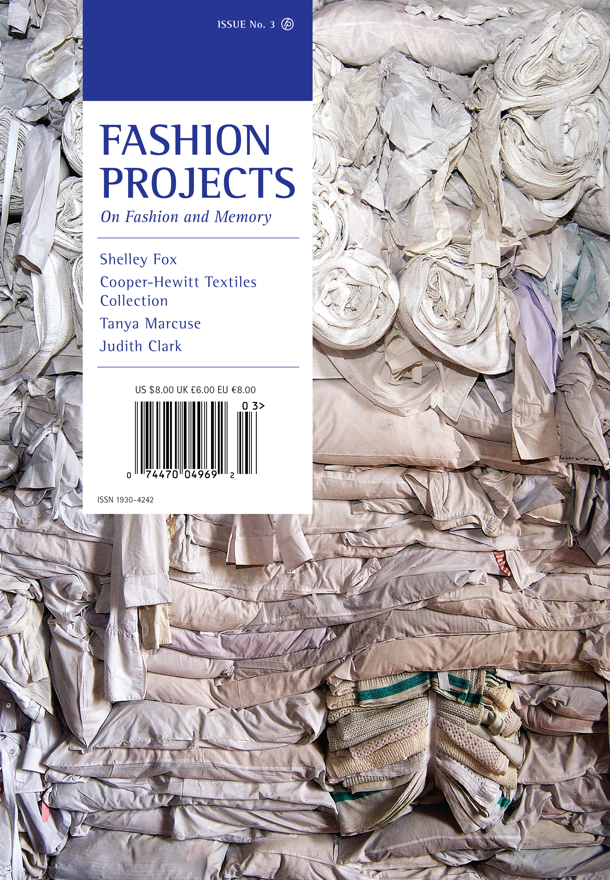
Fashion Projects began in New York in 2004, with the aim to create a platform to highlight the importance of fashion — especially “experimental” fashion — within current critical discourses. Through interviews with a range of artists, designers, writers and curators, as well as through other planned projects and exhibits, we hope to foster a dialogue between theory and practice across disciplines.
We are primarily a print journal, however we also publish web-based updates and interviews (a “digest” version of which you can receive by signing up to our mailing list or via our RSS feed) and are currently working on exhibits based on past and future issues. To order any of our issues visit our ordering page.
We are a nonprofit organization, which has previously received grants from the Lower Manhattan Cultural Council and the New York City Department of Cultural Affairs.
We are currently a sponsored project by the New York Foundation of the Arts, a 501(c)(3), tax-exempt organization. Contributions on behalf of Fashion Projects can be made payable to the “New York Foundation of the Arts,” and are tax-deductible to the extent allowed by the law. For more information please don’t hesitate to contact us.
Mailing List
Contact
For editorial inquiries please email francesca
For advertising and all other matters please email erin
Distribution
Fashion Projects is distributed in the U.S. and Canada through Ubiquity Distributors (tel. 718-875-5491, info [at] ubiquitymags.com) and in Japan through Presspop Inc. ( info [at] presspop.com). It can be found in independent bookstores, Universal News, and other magazines stands across North American and in select stores in Japan and Europe. You can also order it on our site via paypal.
|
|