
Belgian Fashion
/
Last week I went to Belgium, mainly to visit the collection of the Mode Museum in Antwerp. It’s one of the most interesting places for fashion exhibits thanks to their innovative installation practices, as well as their penchant for exhibitions which contextualize the designers’ aesthetics by showing how they’re articulated across a number of media and not exclusively within the garments themselves.
The exhibit that’s currently up is meant as an introduction to the MoMu collection, which has great pieces of contemporary experimental fashion alongside historical ones. And the juxtaposition of historical and contemporary garments, at times within the same mannequin, was perhaps the most interesting part of the show. In July, the museum will organize a show of Bernhard Willhelm’s work in collaboration with the designer himself, which promises to be quite comprehensive as Willhelm donated the entirety of his archives to the museum
MoMu also organized an exhibit on Belgian Fashion at the Flemish Parliament in Brussels. Called “Antwerp Six,” the exhibit is structured in four separate parts. The first is dedicated to the work of the Antwerp Academy and shows students’ work starting from the academy’s beginnings in the 1960s to the present. The subsequent section is dedicated to the Antwerp Six, as well as Martin Margiela. The third shows the work of more contemporary Belgian (or rather Belgian-trained) designers, from Raf Simons to A.F. Vandevorst to Bruno Pieters. Probably the most interesting section, it contains hard-to-find shows and garments by the now retired designer Jurgi Persoons, as well as a video of A.F. Vandevorst Spring/Summer 1999 show. Starting with models sleeping in what appear to be hospital beds, the AFV show must be one of the most lyrical fashion shows ever staged. While the fourth and final section is dedicated to the future of Belgian fashion. What was also interesting about the exhibit was its installation, as each section was made of a free-standing modular cube (whose surface was covered with press clippings about Belgian fashion). It constituted a smart way to exhibit both the garments and the fashion shows in a choesive manner, while sidestepping the fact that the room itself wasn’t quite meant as a traditional exhibition space.
Francesca Granata

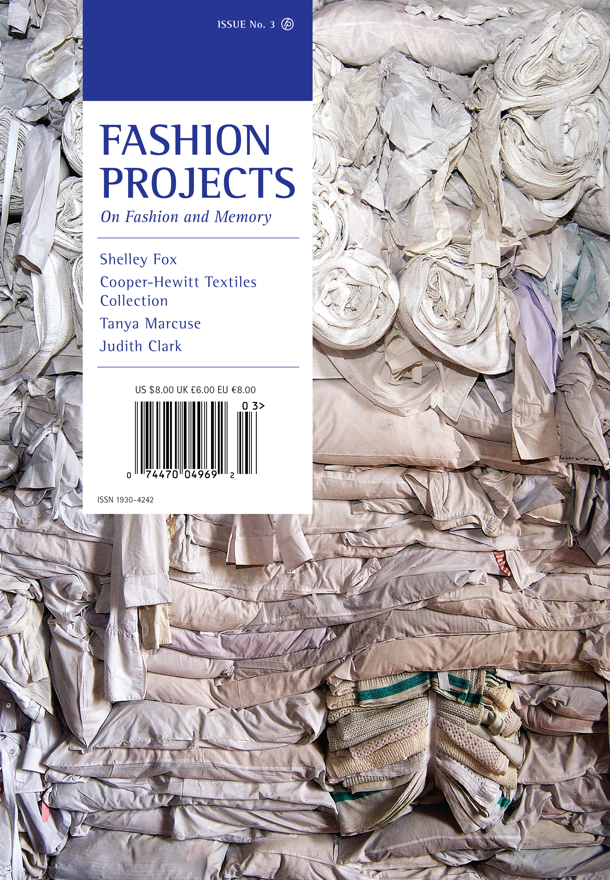


Fashion Projects #5 is devoted to fashion curation, examining the meteoritic rise in relevance of fashion exhibitions.
It features interviews with an eclectic assortment of leading practitioners from different corners of the world. The issue includes long Q&As with Harold Koda, the longtime, recently retired curator of the Met’s Costume Institute, as well as the Museum at FIT’s veteran leader Valerie Steele. It also features interviews with curators in Antwerp (the ModeMuseum’s Kaat Debo), Toronto (Royal Ontario Museum’s Alexandra Palmer) and Venice (Maria Luisa Frisa); academics studying the field (Hazel Clark, Annamari Vänskä, and Alistair O’Neill); and, giving an on-the-ground perspective, the Met’s head conservator, Sarah Scaturro. The issue’s cover stars Greer Lankton’s sculptural representation of legendary Vogue editor and Costume Institute doyenne Diana Vreeland, who continues to loom over the field years after her death.
Table of Contents
Introduction
Showmanship and History: An Interview with Harold Koda by Francesca Granata
Woman of Steele: An Interview with Valerie Steele by Lisa Santandrea
Exploring Fashion’s Openness: An Interview with Kaat Debo by Alex Esculapio
London, After a Fashion Curator: An Interview with Alistair O’Neill by Alexis Romano
Curation and Conservation: An Interview with Sarah Scaturro by Mae Colburn
Reflections on Fashion Curating
An Interview with Hazel Clark and Annamari Vänskä
Fashion in the Vast Museum: An Interview with Alexandra Palmer by Ingrid Mida
Restless Curating: An Interview with Maria Luisa Frisa by Marco Pecorari