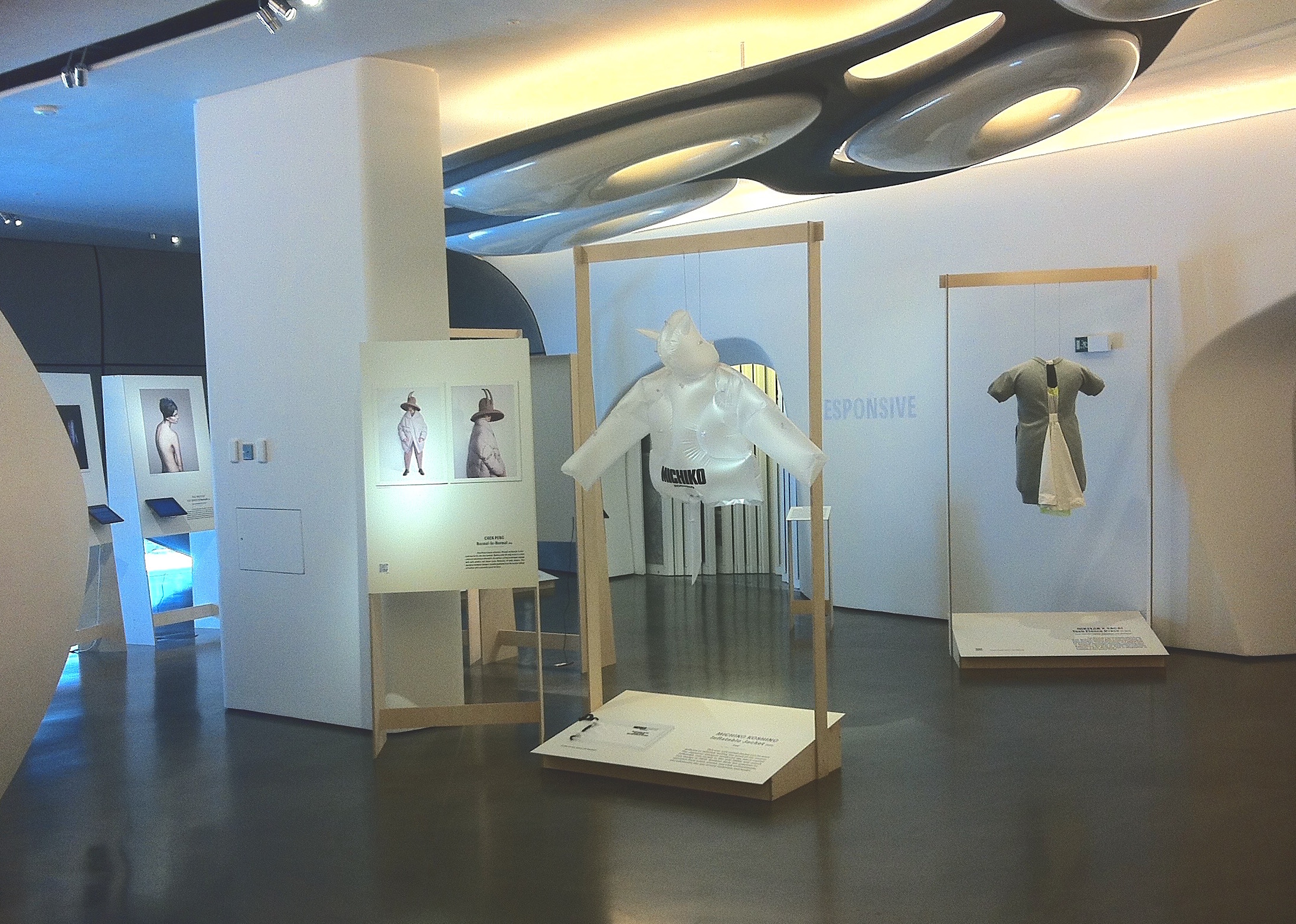
The fourth and final section, ‘Evolution: Adaptable Bodies’, explores future scenarios that challenge the limits of our body. The projects in this segment are speculative and diverse in approach, but all of them engage with the idea of an adaptable second skin that enhances, protects and expands the dermis. Ying Gao’s ‘Neutralité: Can’t and Won’t’ consists of two interactive dresses that react to the on-looker’s facial expressions. The two garments stop morphing as soon as the on-looker manifests an emotional response, thus forcing them to maintain a neutral expression if they wish to see the dresses change. The process was unfortunately shown only on video, which was a missed opportunity. ‘THEUNSEEN Swarovski’ turned the attention back to the wearer. Designer Lauren Bowker created a headdress covered with 4000 Swarovski gemstones which responds chemically to the wearer’s brain activity inducing different colour changes on the surface of the piece. The most forward-thinking project featured is perhaps Lucy McRae’s ‘Future Day Spa’, a personalised treatment that simulates the experience of being hugged by delivering controlled vacuum pressure to the body. The viewer can follow the one-hundred participants who signed up to take part in the installation in Los Angeles in 2015. Originally created to prepare astronauts for space missions, the Future Day Spa may be used in the future to help people who suffer with depression.
McRae’s project is a good conclusion to the exhibition as it brings together the many aspects explored in ‘Mode In Flux’, namely technology, the body and well-being. As a venue Roca London Gallery, designed by Zaha Hadid Studio, amplifies the future-oriented trajectory of the show. The dialogue between the practitioners’ shared desire to create a safe architecture for the body and the curvilinear, maternal elements Hadid is known for makes one hope that the future will be less cold and impersonal that most sci-fi fiction would have us believe.
———
Alessandro Esculapio is a fashion writer and PhD student at the University of Brighton, UK. He holds an MA in Fashion Studies from Parsons the New School for Design. He co-authored the books Just Fashion: Critical Cases On Social Justice In Fashion (2012) and The Fashion Condition (2014). His current research looks at contemporary fashion practices that articulate the mnemonic function of clothing




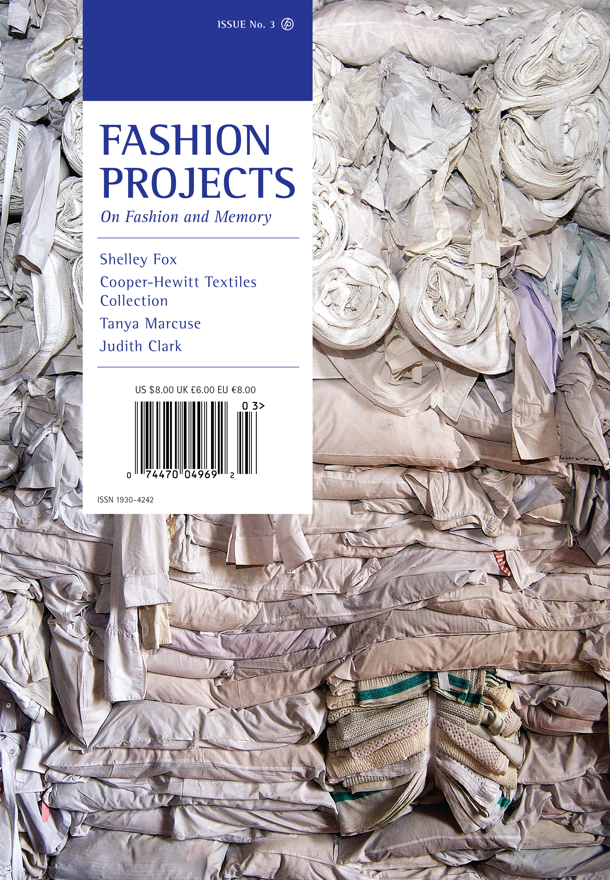


Fashion Projects #5 is devoted to fashion curation, examining the meteoritic rise in relevance of fashion exhibitions.
It features interviews with an eclectic assortment of leading practitioners from different corners of the world. The issue includes long Q&As with Harold Koda, the longtime, recently retired curator of the Met’s Costume Institute, as well as the Museum at FIT’s veteran leader Valerie Steele. It also features interviews with curators in Antwerp (the ModeMuseum’s Kaat Debo), Toronto (Royal Ontario Museum’s Alexandra Palmer) and Venice (Maria Luisa Frisa); academics studying the field (Hazel Clark, Annamari Vänskä, and Alistair O’Neill); and, giving an on-the-ground perspective, the Met’s head conservator, Sarah Scaturro. The issue’s cover stars Greer Lankton’s sculptural representation of legendary Vogue editor and Costume Institute doyenne Diana Vreeland, who continues to loom over the field years after her death.
Table of Contents
Introduction
Showmanship and History: An Interview with Harold Koda by Francesca Granata
Woman of Steele: An Interview with Valerie Steele by Lisa Santandrea
Exploring Fashion’s Openness: An Interview with Kaat Debo by Alex Esculapio
London, After a Fashion Curator: An Interview with Alistair O’Neill by Alexis Romano
Curation and Conservation: An Interview with Sarah Scaturro by Mae Colburn
Reflections on Fashion Curating
An Interview with Hazel Clark and Annamari Vänskä
Fashion in the Vast Museum: An Interview with Alexandra Palmer by Ingrid Mida
Restless Curating: An Interview with Maria Luisa Frisa by Marco Pecorari