
I have mixed feelings about Angel Chang’s Spring 2008 collection. From a technological standpoint, her third attempt to explore “bleeding-edge trends in fashion and technology” was a step back from her first two collections (Spring and Fall 2007).
Her most recent collection showcased shiny fabrics, soft colors, and a nice mix of structured/fluid silhouettes – but little else. Yes, there was the random thermochromic printed textile, as well as some use of innovative fabrics like X-static (with anti-microbial characteristics), but it appeared that Chang’s investigation into technological fashion stopped there. I was disappointed that one of the few emerging designers out there willing to tackle the question of how to make technological clothes actually fashionable was, in a sense, veering away from the very quality that made her so unique. Her designs, while not especially significant, are the kinds of garments that an urban woman would like to wear – functional, utilitarian, and pretty. A 2007 Ecco Domani Fashion Foundation winner, Chang from the get-go had credibility in the fashion world, thanks to her previous work at Donna Karan and other fashion houses and magazines. Because she herself does not construct technological components, nor develop the cutting edge techniques she employs in her designs (unlike the designer Despina Papadopolous of Studio 5050 who can both engineer circuits and design the end-use garment), Chang must rely on partnerships with technological designers, such as Sonali Sridhar and Mouna Andraos, the pair behind her thermochromic textiles. Perhaps Chang has finally realized that, although there MUST be more to technological fashion than Ipod docks, blinking lights, and disappearing inks - it’s pretty hard to figure out what else is out there, and even harder to find someone who can replicate it. Even though I was disappointed with Chang’s halted explorations into technological fashion, I was satisfied to see that Chang is still exploring militaristic themes. Her continued use of patterns with guns, camouflage, airplanes, etc speaks to the larger philosophical issue of the role technology plays in society, especially with regards to warfare. Overall, I think that Angel Chang’s work is commendable for its effort and scope. Perhaps it’s unfair to expect technological advancement with every fashion season. Although, shouldn’t fashion - especially "fast" fashion - be able to keep up with the rapid change that is occurring every day within the technology industry? 
Sarah Scaturro



 I have been meaning to write about
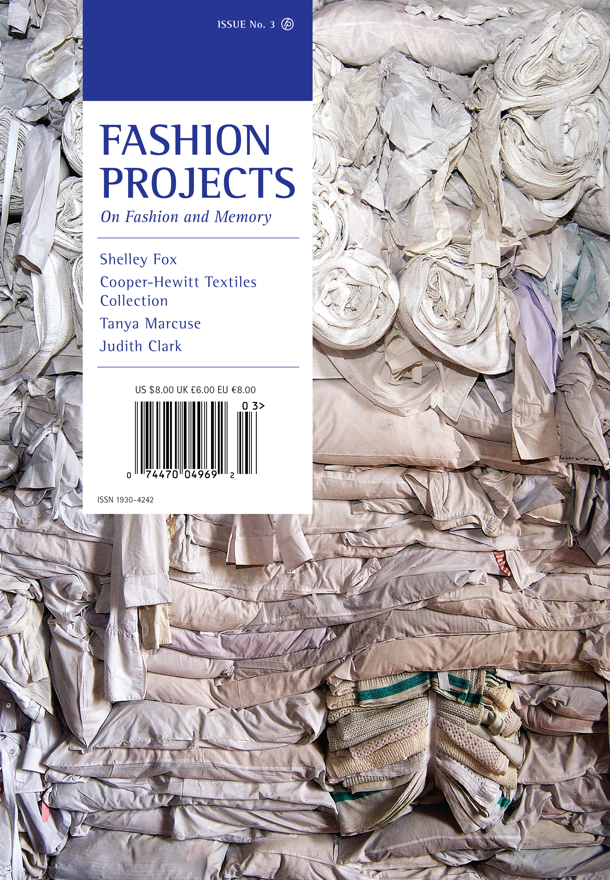


Fashion Projects #5 is devoted to fashion curation, examining the meteoritic rise in relevance of fashion exhibitions.
It features interviews with an eclectic assortment of leading practitioners from different corners of the world. The issue includes long Q&As with Harold Koda, the longtime, recently retired curator of the Met’s Costume Institute, as well as the Museum at FIT’s veteran leader Valerie Steele. It also features interviews with curators in Antwerp (the ModeMuseum’s Kaat Debo), Toronto (Royal Ontario Museum’s Alexandra Palmer) and Venice (Maria Luisa Frisa); academics studying the field (Hazel Clark, Annamari Vänskä, and Alistair O’Neill); and, giving an on-the-ground perspective, the Met’s head conservator, Sarah Scaturro. The issue’s cover stars Greer Lankton’s sculptural representation of legendary Vogue editor and Costume Institute doyenne Diana Vreeland, who continues to loom over the field years after her death.
Table of Contents
Introduction
Showmanship and History: An Interview with Harold Koda by Francesca Granata
Woman of Steele: An Interview with Valerie Steele by Lisa Santandrea
Exploring Fashion’s Openness: An Interview with Kaat Debo by Alex Esculapio
London, After a Fashion Curator: An Interview with Alistair O’Neill by Alexis Romano
Curation and Conservation: An Interview with Sarah Scaturro by Mae Colburn
Reflections on Fashion Curating
An Interview with Hazel Clark and Annamari Vänskä
Fashion in the Vast Museum: An Interview with Alexandra Palmer by Ingrid Mida
Restless Curating: An Interview with Maria Luisa Frisa by Marco Pecorari