Dress Codes at ICP

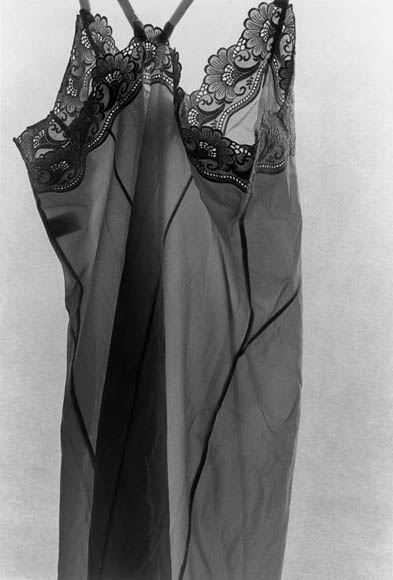
Miyako Ishiuchi, mother's #49, 2002, Gelatin Silver Print

Today I visited the Third ICP Triennial, "Dress Codes," which is dedicated to the interaction between fashion and art. Culminating the ICP's year of fashion, the outstanding exhibition opens tomorrow and will be on view through January 17.

Some of my favorite artists were included in the exhibition, including Tanya Marcuse and Miyako Ishiuchi, whose moving photographs of her deceased mother's clothes and accroutments were originally included in the Venice Biennale's Japanese pavilion in 2005. Also included is the work of the Brooklyn-based video artist Kalup Linzy (whose humorous work was first shown at Taxter and Spengemann), and the Turkish New York–based artist Pinar Yolacan, as well as a number of artists, whose work I was not familiar with, such as the German-based artist Thorsten Brinkmann, whose extravagant self-fashioning is reminiscent of Leigh Bowery's alterations of the body.

Fashion Projects' contributor Tamsen Schwartzman was also in attendance. She has a long-lasting interest in photography and its relation to fashion, and has written an extensive review for the Museum at FIT, which she has kindly agreed to let us republish:

"Dress Codes opens tomorrow.The third ICP triennial of photography and video and the last exhibition installment in their Year of Fashion explores fashion as a celebration of individuality, personal identity, and self-expression, and as cultural, religious, social, and political statements. Previous exhibitions, if you missed them, included Avedon Fashion 1944–2000, Edward Steichen: In High Fashion, The Condé Nast Years 1923–1937, and This Is Not a Fashion Photograph: Selections from the ICP Collection.

Most survey exhibitions of art or photography are a mixed bag. And Dress Codes is no different. However, there is enough really engaging, thoughtful work to make this a necessary visit for the fashion and photography enthusiast.

Jacqueline Hassink BMW Car Girls, 2004 © Jacqueline Hassink Courtesy Amador Gallery, New York

In my opinion, they put some of the strongest work on the top level. There you'll find Jacqueline Hassink's video "BMW Car Girls" which explores how beautiful models are used at car shows to add human seduction to the man's buying experience. The models, and the way they are dressed, function as a branding device and transfer glamour and sex to the car. The video shows how the men shift their attention back and forth from the cars to the girls and back. A fascinating and captivating video.
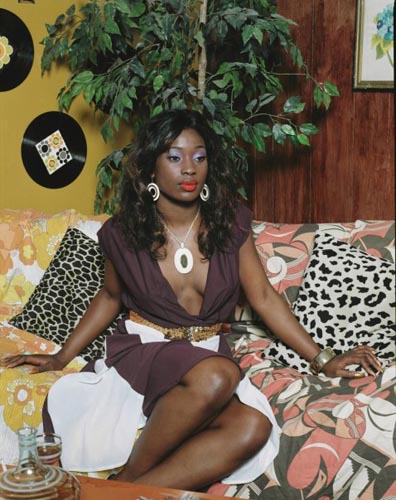
Mickalene Thomas Portrait of Qusuquzah, 2008 © Mickalene Thomas Courtesy the artist and Lehmann Maupin Gallery, New York

Right next to "BMW Car Girls" are three photographs by Brooklyn artist Mickalene Thomas. Her staged photographs celebrate and critique archetypes of black womanhood. Powerful, enticing, sexy, and confrontational, I thought it was some of the best work in the show. The photographs reference the pop aesthetic of Blaxploitation films, Seydou Keïta’s lushly patterned portraits, and Matisse's odalisques. I couldn't help but think of the recent Yinka Shonibare exhibition at the Brooklyn Museum when looking at "Le Leçon d'amour" 2008 and how they share the persistence of the colonial viewpoint. The photos also brought to mind an article I read this morning about the upcoming Tate Modern exhibition Pop Life: Art in a Material World that will include the controversial work of Rob Pruitt and Jack Early.

Another highlight of the exhibition is Tanya Marcuse’s exquisite platinum prints from her "Undergarments and Armour" series. These corsets, breastplates, and bustles from museum costume collections (including ours!) reflect Tanya's historical awareness of how the body has been sculpted and modified through fashion. They also expose dualities of masculine/feminine, hard/soft, hidden/revealed, aggression/vulnerability.

Stan Douglas Hastings Park, 16 July 1955, 2008 © Stan Douglas Courtesy the artist and David Zwirner Gallery, New York

Sartorial signs are addressed in the works of Alice O'Malley, Stan Douglas, and Cindy Sherman. Alice O’Malley's portraits of downtown New York performance artists and musicians serve to address how clothing and makeup are used to articulate outsider identity. Stan Douglas' "Hastings Park, 16 July 1955" is a large-scale photograph depicting the working class at leisure at a Vancouver horse track in 1955. He utilizes extraordinary detailed period dress that contains subtle indicators of working-class status.

Plase vist the Museum at FIT to read the rest of the review

Music and Fashion: Yoko Ono and threeASFOUR

threeASFOUR, Spring/Summer 2010. Photo: Marcio Madeira

I attended the threeASFOUR show this past Thursday—both the show and the collection were inspired by Yoko Ono, who also contributed some prints for their collection.

Fashion Projects contributors Sarah Scaturro and Jay Ruttenberg were both in attendance. The latter wrote a witty report on the show, which comments on the use of music in fashion shows, for Time Out New York:

"The experimental fashion label threeASFOUR, a kind of art collective that sews, presented its Spring 2010 collection last night at MAC and Milk, on 15th Street. Usually, when fashion designers claim to use a music figure as a “muse,” it seems to mean their collection bears vague resemblance to a British depressive from the early ’80s, or Debbie Harry. The trio of New York designers behind this show turned to an infinitely more engaging idol: Yoko Ono.

The label was not merely paying lip service to the artist’s work. Ono sat front and center under an enormous hat, sandwiched between Sean Lennon and Carrie Fisher. Many of the coolest pieces incorporated prints made by the artist decades ago; other garments came in Manhattan black, Ono’s color of choice—she is not a floral-print kind of gal—as well as a nod to the old avant-garde world in which she made her name. The event’s soundtrack came courtesy of Ono too—relying predominantly on her more ethereal work but concluding, cinematically, with the resounding thump of “The Sun Is Down” from her handsome new album, Between My Head and the Sky. At assorted Fashion Week events this year, I heard music by Palace Brothers (in the background of an art-type thing), Spaceman 3 (accompanying a menswear show in which every model seemed to be auditioning for a Jesus and Mary Chain biopic) and, of course, dreadful dance music (do these designers aspire to cliché?). Ono’s music fit best, lending the threeASFOUR show a savage, dreamlike aura."

Read the rest of the Review on Time Out New York

threeASFOUR, Spring/Summer 2010, Dress with Yoko Ono's Prints and Black Leggins with Circle Cut-Outs

Merce Cunningham and Fashion

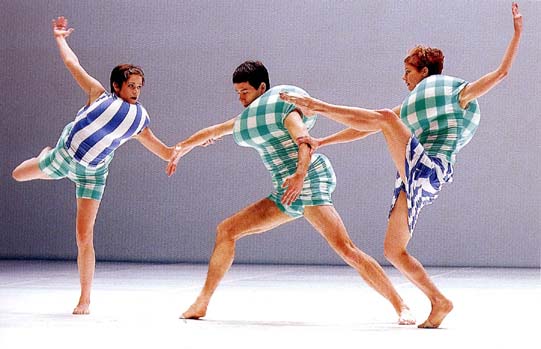
Merce Cunningham wearing a bulging Kawakubo's costume. Poster for Scenario, 1997. Photo: Thimoty Greenfield-Sanders.

Merce Cunnigham, who died July 27 at the age of ninety, had an unreputably lasting influence on the development of dance in the 20th century. In addition to his numerous collaborations with a number of visual artists, starting with Robert Rauschenberg, and musicians from John Cage, his life-partner, to Thurston Moore of Sonic Youth, he collaborated with the avant-garde fashion designer Rei Kawakubo. This was prompted by the Japanese designer's Spring/Summer 1997 collection “Dress Meets Body, Body Meets Dress and They Are One,” which created a range of unorthodox body shapes by including padding at the hips, back and belly.

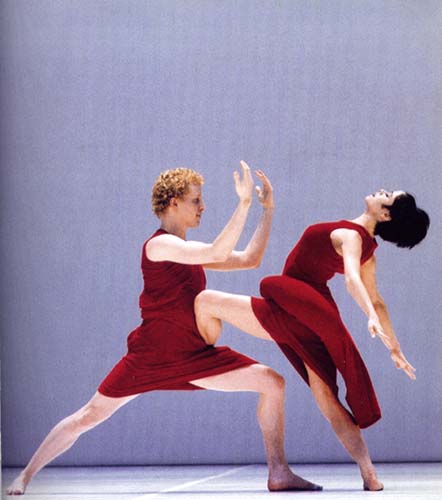
The dance borne of the collaboration is titled Scenario, and premiered in October 1997 at the Brooklyn Academy of Music, where the dancers’ movements took place against a stark all-white stage, lit with fluorescent lighting to the contemplative repetitive music of Takehisa Kosugi and Thurston Moore. Scenario is roughly made of three movements punctuated by the change of the pattern and colour of the outer garments from gingham and striped blue and green, to all black and finally all red—while the padding understructure remains the same throughout. The way Kawakubo’s garments became activated by the dancers’ bodies in motion allowed for the creation of novel and unexpected bodily formations—which reinforced Cunnigham's exploration of the limits and scope of bodily movements, as well as enhancing the bulges and “distortions” of Kawakubo’s 1997 collection.

Scenario, BAM, 1997

Much like Cunningham's entire oeuvre, Scenario leads into uncharted formations and articulations of body shapes, this time highlighted by Kawakubo’s costumes. The alteration of proportions, and of one’s relation to one’s body and to the body of the other dancers and the subsequent sense of estrangement it creates is summed up by dancers in Cunningham’s company, who described the experience as alternatively liberating and unsettling: “If I were to be asked about it as a dancer, I would say it was more of a liberation when I came onto this incredibly wide stage in the costume.” “It’s bizarre to roll on the floor. Or when you touch someone, you’re a foot away from them.” There is, in fact, an element of absurdist humour in Scenario. This is especially evident in the first movement of the piece where the dancers are wearing the costumes with oversized gingham and striped patterns, which are not altogether unlike the heavily patterned costumes characteristic of the Commedia dell’Arte—of Harlequin, in particular.

Humor had been previously explored through costumes in a much earlier piece by Cunningham: Antic Meet from 1958. For this piece, which contains parodic references to Martha Graham's dramatic style of dancing, Cunnigham knitted for himself a sweater with four arms and no neck hole, and in a faux climatic scene struggled to resurface from the sweater. (Footage of the scene can be found in Charles Atlas’ documentary Merce Cunningham: A Lifetime of Dance).

Francesca Granata

Scenario, BAM, 1997

Lowbrow Reader Variety Hour at Housing Works Bookstore Cafe

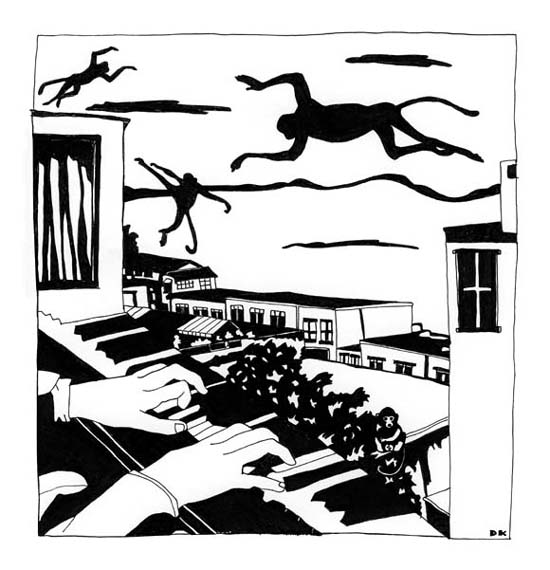
Illustration for Gilbert Rogin's Lowbrow Reader story by Doreen Kirchner

Fashion Projects contributor Jay Ruttenberg is organizing a launch event for the new issue of the Lowbrow Reader, his Manhattan-based comedy journal. The Lowbrow Reader is a small, lushly illustrated comedy magazine edited by Jay Ruttenberg. Its new issue, #7, includes work by Shelley Berman (Curb Your Enthusiasm), David Berman (Silver Jews; no relation) and Sam Henderson (Magic Whistle). Much of the issue is devoted to the novelist Gilbert Rogin, including an assessment of his work by Jay Jennings and the first piece of fiction by Rogin to be published since 1980. It is available online, and in smart stores everywhere.

The event will take place at the Housing Works Bookstore (126 Crosby Street in Soho) on Wednesday July 22nd from 7 to 9 and promises to be an exciting and diverse night. The show will feature short acoustic performances from three great musical acts: The Fiery Furnaces, Peter Stampfel and the Ether Frolic Mob, and Larkin Grimm. There will also be an incredibly funny comedian, John Mulaney, and a reading by Gilbert Rogin, a retired New Yorker writer whose work appears in the new Lowbrow Reader. There is a cover charge of $10 to $5 on a sliding scale, and all of the money raised will go to Housing Works—one of our favourite charities that did pioneering work on AIDS.

For more information on the bands and the event please visit the Housing Works event site.

Update! Below are some photos from the event:

The Fiery Furnace playing at Housing Works as part of the Lowbrow Reader Variety Show. Photo by Jesse Chan-Norris

Larkin Grimm playing at the Lowbrow Reader Variety Hour. Photo by Jesse Chan-Norris

Peter Stampfel and Ether Frolic Mob at Housing Works. Photo by Jesse Chan-Norris

Author Gilbert Rogin reading at Housing Works. Photo by Jesse Chan-Norris

Space Mediations, Space Meditations: An Interview with Gabi Schillig

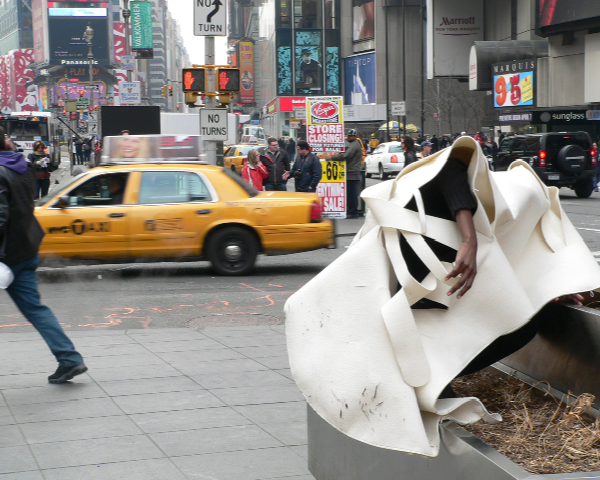
Gabi Schillig, artist and architect, has just completed her four month residency at the Van Alen Institute in New York City. A resident of Berlin, Schillig investigates the relationship between the body and its surrounding space. Her work as a Van Alen Fellow culminated in photo-documented performances around New York involving dancers interacting with her unique, transportable and transformable felt structures. These structures were temporarily grafted onto architectural elements in the city, a form of space mediation which instantly cleaved the wearer's body to their urban environment. Now back in Berlin, Schillig has graciously answered a few questions regarding her provocative project.

What was the importance of felt to your project? Were there any other materials that you had experimented with? Did the fact that felt was traditionally used in housing in Central Asia play into your decision?

For me, there were many different reasons to use felt for my project. One, of course, is the tactile quality of the woolen felt, its variation in thicknesses, density and finally its initial pre-defined structural quality that it provides. Felt is very structural from the onset - fibers connect to each other through a dynamic production process, creating structural surface through density. Furthermore felt protects from environmental conditions such as rain, sun or noise, yet still has the potential to transform in shape despite its structural strength. There are other interesting social and artist´s positions that have influenced my choice of material. Felt’s tradition in general was certainly of great influence for me. But what fascinated me the most was, on the one hand the traditional notion that comes with the felt, but on the other hand its very contemporary and technical uses.

What was specifically interesting to me was to bring the materiality of felt into the urban landscape, a material that is usually considered to be alien to the hard, static and rigid surfaces of a city. Any form of textile materiality in the city constitutes an oddity. Textile structure, in conventional usage, relates clearly to the human body, figure and scale, and thus has the power to produce something new. Within the urban / built environment, the soft geometries and textural surface of textiles allow different social space and interactions to emerge.

I'm reminded of the Turkish Kepenek cloak currently in the Fashioning Felt show at the Cooper-Hewitt. This traditional cloak is worn during the day by sheepherders, and then used as a type of "pup tent" for sleeping at night. Similarly, your structures are portable, and can alternately protect, clothe, and shelter people. Was the multi-functional and portable nature of your structure a primary concern of yours?

I saw the Turkish Kepenek cloak about one year ago in a book on felt and its traditional usage. It was amazing to see it now at the Fashioning Felt Exhibition at Cooper Hewitt - the Turkish Kepenek coat was one of my favourite pieces in the exhibition. This traditional item fascinated me for the simplicity of its shape and usage on the body. Of course it also functions as a kind of shelter against the rain and sun, and the fact that it is "transformable" from a piece of clothing to a tent, a mini-architecture or a cocoon-like structure, had already informed my previous project "Raum(Zeit)Kleider" that I worked on a year ago. A multi-functional nature played an important role in that work, and has always been essential to all of my textile projects. My architectural understanding is about creating spatial boundaries that are not rigid, but rather permeable, changeable - open for adaption and appropriation, creating an ephemeral state of space and allowing for a temporary spatial experience.

"Raum(Zeit)Kleider" still stayed very much in the studio where I had a dancer interacting with it, exploring different states and functions that the textile object could take on in relation to the human body. Now, with "Public Receptors: Beneath the Skin" I had the chance to develop three textile structures and implement them in New York City´s urban public space. Those body/urban structures were moving out of the studio, away from a static and autonomous architecture, towards open systems and soft geometries. Both clothing and architecture can be considered an extension of the body, establishing specific spatial organizations by defining relations within the system itself, as well as between the human body and the built environment. Basically as an architect I am providing an open system, which I give away at a certain point to be appropriated and used by other people. This inclusion of the observer in the design process plays an important role in my projects.

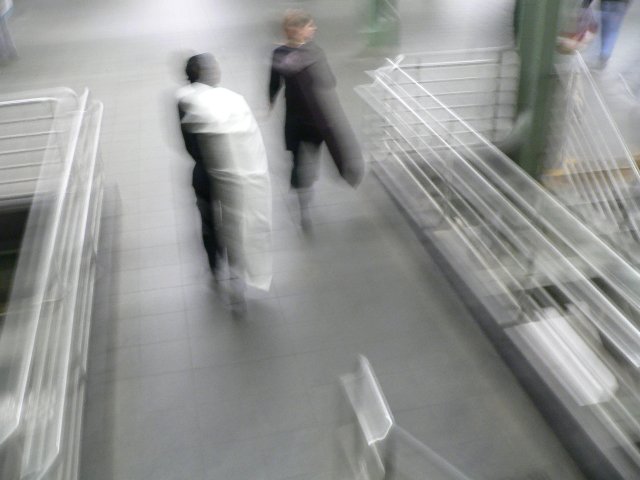
The portable nature of the public receptors was very important, as we needed to transport them in the city - walking, taking the subway etc. The textile objects come folded in bags that can be attached to the body, carrying them through the urban fabric. There is this whole notion of unfolding and folding, packing and unpacking the pieces when being used in the city. It is a temporary intervention that happens spontaneously as soon as a certain locations are "found" in the city where we wanted the structures to unfold and to appropriate space.

And finally, for me three artists were of great importance: Lygia Clark, Helio Oiticica and German artist Franz Erhard Walther. They all investigated in their works notions of participation, the body, performance and particularly geometric abstraction and were working with open systems - textile structures, which reveal entirely unique visual, tactile and acoustic qualities, creating a dialogue between the person and his/her environment. All to be discovered in an object that is not static but that is an open system which is transformative.

Felt structure portable

What were your criteria in picking public spaces? Are there any spaces that you would have liked to interact with that you didn't?

Our aim was to document one day of walking through New York City, implementing the objects into various urban environments that are very diverse from each other. A few days before, the performers and I discussed together various locations that we were interested in. It was great that two of them are originally from New York, so I could share my own experiences in the city with theirs, which were much more the views of "real" New Yorkers. My projects are collaborations where the influence and ideas from my partners are very much appreciated, starting from Barbara Barone, who was the key figure in producing and sewing the heavy felt structures with me, to the performers Lydia Bell, Khalia Frazier and Stephanie Fungsang, who were interacting with the objects out in the public.

As you have seen in the exhibition, I had 11 images framed on the wall. Each of those images basically represents one site that we had chosen on our way up from Central Park down to Brooklyn and back up to Grand Central Terminal. Most of the location we decided upon beforehand, but of course, as soon as you enter a specific location you have to find a spot where you want to attach the soft geometry to an urban element. Especially in the beginning of the day, at the beginning of our "endeavor" I was pretty worried what would and would not be possible in certain locations. Central Park seemed to be pretty easy, but when it comes to sensitive locations such as Times Square, Wall Street or Grand Central Terminal where there are a lot of police, army or security around, I got a little nervous and was waiting for them to stop us doing what we were doing. But nothing happened - on Wall Street we were doing the performance close to a police car and nothing happened. So, obviously soft bodies and geometries are not to be seen as a threat, even if you attach them to building or urban elements. This was a completely surprising and positive experience for me, as I thought after 9/11 especially in New York everything you do out in the public is monitored and observed with great anxiety and concerns.

The Mapping of those 11 specific sites were of great importance as well. We were doing the performances on March 16, 2009, s specific day with specific characteristics in terms of weather for instance. And of course each site carries specific information with it such as the exact coordinates, weather conditions, time during the day and also dirt. The dirt became conceptually very important for the project as well. Each site carries its specific dirt that leaches traces on especially on the white felt structure that we were using. It basically now carries the memories of the city, of 11 different locations, which we went to on a specific day, during a specific time under a certain weather condition. This mapping of the specific locations and its characteristics and the white felt carrying the memory of New York City became a strong point in the work.

Quite often we found interesting locations and urban objects on our way through the city and did a performance there spontaneously. It was all about improvisation and what can be discovered in that process. I was lucky to have great people around me who would be as curious and enthusiastic about the project as I am, to come all the way with me.

Of course, there are many more spaces that we could have used for our interventions. I guess the more you do the less afraid you become and the more you risk. For instance, how about doing such a performance on a very public building that is so highly secured that usually you´re not even allowed to touch or to enter. The trick is that by using clothes and soft materials you seem not to be a threat to the public at all. And that was also the strategy - to start with a piece of clothing and then use this structure to form your own body architecture in the urban fabric, extending your own private body into public space. For me, the limit of a person is not the outermost layer of skin. Therefore, these spatial structures de-limit the surroundings of the body, marking out a territory in the public urban fabric that allows a person to reappropriate the notion of living, bringing architecture back into the realm of the everyday. Also, I am planning to implement public receptors back here in Berlin - I am interested to see if people would react here differently in comparison to New York.

Did you tell the dancers how to interact with the structures? Did they tell you how they felt inside the structures?

As soon as I met Lydia, Khalia and Stephanie I completely trusted them. They knew from our discussions what I was after and that the interaction between the textile structures and the urban environment was very important for me. We met one time before to discuss possibilities and what was I interested in. After that point I left the interaction with the textile structures completely open to them. As I've mentioned before, in my work an essential element is leaving my own control behind, handing it over to other people so that I can explore what will happen and see with surprise what new things are able to emerge out of the open system that I've provided. The question of authorship gets blurred in this moment, which I like. The dancers were basically becoming part of the design process, which is for me open-ended. It is not about the end product or object, but what the spatial system can generate when being used by others. I have learned how important it is to give things away to see how other people interact with it. The figure of the architect traditionally is very much connected to the notion of power. Many architects say they are building for people, but I often doubt that. In the end it is about their own power and control, building designs which leave no space for true appropriation, and the people who have to use the space in the end don´t have any influence on the design process itself.

The dancers told me they "learned" more about the objects with each performance. It was basically about "getting to know" their behavior in relation to the body (or many bodies), their materiality and exploring different possibilities that are hidden in the objects and their different usage. But of course also every site of implementation if different, with its own specific urban condition, people and environment. So each performance was exciting and a new challenge. I guess that one feels pretty safe and secure while being inside those structures. On the one hand, it is an extension of the own body into public space, but the inside space stays very private. That of course relates again to the material and tactile qualitiy of the felt itself, its protective characteristics in terms of outer physical conditions, also including the protection against sound or noise that comes from the outside. So in the end it is a protective device that puts you out in the very most public spaces of New York City, but that still preserves your own, very personal and intimate space that surrounds your own body.

Why did you choose not to document your interaction with the structures?

For me my own interaction with the structures is basically the process of the "Making". During the three months that I worked on the Public Receptors, I continuously documented the design and production process, using different techniques, my camera, camcorder, computer and sketchbooks. For the exhibition at Van Alen Institute it was very important not to show only the textile structures and "final" images. In the whole exhibition you can find traces of the process, to be shown as films on small screens (e.g. the sewing process as short film or me interacting with the objects while figuring out the best strategic way to fold them) or in the little booklets that are distributed in the gallery space on specific locations. The two sketchbooks that you find in the gallery space as well, document my whole thinking process from the last one year, which now manifested itself in the production of the objects themselves.

Are you planning on continuing working with felt? Are there any other textiles that interest you?

I think that felt will definitely continue to play and essential role in my future work. On the other hand I am very curious to explore other materials as well, such as other textiles but also completely different materials. How for instance could I create a transformable object out of a rather static material? I am on a continuous search for new possibilities and am curious about different materialities in general.

The relationship between designing and making requires a certain body of knowledge that resides in the space and time of the working process. Spatial techniques and their established relations may be based upon a beautiful way of ordering elements by defining an open, but clearly defined, system that is able to transform. At the same time the system´s behavior is very much related to its constituent elements, their materiality and their spatial organization. It is fascinating that even flexible elements have the potential to collectively rigidify, when brought together in a certain geometrical order and hierarchy - to be found, for instance, in spatial formations of textile techniques. Open spatial systems that are generated physically and on a material level, hold a great potential to explore unexpected links between those relations. Those tectonic structures possess the ability to adapt, are open for appropriation, and at the same time interact with the environment and enable a constant change of bodies and spaces. This design model stands against a loss of the living body and its senses in the design process and looks beyond humanist practices to consider the body as fixed and static. The rebirth of the tactile, the transformative potential of space and matter determine that action and perception become one.

Photographs courtesy of Gabi Schillig

Interview by Sarah Scaturro