Dolls

Laurie Simmons, Woman/ Purple Dress/ Kitchen, 1978

While the Victor & Rolf exhibition opened at the Barbican in London, with a gigantic doll house containing doll-size replicas of Victor & Rolf's collections of the past fifteen years, in New York there is a much more "minute" doll-themed show by the artist Laurie Simmons.

The New York-based artist's early work, dating from the late 1970s, is on show at Caroline Nitsch's project room and will be on view until June 28. Simmons' black and white photographs stage female dolls in miniature houses and rooms. Some of the houses' façade are disassembled, while the rooms' furniture gets "dislocated" from their proper place. These altered female interiors combined with the off-kilter placement of the figures doubles the uncanny feeling conveyed by the dolls and relays a feeling of disrupted and alienated domesticity.
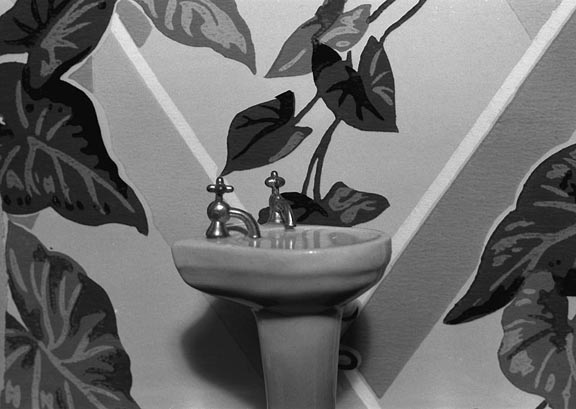
Laurie Simmons, Sink/ Ivy Wallpaper, 1976

Murakami, "Mr.Pointy." Photo by Julien Jourdes for The New York Times

The Murakami exhibition which is currently on view at the Brooklyn Museum, where it traveled from the Los Angeles Museum of Contemporary Art, has been extensively discussed, particularly in relation to the inclusion of a mini-Vuitton boutique carrying the Murakami-Vuitton products in the midst of the exhibition. The debate raised by the store inclusion is a testament to the still-fraught relation between fashion, art and commerce—or rather the fraught relation between art and commerce, which seems to come in sharper focus when said art is aligned with fashion—the quintessential commodity. (The relation between art and fashion ultimately seems to highlight the status of art as commodity—one which, at least within the confines of the art museum, still seems to make people uncomfortable. In this particular case, it suggests a continuum between museum-goers and consumers, or perhaps the notion of museum-goers as consumers of culture and luxury goods alike.)

However, what I found most interesting about the presence of the Vuitton “boutique” in the Brooklyn museum is not so much how it re-activated these debates, but rather how it framed the store and the activities within it as performative. It highlighted the ritualistic nature involved in the consumption of goods (particularly luxury goods) which often goes undetected. In the process, it made these generally seamless actions strange and slightly unsettling.

Vuitton Store at the Brooklyn Museum. Photo by Julien Jourdes for The New York Times

Witnessing a couple purchasing a Vuitton-Murakami bag from the store clerks dressed in pristine white shirts, the viewer was made acutely aware of the awkwardness of the exchange—the forced niceness of the sales clerk and the equally forced (at least in this context) nonchalance of the luxury shopper. This exchange became even more awkward as the museum-goers, following the unwritten rules applying to exhibition-viewing, stared intently at the space and the activities taking place within it, trying to decipher its meaning…

Francesca

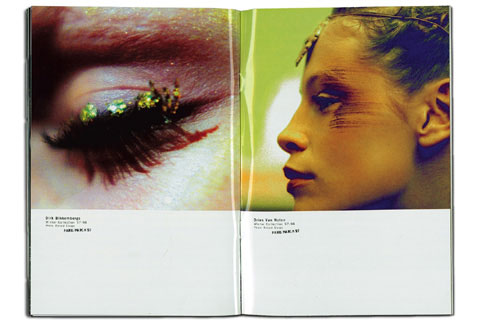
Acne Paper on Inge Grognard

Inge Grognard for Martin Margiela

Don’t miss the current (Spring/Summer) issue of Acne Paper. Of particular interest is the interview with the make-up artist Inge Grognard, whose work often confutes traditional notions of beauty and of what falls under the category of make-up. Grognard has collaborated with a number of Belgian designer (Dries Van Noten, A.F. Vandervorst, Jurgi Persoons) and is particularly well-know for her collaborations with Martin Margiela, whose runway show often used a combination of “accessories” (such as veils and masks) and make-up to cover the model’s eyes and shield their identities.

In the interview with Anja Cronberg for Acne, she recounts her early work with Margiela, who she had met in high school, as well as of her own projects: “I use myself as a model—Grognard says—I use dolls or masks, and then my husband [photographer Ronald Stoops] documents it.”

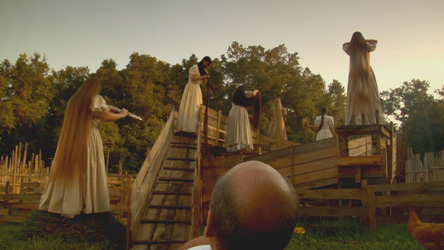
Mika Rottenberg, Cheese

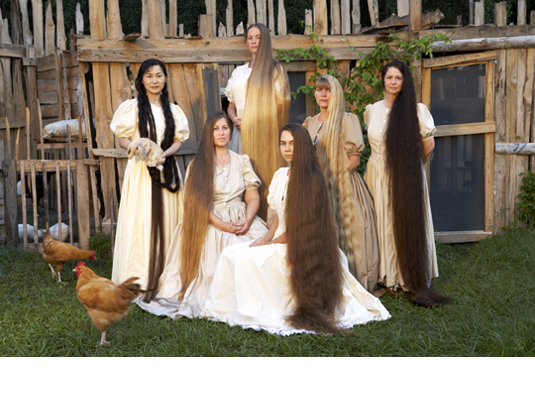
Mika Rottenberg, Cheese, 2007.

I have been meaning to write about Mika Rottenberg’s video installation Cheese at the Whitney Biennial, which just closed. Based on the relation between the body and labor and on the generative ability of the female body, it intertwines grotesque and carnivalesque elements in an absurd makeshift farm setting.

This particular video-installation was shot in Central Florida on the property of one of several women starring in the video—all of whom sport incredibly long hair. (The performers belong to a “long-hair club.”) The piece is based on the story of the Southerland Sisters, 19th century sisters who displayed their extremely long hair in a Barnum and Bailey performance and marketed hair fertilizers: a hair growth formula allegedly made from their own hair, mixed with water from the Niagara falls.

Presented in precarious architectural structures, the footage was shown across a series of different monitors and portrayed the women wearing chemise dresses and engaging in what appear to be absurd and pointless repetitive tasks—many of which involved manipulating their long hair, on a makeshift wood structure, surrounded by farm animals.

In an interview in Flash Artwith Merrily Kerr, the artist points out how “there are parallels between the incredible amount of labor that goes into farming and the routine the women adopt to care for their hair, such as brushing it daily for two hours.” She adds: “My videos employ clichés about femininity, and this one involves associations between women, fertility and the earth. […] But the fun really starts when I dissect the clichés turning them inside out and showing them as they really are—creepy and uncanny.”

Francesca

For more information, see Merrily Kerr’s interview with the artist in the July-September 2007 issue of Flash Art, and/or a video interview with Rottenberg on Coolhunting.

Yves Saint Laurent Retrospective

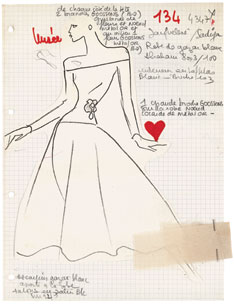
Original sketch for the Wedding Dress from the collection sketchbook; Fall-Winter 1988; Graphite on paper, gazar sample; Fondation Pierre Bergé - Yves Saint Laurent; Photo Fondation Pierre Bergé - Yves Saint Laurent

***Update: Yves Saint Laurent died Sunday, 1 June 2008. His obituary is here.***

The opening of this retrospective exhibition at the Montreal Museum of Fine Arts has flown surprisingly under the radar for being so close to New York City. Curated by the French costume historian Florence Müller, the emphasis is on the dialogue between Yves Saint Laurent and art, both in terms of considering his garments as actual art objects and in recognition of his inspirations found in art. The display is broken into four themes: sketches, gender-bending, color usage and lyricism. The exhibition includes over 160 looks spanning his entire career culled from over 5000 ensembles and 15000 objects belonging to the Fondation Pierre Bergé – Yves Saint Laurent.

The museum’s website, while lacking a bit in object photographs, does have a few video clips along with brief biographical notes on his life.

Montreal Museum of Fine Arts The exhibition runs from May 29 to September 28, 2008, before moving on the Fine Arts Museum of San Francisco.