Slow and Steady Wins the Race at Kiosk

Slow and Steady Wins the Race's Installation at Kiosk (February 14, 2009)

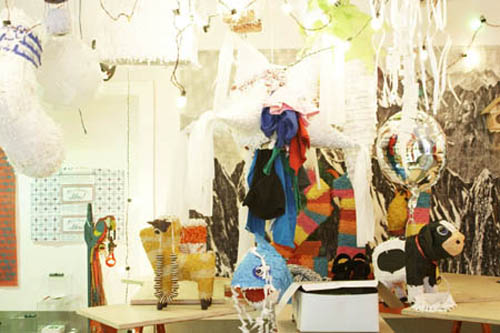
It’s interesting to see designers choosing to have exhibitions, as opposed to shows or presentations, in conjunction with fashion week. The New York–based conceptual designer Mary Ping of Slow and Steady Wins the Race organized a small exhibition for the 21st installation of her line. It was organized along the lines of a birthday party with piñatas and birthday cakes. The saccharine display seemed to do away with garments all together, but, at a closer look, one could see clothes dangling from one of the smashed piñatas. Each piñata actually contained Ping’s conceptually evolved and witty garments, yet their contents remained secret, but to the lucky buyer.

Slow and Steady’s production of slow, high-quality design at affordable prices seems perfect for our contemporary times and well aligned with the mission of Kiosk—the exhibition space/design store that hosted the event.

Other Fashion Weeks Part 1: The Foundry

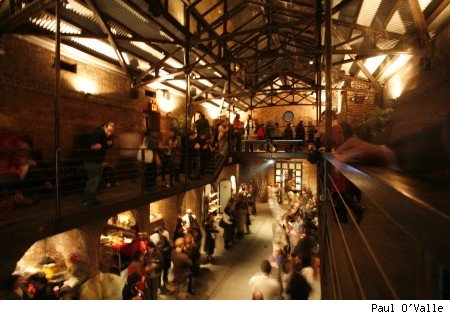
New York Fashion Week was book ended by alternative fashion week events, which were, unfortunately, scarcely written about. Prior to the official beginning of fashion week, a number of independent designers staged a show in Long Island City inside a great industrial space—a repurposed foundry.

I was late to the show—and, oddly, was admitted to the backstage area as opposed to the actual venue. Despite its timely nature, the format of the show seemed similar to a traditional fashion show (at least judging from the view from backstage). It was organized by a boutique-cum-gallery in Queens called Subdivision, whose mission is to promote designers working across media; it hosts performances as well as art shows and carries an array of clothes and design wares.

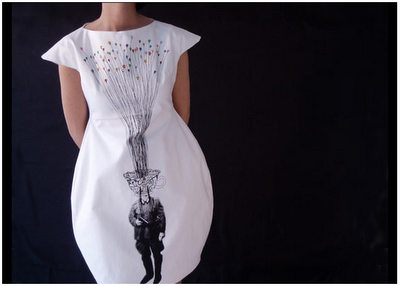
Dress, Death by Drones

Among the most interesting designers were Feral Childe, the artist/designer duo of Moriah Carlson and Alice Wu, whose whimsical prints adorn their detailed garments. Another interesting designer, the young Brooklyn-based duo Death by Drone, was equally print-heavy. I had been meaning to write about them on occasion of their graduation exhibition at Parsons, where they hung their mostly black and white, heavily printed dresses from white and black balloons.

The palette for their work in the Foundry show was equally minimal. The prints adorning their clothes are deceivingly child-like. Upon closer look, they reveal disturbing, slightly perverse undercurrents. Their work reminds me of the Japanese artist Yumiko Inada, who was featured in the very first issue of Fashion Projects. Their pieces are similarly toying with the category of cuteness and turning it on its head. In addition to their clothes, their standalone Ubi Roi-esque illustrations "Tiny People" are not to be missed!

Symposium at FIT

Cue Club, Notting Hill, 1966, Photo by: Charlie Phillips (from the V&A exhibition Black British Style).

FIT is currently hosting its annual fashion symposium. Organized by Valerie Steele cuncurrently with the Gothic: Dark Glamour exhibition, this year's symposium is dedicated to the topic of subcultural styles.

Among the speakers are Carol Tulloch, who completed extensive research on black British style and curated an exhibition on the topic at the V&A in 2004, and the anthropologist Ted Polhemus, known for his pioneering theories on subcultural styles. A special space seems to be occupied by Japanese style, with three speakers--Yuniya Kawamura, Hiroshi Narumi and Tiffany Godoy--discussing various aspects of Japanese subcultures and street styles.

Please visit the FIT site for a complete schedule.

Weird Beauty: Fashion Photography Now

Tim Walker, "Magic World," Vogue Italia, January 2008.

The International Center of Photography just opened four exhibitions to inaugurate their “2009 Year of Fashion,” including the contemporary Weird Beauty: Fashion Photography Now. Surveying recent fashion photography, the show includes magazine spreads alongside actual photographic prints. As noted by New York Times art critic Roberta Smith in her review of the show, the majority of the magazines featured are either European or Japanese, with the lone American titles, W magazine and the New York Times. Smith’s candid admittance that she was unfamiliar with most of these foreign publications was striking: Considering the importance of some of the titles in fashion circles (i.e. Vogue Italia and Purple), it goes to show the strict divide between fashion and art in the States. Perhaps the fashion exhibitions at the IPC will contribute to narrowing this divide.

Weird Beauty’s inclusion of the actual magazine spreads makes for an interesting contextualization of the photographs and gives its due to stylists and make-up artists, yet one would have hoped for more of the actual prints to be included. After all, an avid reader of fashion magazines would have seen a good number of these photographs on the printed page, and the museum could provide a different perspective on the work through blown-up prints. In fact, the photographs whose prints were included alongside the spreads stole the show. Particularly interesting were works which originally had been published in Vogue Italia. A black and white photograph by Tim Walker looks diaphanous, as it explores the transparency of fabrics like organza and tulle. It also points to the notion of prostethically altered bodies via a round egg-shaped ruffle “dress” worn by one of the models and a fork-like device (reminiscent of a prosthesis) that partially holds up the other model in the frame.

Deborah Turbeville, "Charlotte Gainsbourg" Vogue Italia

Other photographs that stand out are a portrayal of Charlotte Gainsbourg by Deborah Turbeville—an established photographer with an enviably long career—also in Vogue Italia. The shot is reminiscent of a turn-of-the-century Chaplinesque heroine. Also of notice are Surrealist-inspired photographs by Sara Van Der Beek for W Magazine, as well as the lighly disturbing photograph by Richard Burbridge, a close-up on an eye doused in candy pink liquid, and aptly titled Pink Eye.

Richard Burbridge, Pink Eye, 2008.

Francesca Granata

Andy Warhol Screen Tests

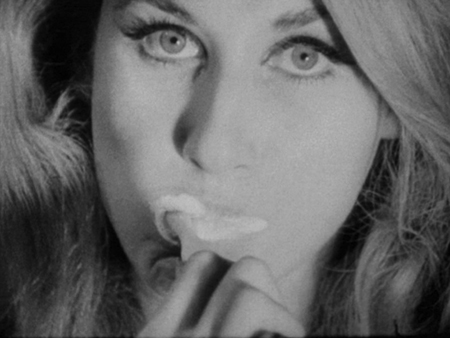
Jane Holzer Screen Test courtesy of the Andy Warhol Museum

This past Saturday, Dean Wareham and Britta Phillips, previously of Luna, performed 13 Most Beautiful…Songs for Andy Warhol’s Screen Tests at the Allen Room as part of Lincoln Center’s American Songbook series. Dean and Britta, backed by a drummer and guitarist, performed to Warhol's Screen Tests of Factory regulars from the mid-60s.

Here is what (our seldom contributor) Jay Ruttenberg had to say about the evening for Time Out New York:

"At the Allen Room, Dean & Britta performed 13 songs, one for each screen test, both covers and originals. Some songs were vague, while others explicitly matched their subjects—say, a handsome rendition of “I’ll Keep It with Mine,” which Bob Dylan wrote for Nico and which the band played to accompany Nico’s screen test. The films themselves remain fascinating, whether portraying Warhol sycophants (Edie Sedgwick, whose brief performance displayed more range than Sienna Miller did in Factory Girl) or future Entourage cameos (Dennis Hopper).

As Dean & Britta played, the ’60s most fabulous Manhattanites gazed at the audience, raising the notion of aloof cool to new and never-again-seen heights. This notion culminated in the filmed portrait of a young and potentially evil Warhol favorite, his eyes shielded in dark sunglasses, staring down the camera as he sipped from a glass-bottled Coca Cola. The sitter was, of course, Lou Reed, and for his screen test Dean & Britta played the Velvet Underground obscurity “Not a Young Man Anymore.” The song could not have been more appropriate. From the middle of the audience, his sunglasses replaced with spectacles, sat New York City’s top concert-goer, Lou Reed himself, staring into his screen test with the rest of the crowd, a young man no longer."

For a full account of the performance, please visit Jay's blog at Time Out New York