Soft Geometries: Fashion, Architecture, and NYC’s Garment District

A felt structure by Gabi Schillig

The Van Alen Institute is hosting a discussion tonight between designer Yeohlee Teng and architect Calvin Tsao on the relationship between fashion and architecture, civic identity and public spaces with regards to the possible rezoning of New York City’s Garment District. This program is in conjunction with their current exhibition by outgoing Van Alen Fellow Gabi Schillig, titled "Public Receptors: Beneath the Skin". Stay tuned to Fashion Projects for an interview with Gabi regarding her work in attempting to mediate the relationship between private users and public spaces using her portable, detachable felt structures.

The program tonight is from 6:30 – 8:30pm at the Van Alen Institute, 30 West 22nd Street (between 5th and 6th Avenues) 6th Floor. $8 for non-members, payable at the door; free for Van Alen Institute members and one guest. RSVP required to rsvp@vanalen.org.

Valentino: The Last Emperor

Valentino sourrounded by his work and pugs.

The Matt Tyrnauer-directed documentary, Valentino: The Last Emperor, which is currently playing at Film Forum, is rather touching, as it shows the swan song of the Italian designer. Most poignant is its depiction of Valentino’s relation with his life and business companion Giancarlo Giammetti, who seems to have patiently supported the designer throughout his career.

From a fashion historical point of view, the film remarks on the end of an era of finely hand-made couture gowns. One of the most interesting parts of the movie shows the highly skilled seamstresses draping and constructing the garments entirely by hand. It’s also significant to hear Valentino recount how his interest in fashion stemmed from watching Hollywood films such as the highly choreographed Busby Berkeley extravaganzas and the 1946 musical the Ziegfeld Follies—which was, in fact, a precursor to the fashion show as spectacle. Valentino, like many Italian designers of the post-war era, was thoroughly inspired by Hollywood glamour, especially by way of Via Veneto, which was famously immortalized by Fellini in La Dolce Vita. In the case of Valentino, this fascination with Hollywood met with an interest and a thorough knowledge of the Parisian haute couture.

Ultimately, the designer’s fondness for the art of dress-making, his attention to the details of the craft combined with his love of an opulent over-the-top lifestyle, put him at odds with the market forces at hand. His 45-year career, however, has extended an influence on generations of designers and consumers alike, while the man himself, in his studied mannerism, has certainly left a strong impression. As a kid, I remember my father recounting how in the early ’70s he shopped in Valentino’s menswear boutique, which was then in Rome’s Via Condotti, and was greatly flattered that the designer himself advised him on what to buy—a fact that to this day my father considers an undeniable stamp of approval on his style.

Valentino and his head seamstress at work in his atelier

Upcoming Conferences in New York

A 1933 window display devoted to American designers at Lord & Taylor in Manhattan.A 1933 window display devoted to American designers at Lord & Taylor in Manhattan from the New York Times

April brings at least two conferences of interest. One is a rather large conference organized by FIT's Sustainability Group. While not focusing specifically on fashion, the conference does have a number or sections that revolve around organic textiles--cotton in particular, as well as one paper on the topic of Slow Design. Ambitiously titled "Putting Sustainability into Action," the conference is scheduled to take place on April 2nd and pre-registration is encouraged.

More specifically on fashion and much smaller in scope is the yearly Richard Martin Visual Culture Symposium organized by the MA in Costume Studies at NYU. This year's keynote speaker is Phyllis Magidson, Curator of Costumes and Textiles at The Museum of the City of New York who will speak on fashion in New York and Paris from 1914 to 1941--possibly an extension of the recent exhibition at the Museum of the City of New York "Paris/New York: Design Fashion Culture, 1925-1940."

Among the papers presented are "Fashion and Façade: Addressing and Undressing the Bourgeoisie in Emile Zola’s Pot-Bouille" by Jessica Pescosolido, "The Italian Look: Unique Synergies at Work" by Gabriella Pannunzio, "Shapewear: A Complicated Affair A Study in the Resurgence of Body Shapers Worn by American Women" by Ashley Cohen, and "Jungle Red and Dragon Ladies: American Femininities and the Modern Manicure" by Suzanne Shapiro. The symposium takes place on Friday April 3rd Friday from 6:00-8:00 in the Einstein Auditorium at 34 Stuyvesant Street.

CAA 2009 Los Angeles (and fashion)

Rei Kawakubo for Comme des Garçons, Spring/Summer 1997. Photo Paolo Roversi.

The recently completed College Art Association Annual Conference had a surprisingly small numbers of papers which could fall under the fashion history and theory heading. More numerous were papers revolving around the theme of craft, ornamentation and the body.

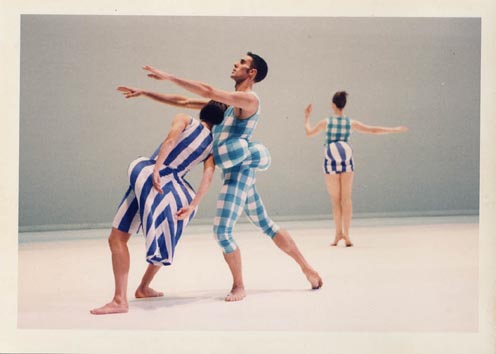
I spoke on Rei Kawakubo’s collection from Spring/Summer 1997 titled “Body Meets Dress,” and her subsequent collaboration with Merce Cunningham for a dance of the same year, Scenario. The paper was part of a panel organized by Victoria Rovine and Sarah Adams titled “Clothing, Flesh, Bone: Visual Culture above and below the Skin.” The papers presented in this stimulating panel ranged the gamut from architectural history—how German Körperkultur translated into architecture—to participatory art practice—the work of Brazilian artist Hélio Oiticica —to medical science (i.e. discussion of reconstructive plastic surgery).

Merce Cunningham, Scenario, 1997. Photo courtesy of the Merce Cunningham Archives

Unfortunately, I missed a panel organized by Alla Myzelev of the University of Western Ontario dedicated to the convergence of fashion and furniture, as well as a panel on ornament organized by Patricia Flores, which included a paper by Glenn Adamson, currently at the V&A. However, the latter’s work seems to have inspired a very interesting and lively panel on Queering Crafts, which featured mostly practioners’ presentations. Among the most interesting papers was Jesse M. Kahn’s. which introduced a range of queer practioners’ work, including his own. Among them were Bren Ahearn—who seems to be commenting both on gender and labor processes, by carefully embroidering the word “manmade” on cheaply mass-manufactured goods.

Francesca

Christian Joy at AVA

Christian Joy, "Nightmare Catcher," 2009.

Another designers’ exhibition, which occurred in conjunction with fashion week, was Christian Joy’s The Visitors Must be Amused. It took place at Audio Visual Arts—a new gallery in the East Village, where it will be on view unti March 8. The premise for the exhibition is that Joy disposed of nine years of left-over, unwanted material in her studio and repurposed it into extravagent representations of female beings through garments. In a further twist, Joy based each sculpture/creation on descriptions given to her by a friend or family member who, in turn, had to incorporate Joy’s finished piece in their own photograph or creation. Among the collaborators were the Yeah Yeah Yeahs's Karen O and Nick Zinner.

The descriptions gave range to an array of seemingly disparate results running the gamut of a Thierry Mugler–inspired cyborg suit to a black body suit. The latter was reinterpreted into a funny night scene, where the black-clad wearer became reminiscent of the early-twentieth century proto catwoman Irma Vep.

One of the costumes involved a video projection, which seemed to be a commentary on a turn-of-the-century trans-Atlantic voyage, while what was perhaps the most interesting costume was “Nightmare Catcher”—a vaguely scarecrow-like attire made of stripes of burlap and gingham fabric.

It’s great to see more and more small exhibitions of experimental New York designers popping up around the city—a trend which will hopefully continue!

Francesca

Christian Joy, The Visitors Must be Amused, Installation View