VLA Launches Sustainable Fashion Workshop Series

New York-based Volunteer Lawyers for the Arts (VLA) recently announced a four-part workshop series focusing on social and legal issues in the fashion industry. The first segment in the series, Social & Legal Issues in Fashion Series: Ethical and Sustainable Practices, explores both the sociology of the fashion industry and legal issues that surround trademarks and counterfeits. It takes place Tuesday, June 15th, 6:00-8:00 pm. Other topics include: human rights issues, sustainable manufacturing, repurposed goods, and a movement towards "local fashion." The workshop will be taught by VLA's executive director, Elena M. Paul, Esq., and Anna Akbari, Ph.D.

Click here to register, or for more information, call Joni Todd at 212.319.2787 x10, or e-mail her at jtodd [at] vlany [dot] org.

Kim Burgas

Natalie Chanin to Give Talk Tonight

Natalie Chanin, founder and designer of Alabama Chanin, will give a talk tonight at the Cooper-Hewitt, National Design Museum. Chanin's company is an integral part of the burgeoning slow fashion movement. I had the opportunity to help out with the recent teen Design Directions stitching workshop here at the museum that she taught - rather than being at "work", I found myself lulled into a peaceful state as I stiched my own fabric while listening to her kind, insightful words. I can say with certainty that this talk is not to be missed!

Details: Alabama Chanin: American Fashion Wednesday, May 19, 2010 | 6:30 – 8:00pm Cooper-Hewitt, National Design Museum, 2 East 91st Street Students are FREE, others: $10 Register HERE Galleries will be open before hand for a private viewing of the new Triennial exhibition.

Sarah Scaturro

Sustainable Exchange

Crochet Workshop

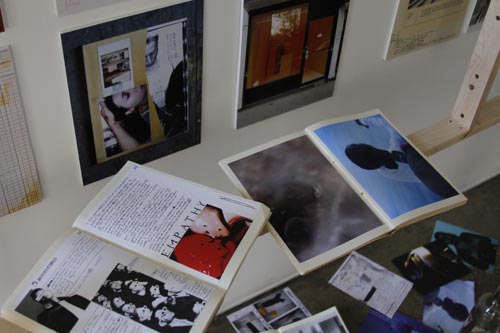
This past weekend the exhibition cum workshop "Sustainable Exchange: Methods and Practices for Collaborative Partnerships took place at TODA, a design studio in Tribeca. Curated by Megan Howard in collaboration with Rachel Littenberg-Weisberg (both study Integrated Design at Parson), the exhibition included the experimental eco designer Susan Cianciolo, the collective Eko-Lab, and the jewelry company Black Sheep and Prodigal Sons, which creates beautifully unsettling pieces using repurposed materials. The exhibition design was completed by the talented design team from the interior design graduate program at the Pratt Institute under the supervision of design director Jon Otis. The exhibition structure was, in fact, made of repurposed material from the exhibition "Ethics + Aesthetics," that Sarah and I curated this past Fall at Pratt.

Particularly interesting was the focus on process, participation and collaboration underscored by the exhibition design, which allowed people to interact with the clothes and furniture and leaf through sketchbook. The interactive nature of the exhibition was also underscored by the rather impromptu performances, which took place during the exhibition opening, as well as several workshops, which covered experimental crochet techniques, natural dying processes, organic cooking and collage-making, which took place throughout the weekend.

Susan Cianciolo, Sketchbooks, Details

Eko-Lab Installation

Eco Chic: Towards Sustainable Swedish Fashion

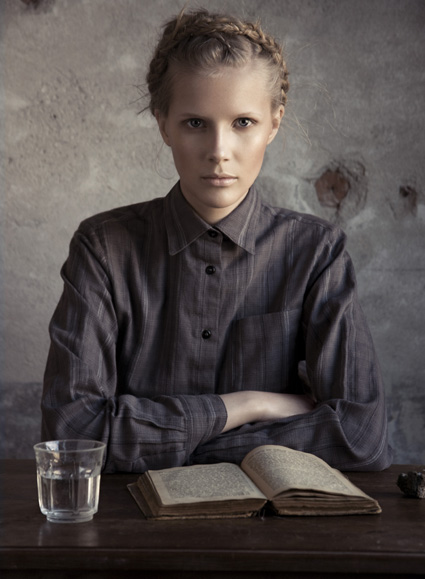
Julian Red. Photo: Mikael Schultz @ Swedish Institute

by Francesca Granata

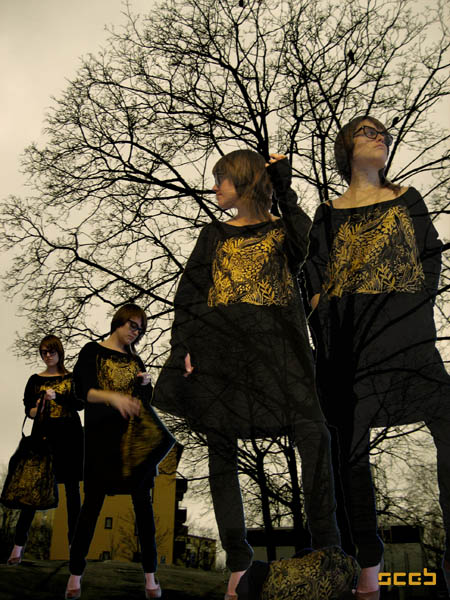
The Eco-Chic: Towards Sustainable Swedish Fashion Exhibition at the Scandinavia House opened with an interesting panel discussion including Marcus Bergman (managing director of Ecocotton, a pioneer in organic cotton production), Sass Brown (a professor at the Fashion Institute of Technology whose research focuses on women’s cooperatives in Latin America) and Karin Stenmar (a founder of the Swedish eco-fashion company Dem Collective). It was moderated by Hazel Clark, Dean of the School of Art and Design History and Theory at Parsons, who has a longstanding interest in slow fashion and the secondhand clothing trade.

Organized as a roundtable discussion, it covered the difficulty in sourcing sustainable material, partially attributed to the lack of innovation in the textiles industry, the need for living wages and the development of women’s cooperatives. Bodkin tied her interest in eco-fashion to her interest in Swedish Modernism and a drive towards functionality in clothing. However, it was interesting to hear how, according to Bergman, the ethos of Swedish design “of functionality and honesty in design” did not sufficiently enter the realm of fashion, due to the fact that fashion/textiles studies developed separately from other branches of design, at least in Sweden. The need for a new fashion design education was thus addressed to allow for the development of more aware designers. Also mentioned was the need for mass-market companies to join the conversation. According to Brown, this is actually occurring: As an example she mentioned Wal-Mart’s commitment to transitional cotton—a company which seemed odd to bring up due to their long-standing history of labour exploitation.

Clark asked about the creation of memories and narratives through clothes, something that Stenmar’s company, Dem Collective, addressed by having buyers record the life of their clothes in a project called One in a Thousand Jeans. This reminded me of an evocative and inspiring project I had been meaning to write about by a Dutch designer Ruby Hoette—Worn Relics—which involves the recording of the life story of one’s favourite piece of clothes.

The exhibition, shows the diversity of design comprising Swedish eco fashion, and proves a real commitment on the part of Sweden and the Swedish design community to the search for sustainable solutions for the fashion industry. It remains open through August 21.

The Concise Dictionary of Dress

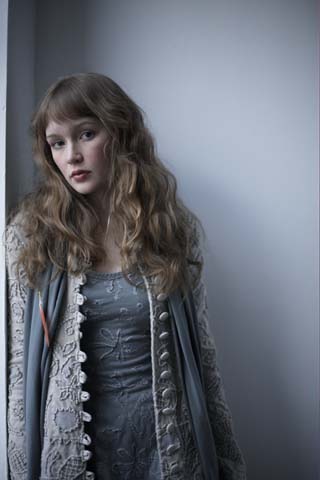
Pretentious 4, photo by Julian Abrams.

The exhibition "The Concise History of Dress" recently opened at the Blythe House—the V&A repository for their reserve collections of furniture, textiles, dress, ceramics, jewellery and fine arts. Commissioned by Artangel, the exhibition is curated by fashion curator Judith Clark and the psychoanalyst Adam Phillips.

The exhibition consists of an hour long tour through the building and re-describes clothing in terms of anxiety, wish and desire, as a series of definitions created by Phillips and accompanying installations designed and assembled by Clark:

"Phillips’ definitions for words commonly associated with fashion and appearance – such as armoured, conformist, essential, provocative – were paired with eleven installations created by Clark on a walk through this vast building, from its rooftop to an underground coal bunker. "

We have yet to visit the exhibition, but it does sound both evocative and innovative in its curatorial and display choices, so it's certainly not to be missed. It is also accompanied by a book, with photographs by Norbert Schoerner.

Conformist-3. Both Images: The Concise Dictionary of Dress Judith Clark and Adam Phillips. Commissioned and produced by Artangel in collaboration with the Victoria and Albert Museum. Photo: Julian Abrams.