Obsessive Consumption
/ Jen Bekman's gallery, Installation View

Avant-garde Fashion, Art, Visual Culture, Fashion Theory, Fashion Exhibitions, Fashion Museums, Fashion Exhibition, Fashion Museum
Jen Bekman's gallery, Installation View

Photograph by Roderick Angle Don't miss out on the new exhibition which opened last week at the Museum of the School of Visual Arts! While many fashion scholars realize that fashion photography is another forum for artistic expression, curator Dan Halm states, "because they’re originally conceived and created to appear in magazines and advertisements, fashion photographs are often considered disposable.” Highlighting work from six SVA alumni, Click Chic aims to recognize fashion photography as an art form. Artists include Roderick Angle, Guy Aroch, Maki Kawakita and Ryan Michael Kelly. The opening reception will be held tonight, from 6-8 pm.
Visual Arts Museum
209 East 23 Street
New York, NY 10010
212.592.2145
On view from September 6 - October 6, 2007
Proposals are invited for an event-style exhibition of wearable technology art, to be held at the College Art Association 2008 Annual Meeting in Dallas, Texas, sponsored by the Leonardo Education Forum.Social Fabrics will explore artists' creative deployments of mobile, socially interconnective media as wearable attire or personal accoutrements. This event-style exhibition, curated by Patrick Lichty and Susan Ryan, will demonstrate convergences between fashion as expression/statement, and the phenomenology of "network culture." Works presented will include technological attire and accessories, as well as works that engage the implications of our contemporary media and fashion driven lifestyles.For more information, visit http://www.socialfabrics.org

Gabrielle “Coco” Chanel, 1925. Photo Irving Solero
The other day, I visited the “Luxury” exhibit, part of the rotating permanent collection at the Museum at FIT. I was given a tour from Tamsen Schwartzman, a research curator who organized the exhibit together with Valerie Steele and Fred Dennis. The exhibit, which opened in May and will remain on view until November 10th, made some very interesting points on the relation between luxury (as a widespread concept and eventually industry) and the rise of the bourgeoisie. Thus, the show started in the 18th century and continued up to the present day. The garments and accessories in the exhibit, which were for the most part arranged chronologically, made a very convincing argument for how luxury is ultimately a constructed cultural category which is constantly shifting and, thus, always historically and geographically specific. The exhibit went from an18th century heavily embroidered men coat (which exemplified the decorative character of menswear at the time) to a late 19th century extremely embellished ball gown which stands as evidence of “the feminization of luxury,” and of Veblen’s theory of “conspicuous consumption.” This move took place as menswear became pared down and opulence and wealth became displaced and displayed onto women.
In the early part of the exhibit covering the early 20th century, it’s quite interesting to compare a Chanel’s dress in its effortless look to a heavily decorated early 20th century Worth gown, and to a more theatrical Poiret dress. As the 20th century progresses, the ’80s stand out as the epitome of ostentatious luxury followed by the ’90s, with its more understated look and the concept of stealth luxury. The exhibit ends with suggestions of what constitutes luxury today:
It often has to do with the personal, the experiences which are often translated into the uniqueness of a piece, and the story associated with the brand or sometimes the individual garment. This made me think of an article on glamour by Elizabeth Wilson which I recently read in Fashion Theory, and which discussed glamour (perhaps counter intuitively) in relation to the dandy, with its aesthetic of restraint, and of refusal. “Glamour,” writes Wilson, is “elitists” and it “depends on what is withheld, on secrecy, hints , and the hidden.” Thus, one is left to wonder whether luxury in contemporary time, where the concept has become ubiquitous, is ultimately to be found in some form of refusal…
Francesca

Tess Giberson, Fall/Winter 2003-04
I have been meaning to write about the exhibit New York Fashion Now, which is currently up at the V&A in London. Curated by Sonnet Stanfill, who originally hailed from this side of the Atlantic, the exhibit gave an interesting and thorough account of recent developments in New York Fashion in the context of drastic changes in the city’s economic and cultural landscape following September 11.
Rather refreshingly, the show focused largely on new and often emerging designers, giving its due to US designers—who can be underrated within the US borders, where Europe is generally equated with better fashion and good design. Personally, I find this association rather puzzling, having grown up in Italy and seen a fair share of bad European design ranging the gamut from hideous post-war architecture to perennially tight pants coupled with the most conservative of attires. Thus, the exhibit was a much-needed argument for the validity of New York–based fashion designers, one made all the more effective as it was staged outside of the city confines, and within what is probably Europe’s preeminent museum of decorative arts.
The exhibit was arranged in four separate sections:
Sportswear chic, Atelier, Avant-Garde, Menswear and Celebrity, and included twenty designers whose company varied significantly in size. Among the designers were Zac Posen, Mary Ping and Behnaz Sarafpour (in the Sportswear section) Maggie Norris and Jean Yu (in the Atelier section), Duckie Brown and Christian Joy (in the menswear and celebrity section, respectively). The Avant-Garde section (which interested me most) included As Four, Tess Giberson, Slow and Steady Wins the Race and Miguel Adrover. In addition to garments and accessories, two of the four designers were represented by fashion shows. On view was As Four Puppencouture Show from 2000, and Tess Giberson Fall/Winter 2003-04 collection, featuring a shelter-like structure made partially of the clothes later worn by the models. The fashion shows were a nice addition to the otherwise static display and left me wishing that more moving images were included in the exhibit.
What was perhaps most interesting about the avant-garde section of the exhibit is the fact that two of the designers (Tess Giberson and Adrover) were no longer in business by the time the exhibit was installed. (Stanfill had started planning the exhibit three years prior.) Upon being asked as to whether she saw an inherent incongruity between the notion of New York design and the avant-garde , the curator mentioned that one of the hindrances to an understanding of New York as an avant-garde fashion city is the preeminence of New York fashion image as one of sportswear and of American fashion design as inherently commercial. This point is, of course, compounded by the fact that a number of designers in this section come from abroad. Ultimately, one wonders whether there is something more deeply ingrained in the American resistance to thinking of fashion as a meaningful cultural and artistic product. Perhaps this resistance is somewhat indebted to a once popular Greenbergian understanding of art, and in particular American art, as a “pure” and ultimately masculine sphere or perhaps it simply has to do with the alleged American pragmatism, which ascribes to clothes a primarily utilitarian function.
If you end up missing the actual exhibit (which is up until September), the well-designed and comprehensive catalogue written by Stanfill (and distributed in the US by Abrams) makes for a great substitute!
Francesca
Fashion Projects is a journal focusing on fashion, art and visual culture.
This issue is devoted entirely to the subject of fashion criticism—the first such study devoted to the cultural field. It features extended interviews with leading practitioners of fashion criticism including W editor Stefano Tonchi, International Herald Tribune critic Suzy Menkes, The New Yorker’s Judith Thurman, New York Times writer Guy Trebay, and Robin Givhan, the first fashion critic to receive a Pulitzer Prize.
Table of Contents
Transdisciplinary Practices: An Interview with Stefano Tonchi by Francesca Granata
Fashion Criticism—A Critical View: An Interview with Robin Givhan by Michelle Labrague
This Is Not a Fashion Critic: An Interview with Guy Trebay by Jay Ruttenberg
“Women’s Work”: An Interview with Judith Thurman by Francesca Granata
Bill Cunningham Multimedia Man by Jay Ruttenberg
Fashion Criticism as Political Critique: An Interview with Lynn Yaeger by Sarah Scaturro
The Critic as Artist: An Interview with Mariuccia Casadio by Marco Pecorari
On Fashion Futures: An Interview with Suzy Menkes by Lucy Collins
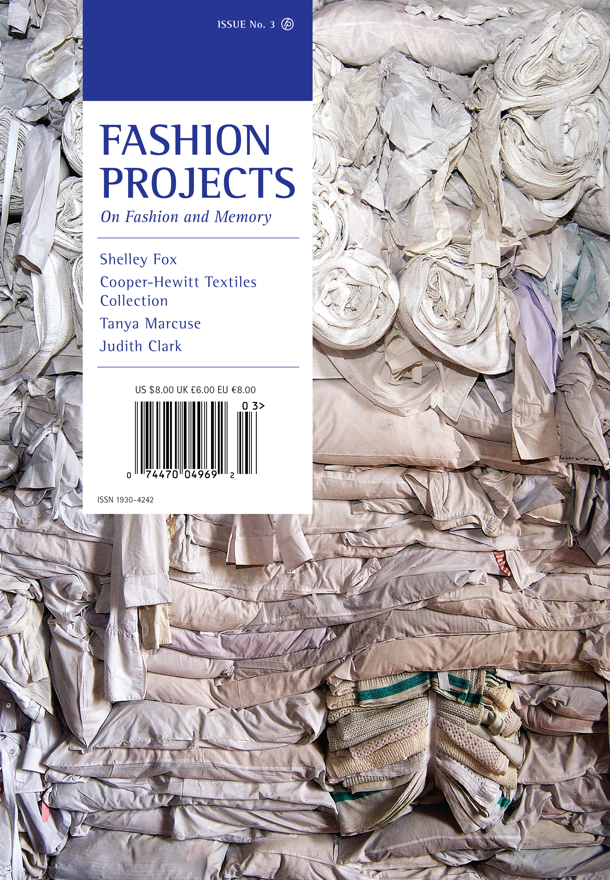
Table of Contents 00— Editorial Letter
01— Fashion as Expanded Practice: An Interview with Shelley Fox by Francesca Granata
02— Experiments in Fashion Curation: An Interview with Judith Clark by Sarah Scaturro
03— Televisual Memories: An Interview with Eugenia Yu by Erin Lindstrom
04— Reflections on Absence Photo Essay: Cooper-Hewitt Textiles Collections Written by Sarah Scaturro; Photographed by Keith Price
05— American Industrial Past: Ohio Knitting Mills by Lisa Santandrea
06— Ready Made Memories: Erica Weiner’s Jewelry by Francesca Granata
07— Imprints of the Body: An Interview with Tanya Marcuse by Tamsen Schwartzman
The second issue of Fashion Projects covers fashion and art collectives, as well as collaborative projects between artists and fashion designers. It’s meant as a reminder of the inherently collaborative nature of fashion which is often forgotten as, particularly at the higher ends of the industry, so much rides on the “individual” designer.
Table of Contents
00. Editorial Letter
01. Elsewhere: Between Art Collaborative and House of Wonder by Francesca Granata
02. Ephemeral Conversations: Simon Periton’s Collaborations with Raf Simons, Philip Treacy and Junya Watanabe by Sonya Mooney
03. Elegant Subversions: An Interview with Cat Chow
04. Show Me Your Reality and I’ll Show You Mine: An Interview with Penny Martin, editor-in-chief of SHOWstudio.com by Patty Chang
05. Studio 5050’s Fuzzy Fashion by Sarah Scaturro
06 Boundless Practice: An Interview with Susan Cianciolo by Sonia Mooney
07 At the Forefront of Austrian Fashion: An Interview with UNIT F
08 Serpica Naro: The Great Fashion Swindle by Francesca Granata
09 Clashing Hues: European Protests Movements and Costume by Lidia Ravviso
10 Pierre Bourdieu Goes to Town by Jay Ruttenberg
The Subtleties of Cross Dressing: An interview with Anne-Sofie Back by Patty Chang
The Red Shoe Delivery Service by Francesca Granata
Reflections on “Meta-Design” with Mary Ping by Chyntia Leung
Rosa Mosa: Walking the Line Between Tradition and Zeitgeist
Exploring Kawaii: An Interview with Yumiko Inada by Tae Yano
Indie Fashionista in Fort Greene
La Voleuse: The Book Bag Revisited
Forgery and Appropriation in the Accessory Industry by Francesca Granata
© Fashion Projects 2016 All rights reserved.



Fashion Projects #5 is devoted to fashion curation, examining the meteoritic rise in relevance of fashion exhibitions.
It features interviews with an eclectic assortment of leading practitioners from different corners of the world. The issue includes long Q&As with Harold Koda, the longtime, recently retired curator of the Met’s Costume Institute, as well as the Museum at FIT’s veteran leader Valerie Steele. It also features interviews with curators in Antwerp (the ModeMuseum’s Kaat Debo), Toronto (Royal Ontario Museum’s Alexandra Palmer) and Venice (Maria Luisa Frisa); academics studying the field (Hazel Clark, Annamari Vänskä, and Alistair O’Neill); and, giving an on-the-ground perspective, the Met’s head conservator, Sarah Scaturro. The issue’s cover stars Greer Lankton’s sculptural representation of legendary Vogue editor and Costume Institute doyenne Diana Vreeland, who continues to loom over the field years after her death.
Table of Contents
Introduction
Showmanship and History: An Interview with Harold Koda by Francesca Granata
Woman of Steele: An Interview with Valerie Steele by Lisa Santandrea
Exploring Fashion’s Openness: An Interview with Kaat Debo by Alex Esculapio
London, After a Fashion Curator: An Interview with Alistair O’Neill by Alexis Romano
Curation and Conservation: An Interview with Sarah Scaturro by Mae Colburn
Reflections on Fashion Curating
An Interview with Hazel Clark and Annamari Vänskä
Fashion in the Vast Museum: An Interview with Alexandra Palmer by Ingrid Mida
Restless Curating: An Interview with Maria Luisa Frisa by Marco Pecorari