Music and Fashion: Yoko Ono and threeASFOUR

threeASFOUR, Spring/Summer 2010. Photo: Marcio Madeira

I attended the threeASFOUR show this past Thursday—both the show and the collection were inspired by Yoko Ono, who also contributed some prints for their collection.

Fashion Projects contributors Sarah Scaturro and Jay Ruttenberg were both in attendance. The latter wrote a witty report on the show, which comments on the use of music in fashion shows, for Time Out New York:

"The experimental fashion label threeASFOUR, a kind of art collective that sews, presented its Spring 2010 collection last night at MAC and Milk, on 15th Street. Usually, when fashion designers claim to use a music figure as a “muse,” it seems to mean their collection bears vague resemblance to a British depressive from the early ’80s, or Debbie Harry. The trio of New York designers behind this show turned to an infinitely more engaging idol: Yoko Ono.

The label was not merely paying lip service to the artist’s work. Ono sat front and center under an enormous hat, sandwiched between Sean Lennon and Carrie Fisher. Many of the coolest pieces incorporated prints made by the artist decades ago; other garments came in Manhattan black, Ono’s color of choice—she is not a floral-print kind of gal—as well as a nod to the old avant-garde world in which she made her name. The event’s soundtrack came courtesy of Ono too—relying predominantly on her more ethereal work but concluding, cinematically, with the resounding thump of “The Sun Is Down” from her handsome new album, Between My Head and the Sky. At assorted Fashion Week events this year, I heard music by Palace Brothers (in the background of an art-type thing), Spaceman 3 (accompanying a menswear show in which every model seemed to be auditioning for a Jesus and Mary Chain biopic) and, of course, dreadful dance music (do these designers aspire to cliché?). Ono’s music fit best, lending the threeASFOUR show a savage, dreamlike aura."

Read the rest of the Review on Time Out New York

threeASFOUR, Spring/Summer 2010, Dress with Yoko Ono's Prints and Black Leggins with Circle Cut-Outs

Films and Installations: Alternative Fashion Presentations at New York Fashion Week

Tim Hamilton and Collier Schorr, Rope, 2009

I always find ways of presenting fashion design other than a typical fashion show interesting—particularly as a number of shows in New York are often streamlined events due to the nature of the industry and, at present, recessionary pressures. (For instance, I just returned from a Maria Cornejo’s show which was visibly paired-down both in terms of colors and looks.)

Among the non-model heavy presentations was Tim Hamilton’s event, which showed two short films by the New York–based artist Collier Schorr (best known for his portraits of adolescents) of a male model climbing a rope in various stages of dress in Hamilton’s pieces. The British designer Gareth Pugh also presented a number of films which he completed in collaboration with the filmmakers Ruth Hogben and can be viewed on SHOWstudio. (Both Hamilton’s and Pugh’s films, however, served as prelude to their upcoming fashion shows in Paris.)

Slow and Steady Wins the Race celebrated fashion week with an installation which opened last night at Saatchi and Saatchi, where it will be on view through September 18. This incorporated works from a range of other designers and artists (Andrew Kuo, Miranda July) alongside Ping’s own. (Talking with some of the British guests at the show, it was interesting to reminisce,in the midst of an artsy and, one assumes, progressive crowd, how Saatchi and Saatchi came to prominence through an advertising campaign for Margaret Thatcher.)

Among other designers who have used the medium of film or installation to present their work during fashion week are Titania Inglis—who has just launched a sustainable fashion line—while later this week the London-based designer Temperley will also present her work via an installation.

Earlier in the year, at a panel on fashion and culture, the New York Times cultural critic Guy Trebay pointed out how one way to overcome the economic pressures for young and established designers alike might be via creative collaborations across disciplines—an approach which would seem to foster novel ways of presenting fashion. Yet not many designers in New York seem to have taken notice…

Francesca

Summer Readings: Fashion Practice et al.

Cover of Fashion Practice, Volume 1, Issue 1

A sister publication to Fashion Theory was recently launched by Berg Publishers. Titled Fashion Practice, it focuses on the interaction between theory and practice alongside practice-based research and is mainly concerned with contemporary design. Among its recurrent areas of interest are the interaction of fashion and technology, as well as sustainable fashion, as it is geared to be of interest to practicing designers alongside academics. The journal is edited by Sandy Black of the London College of Fashion, and Marilyn DeLong of the College of Design at the University of Minnesota, and it is published biannually. (Disclosure: I recently contributed to the journal.)

Also of interest is the proliferation of academic blogs devoted to fashion and based in the USA---a relatively new phenomenon. Among the ones that I have recently discovered is the historically driven Thread for Thought, as well as the more contemporary-minded Threadbared and Worn Through.

Francesca

X-Initiative II

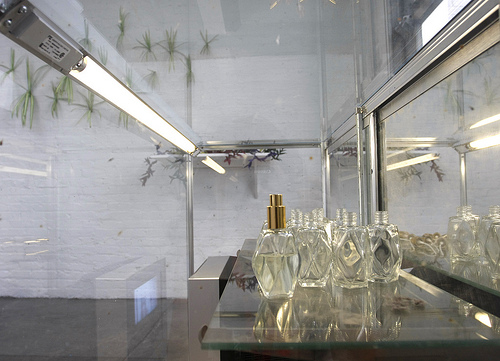
Anicka Yi and Maggie Peng, "Acceptable Substitute, I Mean One Acceptable Substitute To Me," 2009. Photo: Margaret Lee

Among the unusually sparse number of exhibitions currently up in Chelsea is a small and unassuming show on the roof of the former DIA Center, now home to the X-Initiative. The show, titled “Today and Everyday,” brings together a number of works that seem to share an interest with notions of artificiality.

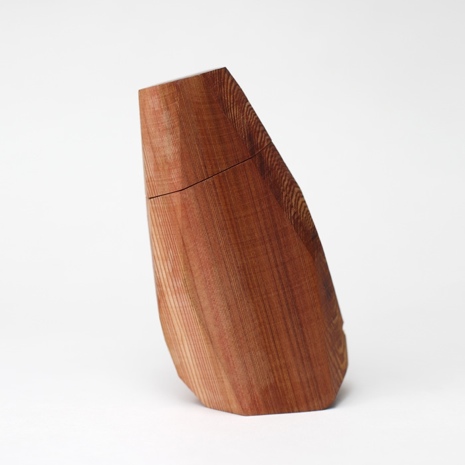
One of the pieces included was a glass case containing empty perfume bottles alongside a video and sawdust (I later learned the case also contained moths).Titled “Acceptable Substitute, I Mean One Acceptable Substitute To Me,” the piece was the continuation of an earlier project that the New York–based artist Anicka Yi and the architect Maggie Peng had completed the same year. They had developed a conceptual perfume called “Shigenobu Twilight” after Fusako Shigenobu, former leader of the violent dissent group the Japanese Red Army. Shigenobu eventually went into exile in Lebanon. Yi and Ping used the cedar wood, as the dominant notes of the perfume as well as its encasement to represent Shigenobu’s relation with Lebanon.

For the X-initiative project, they commissioned a Chinatown perfume forger to create a replica of their perfume, which they exhibited alongside a video. Both the video and the forged perfume bottles were meant to explore what brought Shigenobu to move to Lebanon and join the Palestinian cause, and thus questions notions of authenticity and nationality.

Anicka Yi and Maggie Peng, Shigenobu Twilight Perfume

Ultimately, however, the original perfume seems to play into the aesthatization of 1970s terrorist groups, perhaps best exemplified in the fascination with RAF member Ulrike Meinhof. This analogy is made particularly relevant by the fact that Shigenobu was an object of fascination due to her gender and looks—something the perfume hints at, but never fully develops. The installation at X-Initiative, instead, creates a more complex dynamic in its exploration of forged and borrowed identities and national struggles.

Francesca Granata

Anicka Yi and Maggie Peng, "Acceptable Substitute, I Mean One Acceptable Substitute To Me," 2009. Photo: Margaret Lee

Merce Cunningham and Fashion

Merce Cunningham wearing a bulging Kawakubo's costume. Poster for Scenario, 1997. Photo: Thimoty Greenfield-Sanders.

Merce Cunnigham, who died July 27 at the age of ninety, had an unreputably lasting influence on the development of dance in the 20th century. In addition to his numerous collaborations with a number of visual artists, starting with Robert Rauschenberg, and musicians from John Cage, his life-partner, to Thurston Moore of Sonic Youth, he collaborated with the avant-garde fashion designer Rei Kawakubo. This was prompted by the Japanese designer's Spring/Summer 1997 collection “Dress Meets Body, Body Meets Dress and They Are One,” which created a range of unorthodox body shapes by including padding at the hips, back and belly.

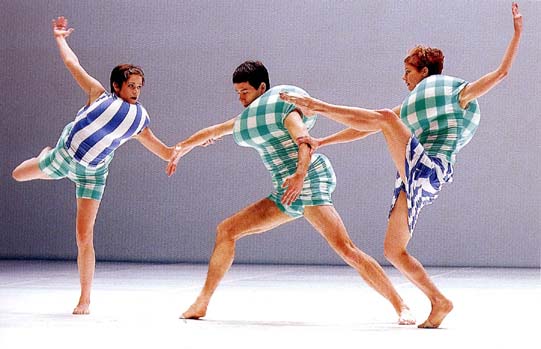
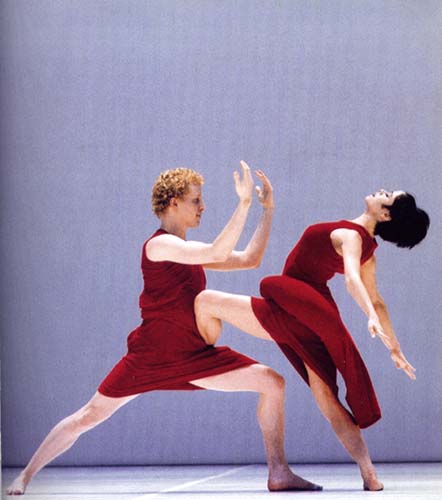
The dance borne of the collaboration is titled Scenario, and premiered in October 1997 at the Brooklyn Academy of Music, where the dancers’ movements took place against a stark all-white stage, lit with fluorescent lighting to the contemplative repetitive music of Takehisa Kosugi and Thurston Moore. Scenario is roughly made of three movements punctuated by the change of the pattern and colour of the outer garments from gingham and striped blue and green, to all black and finally all red—while the padding understructure remains the same throughout. The way Kawakubo’s garments became activated by the dancers’ bodies in motion allowed for the creation of novel and unexpected bodily formations—which reinforced Cunnigham's exploration of the limits and scope of bodily movements, as well as enhancing the bulges and “distortions” of Kawakubo’s 1997 collection.

Scenario, BAM, 1997

Much like Cunningham's entire oeuvre, Scenario leads into uncharted formations and articulations of body shapes, this time highlighted by Kawakubo’s costumes. The alteration of proportions, and of one’s relation to one’s body and to the body of the other dancers and the subsequent sense of estrangement it creates is summed up by dancers in Cunningham’s company, who described the experience as alternatively liberating and unsettling: “If I were to be asked about it as a dancer, I would say it was more of a liberation when I came onto this incredibly wide stage in the costume.” “It’s bizarre to roll on the floor. Or when you touch someone, you’re a foot away from them.” There is, in fact, an element of absurdist humour in Scenario. This is especially evident in the first movement of the piece where the dancers are wearing the costumes with oversized gingham and striped patterns, which are not altogether unlike the heavily patterned costumes characteristic of the Commedia dell’Arte—of Harlequin, in particular.

Humor had been previously explored through costumes in a much earlier piece by Cunningham: Antic Meet from 1958. For this piece, which contains parodic references to Martha Graham's dramatic style of dancing, Cunnigham knitted for himself a sweater with four arms and no neck hole, and in a faux climatic scene struggled to resurface from the sweater. (Footage of the scene can be found in Charles Atlas’ documentary Merce Cunningham: A Lifetime of Dance).

Francesca Granata

Scenario, BAM, 1997