
Savage Beauty: Alexander McQueen at the Metropolitan Museum of Art
/
Alexander McQueen Savage Beauty, Courtesy of the Metropolitan Museum of Art
by Ingrid Mida
“The world is experiencing a McQueen moment” said Thomas P. Campbell, director of the Metropolitan Museum of Art in his opening remarks to the press at today’s preview of the exhibition Savage Beauty: Alexander McQueen.
A more fitting choice of words could not be spoken. Until now, the extraordinary and rare genius of Lee Alexander McQueen’s artistic vision was not widely appreciated. In this retrospective presentation of about one hundred garments and seventy accessories from the late designer’s relatively short career from 1992-2010, The Metropolitan Museum has honored and documented the enormous legacy of McQueen to the world of fashion and art.
Alexander McQueen once said “For me, what I do is an artistic expression of that which is channeled through me. Fashion is just the medium.”
Not defined by stylistic convention, McQueen explored themes of love, nature, sex, and politics in terms of clothing and accessories for women. McQueen was also fascinated by the polarities of light/dark, wonder/terror, ugly/beautiful, life and death. Although his medium was fashion, McQueen’s thematic precepts were the opus of contemporary art and the exhibition celebrates that aspect of his work.
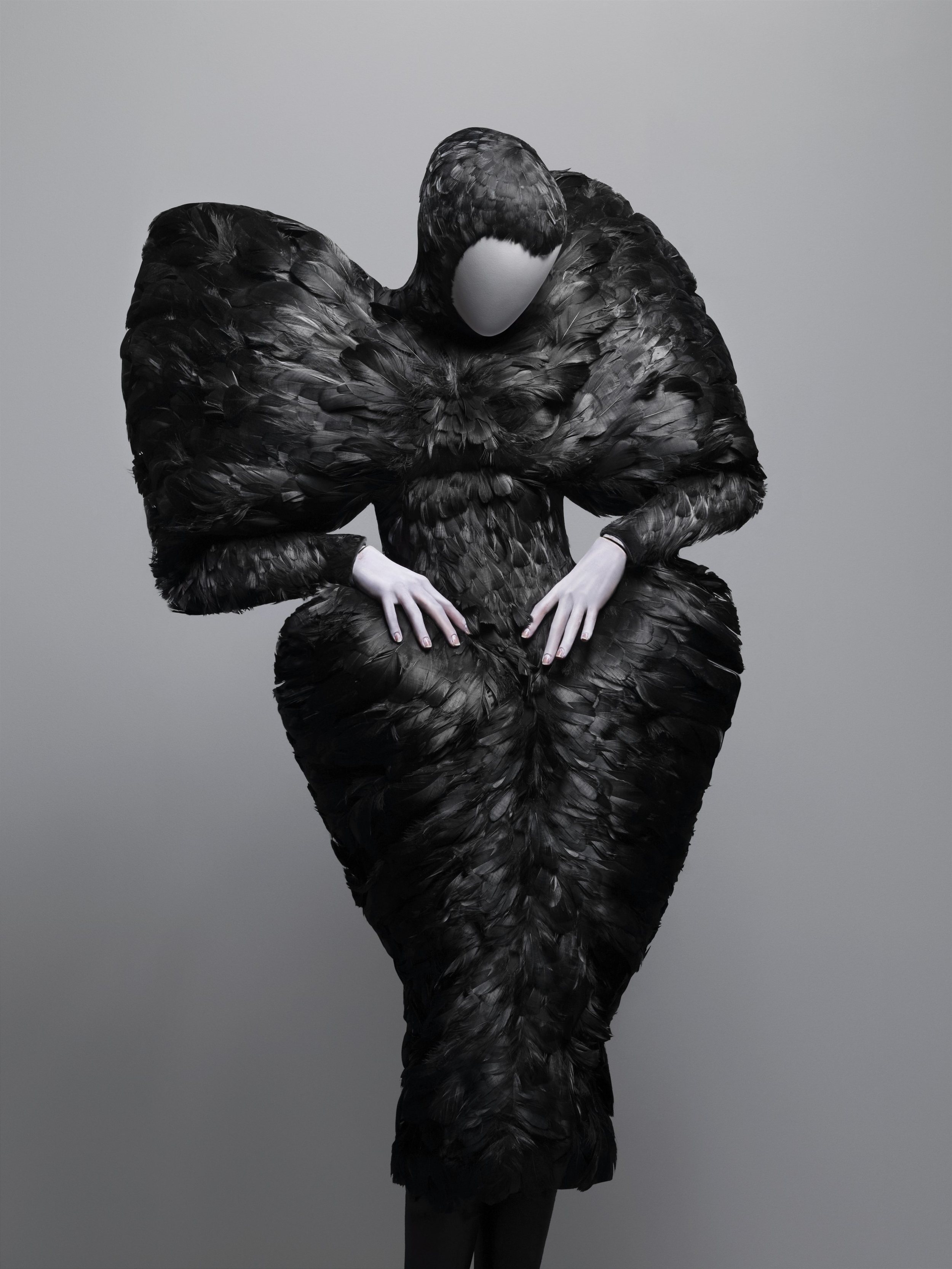
McQueen Black Duck Feathers Fall 2009, Courtesy of the Metropolitan Museum of Art
The expansiveness of McQueen’s vision is apparent in not only the thematic underpinnings to his work but also in his innovative use of materials. He manipulated feathers, horns, wood, glass, flowers, horsehair and shells into coverings for the female form. Mollusk shells became a corset, feathers became a skirt, alligator heads peeked out of jacket epaulettes, carved wooden boots became prosthetic legs, a jawbone became jewelry. There can be no doubt that he was an artist who presented his work in runway spectacles instead of a gallery. Looking to provoke reactions from his audience, he scripted the models for the runway shows to act with the charged emotions of a performance piece.
Presented thematically instead of chronologically, the exhibition defines McQueen’s work as a Romantic individualist, a “hero-artist who staunchly followed the dictates of his inspiration,” in the words of exhibition curator Andrew Bolton. Divided into galleries defined by themes of romantic historicism, naturalism, primitivism, and nationalism, the exhibition is evocative of a gothic fairy tale. One moves from light into darkness and the stuff of dreams.
Creating an exhibition that translated the spectacle of a McQueen show into the confines of a museum setting seems like a virtually impossible proposition. But curator Andrew Bolton and the exhibition designers captured the spirit of McQueen in a multi-dimensional sensory immersion into his oeuvre. Sound, air and light are designed to synthesize the effect of being at a McQueen runway show. Wind effects create movement of the garments. Music and music and light are manipulated to achieve a dream like quality to the galleries. Video projections within, behind, and around the objects, and in one case on the ceiling, animate the displays and allow the visitor to check their reality with the looped clips from runway shows.
Much care has been given to the mannequins. Masks by Guido created out of leather, lace, linen and other materials conceal some of the mannequins faces and evoke a haunting presence. Some mannequins are headless and others look as if they are moving. Some sit on turntables or are backed by mirrors.

McQueen Gallery View Highland Rape, Courtesy of the Metropolitan Museum of Art
No detail has been overlooked in this hauntingly beautiful presentation. Several of the rooms bring to mind a Baroque palace with glass-fronted cabinets befitting such a place. One gallery is suggestive of the Victorian cabinet of curiosities and showcases accessories that were created in collaboration with others such as Philip Treacy and Shaun Leane. And yet other galleries are modern and as disparate as the designer’s collections were from season to season. The exhibition is a showcase of unexpected delights, featuring the best examples of McQueen’s work sourced from the McQueen and Givenchy archive, as well as private collectors such as Daphne Guinness and Hamish Bowles.
The Metropolitan Museum of Art has set a new standard for exhibitions of costume. This exhibition is a fitting tribute to Lee Alexander McQueen’s extraordinary talent and is one of those shows that people will undoubtedly reference for years to come.
By Ingrid Mida
Ingrid Mida is a freelance writer, researcher and artist whose work explores the intersection between fashion and art. Based in Toronto, she is represented by Loop Gallery and also writes for a variety of journals. She will be the keynote speaker at the American Costume Society mid-west conference where she will talk about her artistic practice and when fashion becomes art.
Photos provided courtesy of the Metropolitan Museum of Art




Fashion Projects #5 is devoted to fashion curation, examining the meteoritic rise in relevance of fashion exhibitions.
It features interviews with an eclectic assortment of leading practitioners from different corners of the world. The issue includes long Q&As with Harold Koda, the longtime, recently retired curator of the Met’s Costume Institute, as well as the Museum at FIT’s veteran leader Valerie Steele. It also features interviews with curators in Antwerp (the ModeMuseum’s Kaat Debo), Toronto (Royal Ontario Museum’s Alexandra Palmer) and Venice (Maria Luisa Frisa); academics studying the field (Hazel Clark, Annamari Vänskä, and Alistair O’Neill); and, giving an on-the-ground perspective, the Met’s head conservator, Sarah Scaturro. The issue’s cover stars Greer Lankton’s sculptural representation of legendary Vogue editor and Costume Institute doyenne Diana Vreeland, who continues to loom over the field years after her death.
Table of Contents
Introduction
Showmanship and History: An Interview with Harold Koda by Francesca Granata
Woman of Steele: An Interview with Valerie Steele by Lisa Santandrea
Exploring Fashion’s Openness: An Interview with Kaat Debo by Alex Esculapio
London, After a Fashion Curator: An Interview with Alistair O’Neill by Alexis Romano
Curation and Conservation: An Interview with Sarah Scaturro by Mae Colburn
Reflections on Fashion Curating
An Interview with Hazel Clark and Annamari Vänskä
Fashion in the Vast Museum: An Interview with Alexandra Palmer by Ingrid Mida
Restless Curating: An Interview with Maria Luisa Frisa by Marco Pecorari